Generative Engine Optimization vs SEO: Key Differences Explained
Published: May 2026 · Reading Time: 18 mins · Author: Muhammad Ehsan Khan
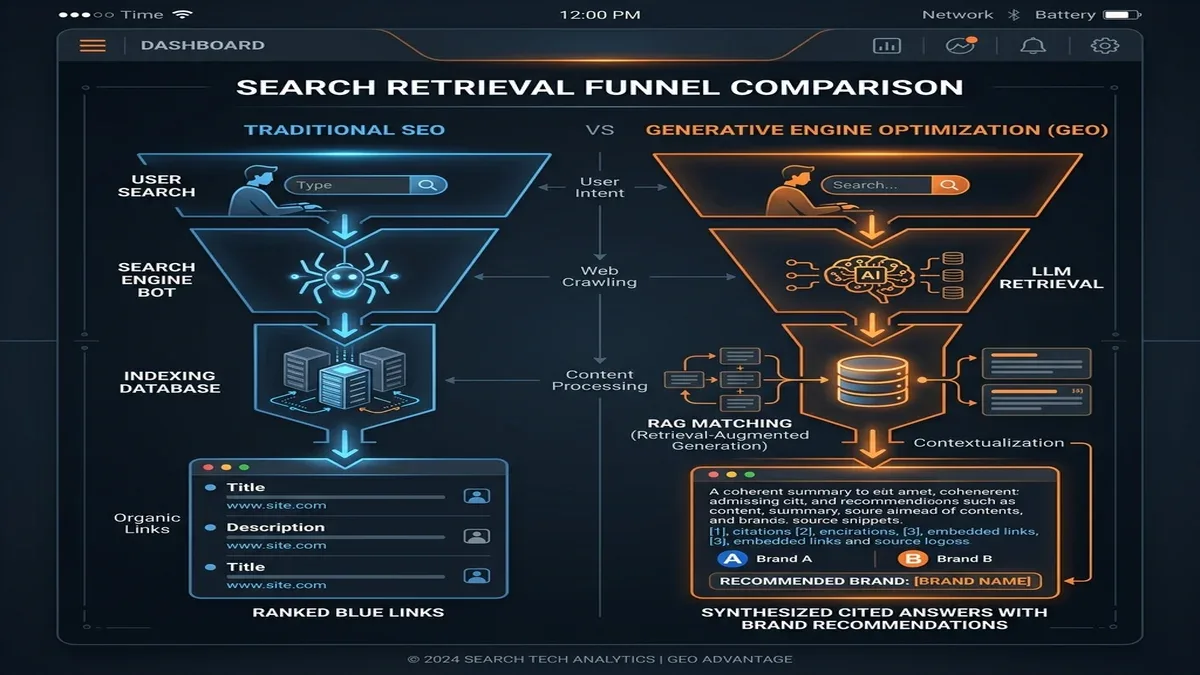
Figure 3: The operational differences in content search, indexing, retrieval, and target rendering between SEO and GEO.
Generative Engine Optimization (GEO) and traditional Search Engine Optimization (SEO) are overlapping but fundamentally distinct search disciplines. While SEO is the art of climbing the ten organic blue links on Google, GEO is the technical practice of structuring content so that generative AI engines—like ChatGPT, Gemini, and Perplexity—synthesize and cite your brand as the recommended answer. They are not mutually exclusive; they are complementary strategies required to dominate modern search landscapes. For a comprehensive introduction, see our guide on What is Generative Engine Optimization?.
The Technological Foundations: Inverted Indexes vs. Vector Latent Space
To understand the core differences between SEO and GEO, we must analyze how these search engines store and parse information. Traditional search engines like Google and Bing rely on massive inverted indexes. An inverted index is essentially a highly optimized lookup table mapping specific keywords to the webpages where those words appear. When a user enters a query, Google matches the keyword strings, evaluates domain authority via link graphs (PageRank), and outputs ranked lists of URLs.
In contrast, AI search engines and Large Language Models (LLMs) operate within a multi-dimensional latent vector space. Content is converted into dense mathematical vectors (vector embeddings) using models like Ada or Cohere. The position of a text block in this space represents its semantic meaning. When a user asks a question, the AI model calculates the geometric similarity (e.g. cosine similarity) between the query vector and the content vectors. The top matching chunks are retrieved, fed into the LLM context window, and synthesized into a natural language response. This structural difference requires completely separate optimization methodologies.
This means traditional keyword stuffing is completely ineffective for GEO. While Google's bots look for keyword matching, synonym patterns, and anchor text links, LLMs analyze context, conceptual similarity, and factual density. If your page contains long paragraphs of fluff text designed to reach a keyword metric, the vector embedding model will dilute its relevance score, causing retrieval engines to exclude your page chunks entirely.
Key Differences At A Glance
| Dimension | Traditional SEO | Generative Engine Optimization (GEO) |
|---|---|---|
| Primary Target | Google, Bing (Search bars) | ChatGPT, Perplexity, Gemini, AI Overviews |
| Core Metric | Keyword rankings, organic clicks | Citation rate, share-of-voice (SOV) |
| Content Style | Comprehensive, keyword-targeted | Answer-first, declarative, fact-dense |
| Off-Page Focus | Backlink volume, domain authority | Co-occurrence brand mentions, listicles |
| Technical Code | Sitemaps, canonicals, robots tags | Breadcrumbs, JSON-LD entity schema |
Retrieval-Augmented Generation (RAG) vs. SERP Ranking Algorithms
Traditional SEO is governed by search algorithms like Google's RankBrain and BERT, which evaluate page authority, on-page keyword density, search intent, and geographic signals to rank links. The primary goal is to ensure a user clicks your link to visit your site.
GEO is governed by RAG pipelines. When a user asks an AI engine for advice (e.g. "What is the most reliable CRM for small marketing agencies?"), the system performs a multi-step retrieval loop:
- Retrieval: An AI crawler accesses a localized database containing scraped pages, matching vector weights.
- Reranking: Retrieval systems run cross-encoder models to rank the most relevant text chunks based on semantic accuracy.
- Synthesis: The LLM reads the retrieved text chunks inside its context window, synthesizes a summary answer, and attaches footnotes citing the source websites.
Because the AI engine synthesizes the text inside the chat window, the CTR (Click-Through Rate) behavior changes. Users often read the answer directly on the chat screen. To earn visits, your brand must be cited as the primary recommendation with an inline link, making GEO citation tracking more critical than simple tracking of SERP ranks.
This means your conversion funnel changes from a traditional landing page model (traffic -> lead form) to an entity-based model. When an AI engine recommends your brand, it builds trust directly inside the user's chat session. Users who click your cited footnotes are already highly qualified buyers who have been pre-sold by the LLM recommendation, leading to significantly higher post-click conversion rates.
Deep Dive: Latency, Index Caching, and Scraper Budgets
Another major difference lies in latency and update frequencies. While Google updates its search results within milliseconds using pre-indexed tables, running an LLM inference cycle is extremely compute-heavy. To reduce latency and compute costs, platforms like ChatGPT and Gemini cache common query responses and run their RAG crawlers on selective schedules.
This creates a dual challenge: you must optimize both the static crawled pages that AI bots read during indexing cycles, and the real-time dynamic RAG pipelines that Perplexity runs for trending queries. Managing crawl budgets for AI spiders requires ensuring that your server handles sudden traffic spikes from bots like `GPTBot` without returning 504 Gateway errors, which would instantly remove your site from cached retrieval indexes.
How GEO and SEO Work Together
Do not throw away your traditional SEO strategies. GEO is built directly on top of solid SEO foundations. Search crawlers must still be able to discover, crawl, and render your pages before AI indexing engines can parse them. If your site has bad page speed (poor Core Web Vitals) or broken internal redirect chains, search engine spiders will discard your domain before AI crawlers even analyze your semantic formatting. A successful search campaign in 2026 integrates both: building solid organic footprints while restructuring top pages for AI citations. This integration falls under the broader practice of AI Search Optimization, which coordinates both search channels.
The Hybrid Search Strategy Roadmap
To dominate search channels in 2026, brands must deploy a unified hybrid model. Below is a step-by-step roadmap to align both strategies:
Phase 1: Build organic indexability (SEO Foundations)
Ensure your site is fast, responsive, and completely crawlable by bot arrays. Use clean sitemaps, resolve redirect chains, pre-render JavaScript elements server-side, and secure core backlinks to build Domain Rating (DR) authority. If your site lacks crawlable pages, AI scrapers cannot read your brand's definitions.
Phase 2: Restructure on-page layouts (GEO Content Adjustments)
Apply our 15 Algorithmic Authorship Rules to your core landing pages. Implement answer-first structures beneath all subheadings, place key metrics in clean HTML tables, and repeat named entities instead of generic pronouns. This ensures that when RAG systems grab your page chunks, they find easily digestible, citable snippets.
Phase 3: Deep Schema & Entity Definition (Technical GEO)
Deploy JSON-LD schemas explicitly linking your brand to categories, products, and founder profiles. Use SameAs schema links pointing to trusted external directories like Wikipedia, Crunchbase, or LinkedIn to build a defined semantic profile. This enables LLMs to link mentions of your company to a specific entity map.
Phase 4: Co-Occurrence Seeding (Off-Page Authority)
Get your brand mentioned in comparative roundups, listicles, and review pages. Seed real, helpful discussions containing your product name and specific keywords on Reddit and Quora. The co-occurrence of your brand name alongside key category keywords on external sites teaches retrieval models that your company is a category authority.
Is GEO the Future of Digital Marketing?
Yes. The zero-click search era is already here. With over 25% of all searches shifting to AI engines (Gartner), users are actively avoiding clicking through ten blue organic links. They want a fast, synthesized answer. Brands that fail to optimize for generative citations risk becoming completely invisible to this growing audience. Fortunately, you do not need enterprise retainers to bridge this gap. Our productised GEO packages are designed specifically as accessible entry points for SMBs and growing brands. To implement these changes yourself, follow our checklist of GEO Best Practices.
By coordinating both channels, you build an organic firewall: when users search Google, they find your ranked links; when they query ChatGPT, they get your cited recommendations. This creates a multi-touch digital authority loop that traditional SEO cannot match alone.
Scale Your Search Presence Instantly
Combine content creation, backlinks, and brand placements in our rolling monthly GEO managed packages from $590/mo.
Browse Monthly Packages →Frequently Asked Questions

Written by: Muhammad Ehsan Khan
Engineer, SEO Consultant, and Semantic SEO Explorer. Specializing in advanced search strategies, LLM citation optimization, and entity-building architectures.