How to Get Cited in ChatGPT: A Practical GEO Guide for 2026
Getting cited in ChatGPT starts with making your website accessible to ChatGPT Search, but crawlability alone does not guarantee a citation. Your pages also need to match the information being sought, answer the question clearly, identify entities precisely, support factual claims, and give the retrieval system a useful passage to surface.
Table of Contents
OpenAI confirms that public websites can appear in ChatGPT Search. Publishers that want their content included in ChatGPT summaries and snippets should allow OAI-SearchBot, OpenAI’s search crawler, to access their pages. OpenAI also makes no promise that allowing the crawler will produce a particular position or citation. (OpenAI Help Center)
That distinction matters.
There is no single “ChatGPT ranking factor” you can switch on. Generative Engine Optimization (GEO) involves removing technical barriers, improving how clearly your content communicates facts and entities, covering the context behind a query, and building enough external credibility for your website to be a useful source when ChatGPT searches the web.
This guide explains how to do that.
What Does Getting Cited in ChatGPT Actually Mean?
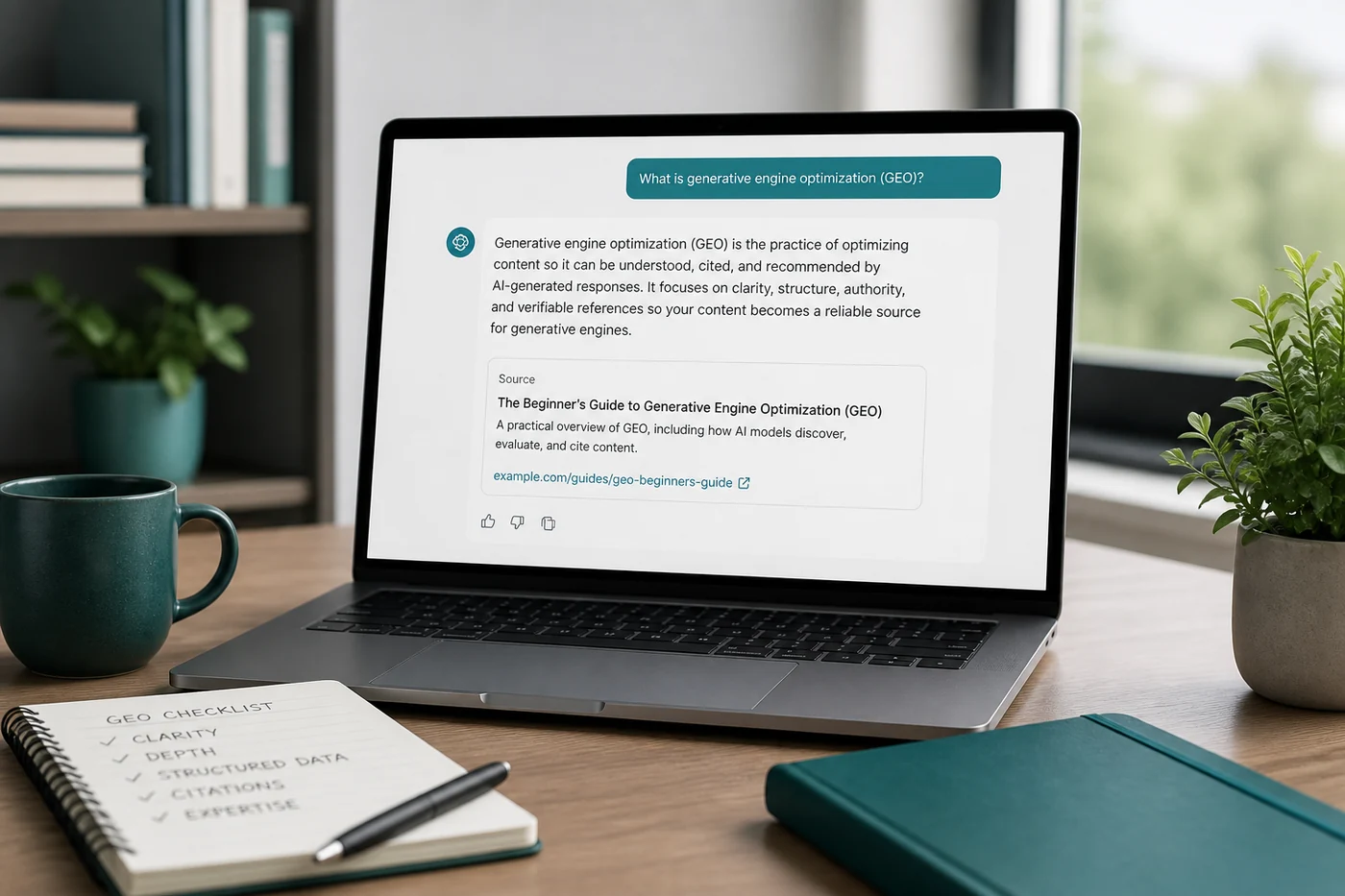
A ChatGPT citation is not the same thing as ChatGPT knowing that your company exists.
When ChatGPT uses web search, its answer can contain links to relevant web sources. Responses may show citations alongside individual statements, and users can access a Sources panel containing cited sources and other relevant links. (OpenAI Help Center)
That creates several different levels of AI visibility.
| Visibility outcome | What it means |
|---|---|
| Brand mention | ChatGPT names your company, product or website |
| Recommendation | ChatGPT selects your brand as an option for a user’s problem |
| Citation | A specific page from your website is attributed as a source |
| Referral | The user follows the citation or source link to your website |
These outcomes should not be measured as if they are identical.
A business might be mentioned frequently but receive few source citations. Another site might be heavily cited for informational queries but rarely recommended commercially.
For GEO, the objective should therefore be defined by query type. An informational publisher may prioritize source citations. A SaaS company may care more about recommendation visibility. An ecommerce business may care about whether its products appear when users ask for comparisons.
For this article, the focus is specifically on making your webpages more discoverable and suitable for web-search citations in ChatGPT.
Can Any Website Appear in ChatGPT Search?
Potentially, yes.
OpenAI states that any public website can appear in ChatGPT Search. It recommends allowing OAI-SearchBot so that site content can be discovered and potentially included in summaries and snippets. (OpenAI Help Center)
That does not mean every public page is equally likely to be surfaced.
There are two separate questions:
Can ChatGPT Search access the page?
and:
Is the page useful enough for this particular query to be selected as a source?
You need to solve the first before optimization of the second has much value.
Allow OAI-SearchBot
OAI-SearchBot is the crawler OpenAI identifies for search-related discovery.
If your robots.txt file blocks it, you are creating a direct obstacle to having page content included in ChatGPT summaries and snippets. OpenAI specifically advises publishers to ensure OAI-SearchBot is not blocked.OpenAI Help Center
Check more than the robots.txt file itself.
A website may appear open in robots.txt while still blocking bots through a CDN, Web Application Firewall, security plugin or server-level rule. If you use Cloudflare or another security layer, crawler accessibility should be tested from the server side rather than assumed from a browser visit.
Allowing OAI-SearchBot is an eligibility measure, not an optimization guarantee.
It tells the crawler that it can access your content. It does not tell ChatGPT that the page deserves to be cited.
Keep Important Pages Indexable
A page intended to generate AI visibility should not accidentally carry a noindex directive, conflicting canonical URL or authentication requirement.
OpenAI notes that publishers can use noindex when they do not want a page surfaced, and the crawler must be able to access the page to read that directive. (OpenAI Help Center)
For commercially important and informational pages, check:
the canonical URL, robots directives, HTTP status, page accessibility and whether the primary content is present in the delivered HTML.
Your technical SEO foundation still matters.
Make the Main Content Easy to Retrieve
A visually impressive page is not automatically a crawler-friendly page.
AI-generated websites are particularly prone to loading important content through client-side JavaScript. Your technical development framework correctly treats server-rendered content, clean URLs, self-referencing canonicals, valid 404 responses, sitemap consistency and semantic heading structures as foundational crawlability requirements.
Server-side rendering should not be presented as an officially confirmed ChatGPT ranking factor. It is better understood as a technical measure that reduces retrieval friction and ensures your important information is actually present in the document a crawler receives.
How Does ChatGPT Find Sources?

ChatGPT Search is not simply matching the exact words a user typed against webpages.
OpenAI says that, when ChatGPT Search works with search providers, it may rewrite a user’s question into one or more targeted search queries before sending them to those providers. (OpenAI Help Center)
This has important consequences for GEO.
Imagine a user asks:
“How can I get my SaaS company recommended by ChatGPT?”
The retrieval process does not necessarily need to search that sentence verbatim. Semantically related searches might concern ChatGPT visibility, SaaS recommendations, AI citations, brand visibility or optimization for AI search.
Those are illustrative examples, not disclosed OpenAI query rewrites.
The strategic point is that optimizing a page for one exact keyword string is insufficient. The page must clearly cover the meaning and context behind the query.
This is where traditional keyword targeting becomes semantic retrieval optimization.
A strong page makes it easy to establish relationships such as:
ChatGPT Search → web sources → citation → crawler accessibility → content relevance → source credibility
rather than merely repeating “ChatGPT SEO” ten times.
ChatGPT Search also uses web information from search providers and other web sources to provide timely answers with links to relevant sources. OpenAI Help Center
So the practical GEO question is not:
How often should I use my keyword?
It is:
How clearly does this document resolve the information need that may emerge from the original query and its related retrieval queries?
How to Increase Your Chances of Getting Cited in ChatGPT
There is no documented formula that guarantees a citation. The following tactics combine OpenAI’s published search-access requirements with sound information-retrieval and semantic SEO practices.
- Make sure OAI-SearchBot can crawl the page. Start with technical eligibility. Inspect
robots.txt, security rules and CDN bot controls. OpenAI explicitly recommends allowing OAI-SearchBot if you want content eligible for inclusion in ChatGPT summaries and snippets. (OpenAI Help Center) - Give each page a clear information purpose. A page trying to rank for twenty loosely related topics creates ambiguity. Decide which central question the document exists to resolve, then build supporting sections around the questions required to understand that subject fully.
- Put the answer directly below the relevant heading. If the heading asks “What is OAI-SearchBot?”, the next sentence should define OAI-SearchBot. Do not make readers—or retrieval systems—work through three introductory paragraphs before encountering the answer. Answer-first construction also makes important passages more independently understandable.
- Name entities precisely. Prefer “OpenAI’s OAI-SearchBot” over “the AI bot,” “ChatGPT Search” over “the platform,” and “Google Analytics” over “your tracking software” where those are the entities you actually mean. Clear entity references reduce ambiguity and strengthen the relationship between subject and statement.
- Support factual claims with authoritative sources. If you state how ChatGPT Search operates, cite OpenAI. If you publish statistics, trace them to the study or organization that produced them. Primary evidence makes a passage more defensible and more useful to anyone evaluating it as a source.
- Cover the query’s necessary context. A page about getting cited in ChatGPT should not contain twenty synonyms for “ChatGPT citation.” It should explain crawler access, indexability, source retrieval, query context, answer structure, authority, freshness and measurement because those concepts help resolve the underlying problem.
- Write factual passages that survive extraction. “This improves visibility” is weak because the reader needs surrounding context to know what “this” means. “Allowing OAI-SearchBot lets OpenAI crawl content that may be included in ChatGPT Search summaries and snippets” is clearer because the subject, action and consequence exist in the same passage. (OpenAI Help Center)
- Strengthen the entity beyond your own website. Consistent descriptions, relevant third-party coverage, authoritative mentions and legitimate links can help establish what your company or subject is associated with across the web. Do not treat Reddit mentions, listicles or backlinks as confirmed ChatGPT ranking factors; OpenAI does not publish such a rule. Think of them as broader authority and entity-corroboration signals.
- Keep time-sensitive information current. Pricing, product capabilities, executive names, regulations and year-specific statistics can become wrong quickly. If an answer requires current information, stale material becomes less useful regardless of how well optimized the page once was.
- Remove technical retrieval friction. Use stable URLs, correct canonicals, valid status codes, sensible internal links, crawlable navigation, sitemap coverage and logical heading hierarchies. These technical requirements also align with the site architecture you have established for the GEO project.
The common theme is clarity.
A citeable passage usually does not need to sound like it was “written for AI.” It needs to state the right information, about the right entity, in a form that can be understood without unnecessary interpretation.
Write for Questions, Not Keyword Variations
Consider these two content approaches.
The first page creates separate sections called:
ChatGPT SEO Tips
Best ChatGPT SEO Tips
ChatGPT SEO Strategies
ChatGPT Optimization Tips
Those headings may contain target terminology, but they create little additional information.
The second page answers:
Can any website appear in ChatGPT Search?
What is OAI-SearchBot?
Why is ChatGPT citing competitors instead of my site?
Does schema guarantee a ChatGPT citation?
How can I measure ChatGPT referral traffic?
The second structure expands the page’s semantic coverage because each section resolves a distinct uncertainty.
This matters because ChatGPT Search may transform a conversational prompt into more targeted queries. (OpenAI Help Center)
Your content therefore needs to cover likely information needs, not just keyword variants.
Make Important Passages Independently Understandable
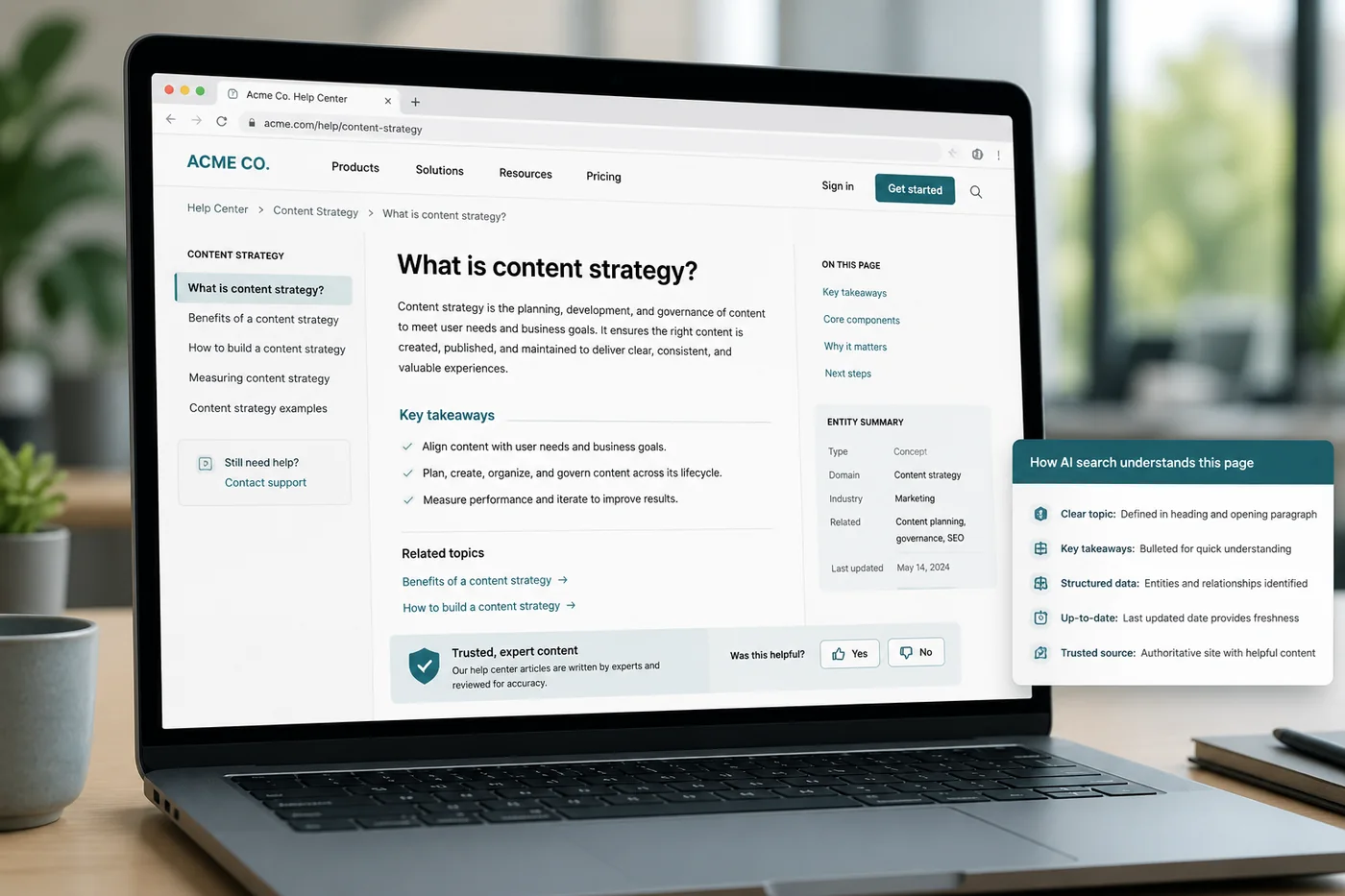
Citation-friendly writing benefits from explicit semantic relationships.
Compare:
This is why doing it correctly can help you rank.
with:
A self-referencing canonical identifies the preferred version of a page and reduces ambiguity when multiple URL variants contain substantially the same content.
The second passage has a defined subject, action and consequence.
You can apply the same structure throughout GEO content:
Entity → relationship → consequence → qualification
For example:
OAI-SearchBot → crawls public web content → enables content to be considered for ChatGPT Search summaries and snippets → but does not guarantee citation.
That sentence resolves an entire micro-question.
This approach also aligns well with phrase-based information retrieval concepts. The phrase-based indexing material you supplied describes systems that identify meaningful phrases, relationships and co-occurrences rather than treating every isolated word as equally informative.
The practical lesson is not to force exact phrases unnaturally. It is to establish consistent, meaningful relationships between the entities and concepts that define the topic.
Use Primary Sources When You Make Important Claims
A GEO article can lose credibility quickly by presenting industry speculation as an official ranking factor.
For example, it would be inaccurate to write:
“FAQ schema makes ChatGPT cite your page.”
There is no public OpenAI documentation establishing that rule.
A more defensible statement is:
Structured data can improve how explicitly page information is represented to machines, but OpenAI has not published FAQ schema as a direct organic ChatGPT citation ranking factor.
Apply the same standard to backlinks, Reddit mentions, content length, author bios and domain authority.
They may be useful components of a broader search and authority strategy.
That is different from saying OpenAI has confirmed them as ChatGPT ranking factors.
The distinction between documented behavior and optimization hypothesis should be maintained throughout your GEO strategy.
Build Complete Query Context
Topical completeness does not mean writing the longest page on the internet.
It means covering the concepts required to answer the central question without forcing the user to search elsewhere for basic missing context.
For “how to get cited in ChatGPT,” that means explaining the path from:
access → retrieval → understanding → source usefulness → citation → measurement
Notice what is not included in that chain:
word count.
A 6,000-word page that repeats generic optimization advice can be less useful than a 2,500-word page in which every section resolves a different question.
Your site’s existing GEO architecture is designed around this distinction: broader informational content should establish topical authority while connecting naturally to more specific commercial solutions.
Strengthen Entity Corroboration Beyond Your Website
Your own website tells search systems what you say about yourself.
The wider web can help show whether other sources associate your entity with the same subject.
For a GEO agency, for example, you want the relationship between the brand and Generative Engine Optimization to be consistently observable.
That can come from genuine industry citations, relevant backlinks, expert commentary, reviews, comparison pages, directories where appropriate, interviews and other third-party references.
Avoid manufacturing mentions purely to create volume.
The objective is coherent corroboration, not random repetition.
It is also important not to overstate this section. OpenAI does not publish a rule saying that a particular number of backlinks or brand mentions will cause a ChatGPT citation.
Treat external authority as part of the broader evidence environment surrounding an entity.
Keep Important Facts Current
ChatGPT Search is useful partly because it can retrieve timely web information. (OpenAI Help Center)
That makes content maintenance a GEO task, not simply an editorial housekeeping task.
Imagine two articles explaining the price of a software platform.
One was thoroughly written three years ago but contains an obsolete pricing structure. The other was reviewed last month and accurately identifies the current plans.
For a price-related query, the second page offers more useful evidence.
This is particularly important for pages covering:
pricing, statistics, product features, laws, rankings, market data, leadership, software interfaces and “best X in 2026” queries.
Do not change the publication date merely to make an old article appear fresh. Update the information that actually became stale and make substantive revisions where required.
What Does Not Guarantee a ChatGPT Citation?
One of the biggest problems in GEO advice is turning reasonable optimization practices into invented guarantees.
Adding FAQ schema does not guarantee a citation.
Publishing 5,000 words does not guarantee a citation.
Repeating “ChatGPT” throughout a document does not guarantee a citation.
Allowing OAI-SearchBot does not guarantee a citation.
Ranking first for a related Google query does not automatically mean ChatGPT must cite your page.
Building backlinks does not create a contractual entitlement to AI visibility.
Using AI to produce hundreds of articles does not create topical authority by itself.
Think of crawlability as the entrance ticket rather than the trophy.
OpenAI’s guidance explains how publishers can make content accessible for discovery and citation, but it does not offer an organic “submit this page and rank first” mechanism. (OpenAI Help Center)
The optimization opportunity comes from making your page a better source for the information being requested.
Why Is ChatGPT Citing Competitors Instead of Your Website?
When a competitor is being cited and you are not, avoid assuming the problem is simply “domain authority.”
Diagnose the entire retrieval path.
| Potential problem | What to inspect |
|---|---|
| Crawler blocked | robots.txt, firewall and OAI-SearchBot access |
| Page excluded | noindex, canonical and HTTP status |
| Weak query alignment | Whether the page actually resolves the searched problem |
| Poor answer passage | Whether important questions receive clear direct answers |
| Stronger competing evidence | Sources, facts, examples and specificity |
| Stale information | Dates, pricing, statistics and current claims |
| Entity ambiguity | Brand, product and organization naming |
| Weak site relationships | Internal links and topical architecture |
| Limited external corroboration | Relevant citations, mentions and legitimate links |
This is exactly why a GEO audit should compare prompt → cited competitor → cited page → passage characteristics → your equivalent page.
Looking only at keywords misses the important part.
You want to determine what information the competing source provides that yours does not, whether ChatGPT can access your equivalent page, and whether your page expresses the answer with comparable clarity.
For sites that repeatedly see competitors in AI results while remaining absent themselves, a structured GEO Audit is the appropriate next step rather than blindly rewriting every page.
Does Schema Markup Help With ChatGPT Citations?
Schema can make important page relationships more explicit to machines.
For example, Organization schema can identify the organization represented by a website, while Article, Service and BreadcrumbList markup can describe other structural relationships.
That makes structured data worthwhile as part of technical semantic SEO.
But there is an important qualification:
OpenAI does not publicly state that adding a specific Schema.org type directly increases ChatGPT citation rankings.
Do not install FAQ schema and tell a client that ChatGPT will now cite the page.
Use schema because explicit machine-readable structure is good technical practice, because it supports the wider search ecosystem, and because it reduces ambiguity about page entities and relationships.
Your website specification already maps schema types to page purposes—including Organization, WebSite, BreadcrumbList, Service, ItemList and Article—so the better strategy is to implement those consistently rather than adding markup solely because it contains a fashionable GEO label.
Do Backlinks Help You Get Cited in ChatGPT?
Backlinks still matter to the broader web ecosystem because they can establish discovery pathways, relationships between documents and evidence of third-party recognition.
But “more backlinks = more ChatGPT citations” is not an officially documented OpenAI formula.
The better approach is to pursue links that make sense for the entity and topic.
A citation from an authoritative industry publication discussing your original research has much more contextual value than a large batch of unrelated links created only to manipulate metrics.
Think in terms of corroboration and topical authority, not arbitrary link counts.
The same logic applies to brand mentions.
A company consistently discussed in the context of a particular service, technology or field develops a clearer external entity footprint than one mentioned across unrelated low-quality pages.
How to Check Whether ChatGPT Can Cite Your Site
Start with technical access.
Check whether OAI-SearchBot is allowed to crawl the relevant page and whether any server, firewall or CDN rule interferes with that access. Confirm the page returns a valid 200 response, carries the intended canonical and does not contain an unwanted noindex.
Then test representative prompts in ChatGPT Search.
Do not test only your brand name. Brand queries tell you whether ChatGPT can find the brand; they do not tell you whether you are visible for commercially meaningful non-brand questions.
Test the questions your prospects actually ask.
For this site, examples might include queries about selecting GEO services, improving ChatGPT visibility, conducting a GEO audit or optimizing existing content for AI citations.
Inspect the cited pages and record which competitors repeatedly appear.
Then compare their pages with yours at the passage level.
Finally, measure actual visits.
OpenAI states that publishers allowing OAI-SearchBot can track ChatGPT referral traffic through analytics platforms such as Google Analytics. (OpenAI Help Center)
Traffic alone should not be your only KPI, however. A useful GEO reporting framework can separately record citation visibility, brand mentions, recommendations and referral sessions.
A Practical ChatGPT Citation Checklist
Before publishing an important GEO page, verify that OAI-SearchBot is allowed, the page is indexable, the canonical points to the correct URL, the main content is crawlable, the page has one clear central topic, important questions receive direct answers, entities are named explicitly, important factual claims have credible evidence, time-sensitive information is current, and relevant pages on your site link to the document contextually.
Passing that checklist does not guarantee a citation.
It gives the page a cleaner technical and semantic foundation from which it can compete to become a useful source.
Frequently Asked Questions
Can any website be cited by ChatGPT?
A public website can potentially appear in ChatGPT Search. OpenAI says publishers should allow OAI-SearchBot if they want their content to be discoverable and eligible for inclusion in ChatGPT summaries and snippets.OpenAI Help Center
Accessibility does not guarantee selection. The page must still be relevant and useful for the user’s query.
What Is OAI-SearchBot?
OAI-SearchBot is the crawler OpenAI identifies for search-related discovery. Publishers that want their content included in ChatGPT Search summaries and snippets should ensure they are not blocking it. (OpenAI Help Center)
Does Allowing OAI-SearchBot Guarantee a ChatGPT Citation?
No. Allowing the crawler removes an access barrier; it does not guarantee that a page will be chosen as a source.
Citation selection still depends on the search context and the usefulness of available sources.
Does ChatGPT Use Search Engines to Find Sources?
ChatGPT Search can work with third-party search providers. OpenAI says it may rewrite a user’s prompt into one or more targeted searches before sending those queries to providers. (OpenAI Help Center)
This is one reason GEO content should address the semantic context behind a query rather than only an exact keyword.
Does Schema Markup Help With ChatGPT Citations?
Schema provides explicit structured information about webpages and entities, making it useful technical SEO infrastructure. However, OpenAI has not publicly documented a particular schema type as a direct organic ChatGPT citation ranking factor.
Implement relevant schema accurately, but do not treat it as a citation guarantee.
Do Backlinks Help With ChatGPT Citations?
Relevant backlinks and third-party mentions can strengthen the wider authority and corroboration surrounding a website or entity. OpenAI does not publicly provide a formula connecting backlink count with ChatGPT citations, so links should be treated as part of broader authority building rather than a guaranteed ChatGPT ranking factor.
How Can I Track Traffic From ChatGPT?
OpenAI says publishers that allow OAI-SearchBot can track referral traffic from ChatGPT using analytics tools such as Google Analytics. (OpenAI Help Center)
For a complete GEO measurement framework, track referrals alongside citation frequency, recommendation visibility and competitor share across a fixed set of prompts.
Why Does ChatGPT Cite My Competitors Instead of My Website?
The cause may be technical, semantic or authority-related. Check crawler access, indexability, query relevance, answer quality, factual evidence, freshness, entity clarity, internal linking and external corroboration.
The fastest way to identify the difference is to compare the pages ChatGPT actually cites against your corresponding page rather than guessing which optimization signal is missing.
Final Takeaway
Getting cited in ChatGPT is not about finding a secret prompt or adding “AI optimized” to your metadata.
Start by making the website accessible to OAI-SearchBot. Then build pages around identifiable questions, answer those questions directly, name entities precisely, support important claims, cover the necessary semantic context and keep factual information current.
Most importantly, distinguish what OpenAI has actually documented from what GEO practitioners infer from information retrieval and search behavior.
OpenAI confirms the access layer: public sites can appear in ChatGPT Search, OAI-SearchBot should be allowed when publishers want content included in summaries and snippets, and ChatGPT Search can use targeted rewritten queries and web sources. (OpenAI Help Center)
Everything after that should focus on making your page a better source.
If your competitors are already being cited and you are not, the question is no longer whether ChatGPT citations are possible.
The question is what their pages provide—and what your page is currently missing.