The Death of the Traditional Agency Retainer Model
Traditional marketing agencies love to trap businesses behind discovery calls, custom proposals, and thousands of dollars in monthly retainers. For decades, the standard operating procedure for digital marketing has been slow, administrative, and unnecessarily complex. A brand looking to improve its search visibility was forced to navigate multiple sales calls, wait weeks for a customized proposal, negotiate minimum six-month contracts, and undergo lengthy onboarding processes before a single line of code or copy was ever modified. We believe this model is fundamentally dead.
When AI engines like ChatGPT, Perplexity, and Google AI Overviews completely disrupted how users search, the timeline for search visibility changed overnight. AI models update their indices and retrieval patterns dynamically. LLMs (Large Language Models) pull information from live web indexes, third-party databases, listicles, and review platforms in real time. In this fast-evolving search landscape, businesses cannot afford to wait months for an agency to execute basic optimization strategies. You need immediate, agile execution—not weeks of administrative overhead.
That is why we productised Generative Engine Optimization. By packaging audits, page optimizations, off-page brand mentions, schema integration, and topical mapping into clear, transparent, fixed-price tiers, we eliminate the friction. You know exactly what you are ordering, what it costs upfront, and when it will be delivered. There are no sales pitches, no hidden fees, and no lock-in contracts. You simply select the service you need, upload your briefs at checkout, and our fulfillment engine starts working immediately.
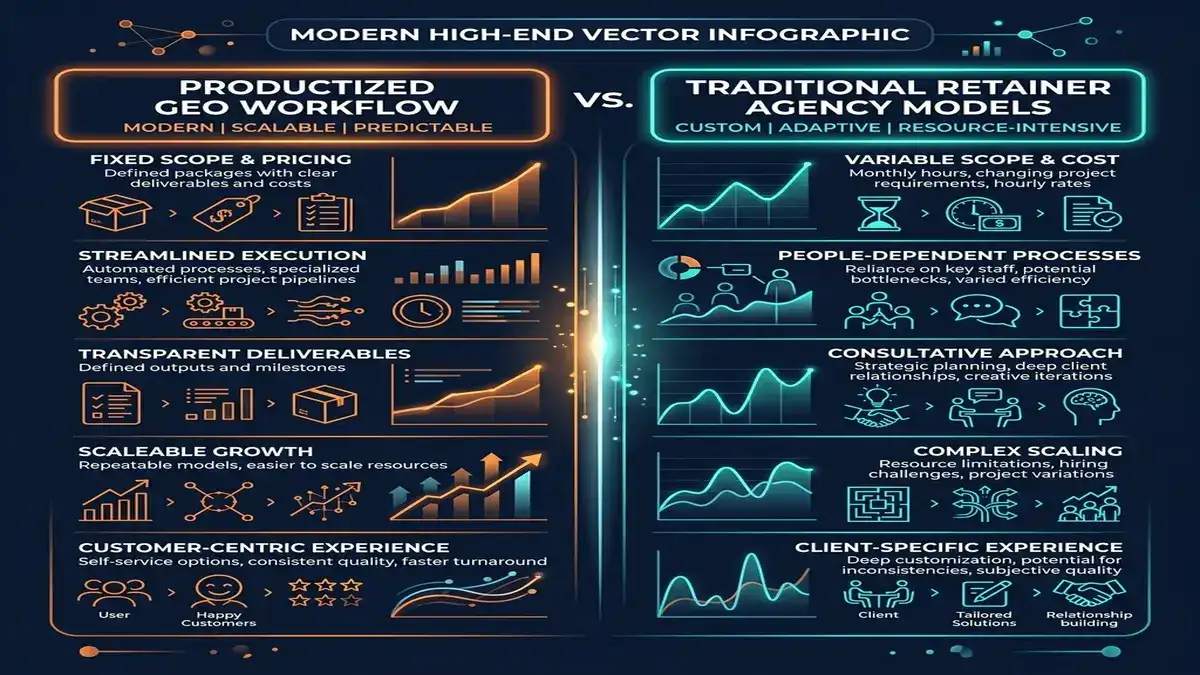
Why We Productised GEO (Generative Engine Optimization)
Generative Engine Optimization is not a mystery. It is a technical and structural science that follows clear rules of retrieval-augmented generation (RAG). AI search engines do not rely on traditional page-ranking metrics alone; instead, they retrieve content that satisfies specific citation triggers. These triggers include answer-first openings, tabular comparisons, clear entity co-occurrences, valid schema markup, and robust off-page authority signals.
Because the requirements of LLM scrapers are so structured, the process of optimizing for them can be standardized. We spent months researching LLM citation behavior and running prompt-level visibility tests to codify these rules. Once we mapped out what engines like ChatGPT and Perplexity look for when citing sources, we realized that custom-scoped campaigns were unnecessary.
By productising our findings, we created a faster, more cost-effective way for brands to build visibility. Instead of paying a generalist agency a large monthly retainer to figure out how AI search works, you can purchase targeted, specialized modules:
1. Diagnostics
Our GEO Audit maps out exactly where ChatGPT and Perplexity are recommending your competitors over you and outlines the quick-wins to capture the traffic.
2. On-Page Structures
We restructure your published content to include answer-first paragraphs, custom FAQ tables, and JSON-LD schema so LLMs can extract it easily.
3. Off-Page Entities
We place your brand in listicles, product comparison guides, and community discussions where AI engines extract recommendation data.
This modular approach puts the control back in your hands. You can start with a basic $99 audit, implement the fixes yourself, and then order off-page placements as your budget allows. If you want continuous optimization, we offer managed monthly packages that handle all three stages concurrently—always with transparent pricing and no lock-in contracts.
Our 5 Core Methodology & RAG Principles
Every campaign, article, and audit we deliver is built upon our 5 core pillars of retrieval-augmented generation optimization:
Crawler Eligibility & Access Controls: We ensure that OAI-SearchBot, GPTBot, and other search engines are permitted in your firewalls and robots.txt. If scrapers cannot access your pages at minimum cost, your content is effectively invisible to AI engines.
Direct, Answer-First Restructuring: AI search models evaluate sentence relevance in fractions of a millisecond. We restructure paragraph openings following strict semantic answers so scrapers extract your brand details immediately.
Factual & Attributed Data Blocks: Attributed statistics, tight definitions, and structured comparison tables are highly selected by LLMs when assembling an answer. We build these direct data blocks into all on-page optimizations.
Schema & Structured Entity Validation: We design deep JSON-LD structured schema maps. This links your digital properties together, standardizing brand, product, and category naming across the web so AI engines resolve your entity name with confidence.
Third-Party Co-Occurrence Mentions: LLMs verify brand recommendations by checking independent sources (BBB, LinkedIn, listicles, review boards, news publications, and forums). We secure clean brand mentions across DR30+ placements to build your off-page citation signals.
The Mathematical Science of LLM Retrieval & Content Scoring
To understand why Generative Engine Optimization works, one must look at the mathematical systems powering modern LLM search engines. When a user submits a query to ChatGPT Search, Gemini, or Perplexity, the engine does not perform a simple keyword search. Instead, it utilizes a multi-step retrieval-augmented generation (RAG) pipeline. This pipeline converts the user's natural language prompt into a dense vector embedding—a mathematical coordinate in a high-dimensional semantic space. It then scans indexed web pages, converting their text passages into matching vector coordinates.
The retrieval system calculates the cosine similarity between the query vector and candidate text passages. The passages with the highest semantic overlap are retrieved as candidate text chunks. However, retrieval is only the first stage. Modern AI search agents apply a secondary "reranking" process using cross-encoder models. These models evaluate candidate chunks for directness, factual density, and entity clarity. If your content is wrapped in fluffy, marketing-heavy language, the reranker flags it as low-relevance noise, dropping it from the context window entirely.
To guarantee citation selection, content must be formatted as an "information anchor." AI search models operate under strict context token limits. They seek chunks that deliver the maximum volume of high-confidence facts in the minimum number of tokens. When a page presents a structured HTML table or an answer-first paragraph, it reduces the computational effort required for the LLM to synthesize the final answer. The model rewards this efficiency by selecting the chunk, embedding it in the generated response, and attaching a citation link to the source page. This is the exact mechanism our methodology leverages.
Our 15 Algorithmic Authorship Rules Explained
To guarantee that every page we optimize is crawl-ready and citation-dense, our team audits all copy against our 15 strict, proprietary compilation rules:
Rule 1: Crawler Eligibility Verification
We test all directories and subfolders against robots.txt parameters to guarantee OAI-SearchBot and other scrapers have immediate, unblocked file permissions.
Rule 2: Direct, Non-Ambiguous Opening Declarations
We remove introductory filler. Every section must start with a direct answer containing the target keyword and entity identifiers to maximize immediate scraper matching.
Rule 3: Attributed Statistical Injection
Any numerical claim must be backed by a clear year and named source (e.g. "Gartner, 2026"). AI engines actively reward data blocks with specific source attributions.
Rule 4: Semantic Term Density
We map primary, secondary, and co-occurring terms dynamically, placing key entities within close proximity (sentence level) to increase contextual relevance scores.
Rule 5: Elimination of Adjective Overhead
We delete subjective words like "best", "industry-leading", or "revolutionary". Scrapers filter out marketing puffery; we use pure, objective, factual copy.
Rule 6: Tabular Data Structuring
Complex features or specifications are restructured into clean HTML tables. Scrapers prioritize structured tables over dense paragraphs for quick comparison extraction.
Rule 7: FAQ Accordion Tagging
We structure FAQs using semantic HTML5 elements (details/summary) and match them with validated FAQPage JSON-LD schemas to build citation hooks.
Rule 8: Schema Disambiguation Linkage
We map sameAs arrays linking local profiles, registered entities, and founder directories, providing explicit evidence of the brand's entity legitimacy.
Rule 9: Physical DOM Order Match
The visual order of page content must match the physical DOM tree. Scrapers read linearly; a clean DOM reduces parsing budgets and increases extraction speed.
Rule 10: Canonical URL Alignment
We enforce clean canonical tags across all platforms, ensuring crawlers index only the canonical root, eliminating duplicate content conflicts.
Rule 11: Semantic Silo Linkage
Internal links must use contextually relevant anchor text and connect pages in tight, thematic siloing structures to build domain-wide authority.
Rule 12: Image WebP & Alt Verification
All graphics must be WebP formatted, compressed under 100KB, and embedded with descriptive alt text to ensure fast page speed and image-search indexing.
Rule 13: Local Business NAP Consistency
For local service pages, Name, Address, and Phone data must match external directory signals exactly to eliminate entity resolution conflicts.
Rule 14: Objective Content Validation
All claims must be supported by evidence within the document, removing any assumptions that could cause LLMs to flag the content as hallucinated.
Rule 15: Authoritative Attribution
Every article must link to a verified author entity with credential references, raising recommendation confidence scores inside generative engines.
Meet the Pioneers Behind GEO Solutions
Our team consists of senior engineers, semantic SEO specialists, and LLM retrieval architects working together to deliver premium visibility results.

Muhammad Ehsan Khan
Lead SEO Consultant & Semantic Explorer
Muhammad is an engineer, SEO consultant, and semantic explorer. He has spent the last decade designing schema validation protocols, building structured content maps, and researching LLM citation behavior. As lead consultant, he reviews all campaigns and audits to ensure compliance with our strict algorithmic requirements.
Our Global Delivery Network
GEO Solutions operates as a productized delivery engine. While Muhammad leads the consulting and strategic validation, our global network consists of 14 content strategists, entity engineers, and outreach managers. This structure allows us to maintain wholesale pricing and deliver results at scale without the expensive corporate overhead.
By separating strategy, optimization, and outreach into specialized pipelines, we can guarantee fast execution times (3–5 days for audits, 5–10 days for page optimizations) that traditional agencies cannot match.
Our Productised Execution Pipeline
Here is exactly what happens when you place a self-serve order through our portal:
Brief Submission & Checkout
You select your package (Starter or Pro), submit your page URLs, target topics, and competitors at checkout. No sales calls, no contract negotiations, and no onboarding delays.
Algorithmic Scraping & Baseline Scan
Our proprietary tools crawl your DOM tags, check schema formatting, and test your target prompts across ChatGPT, Perplexity, and Google AI Overviews to map your citation share-of-voice baseline.
Expert Optimization & Re-writing
Our specialists manually restructure your copy, writing direct answer-first headings, building semantic data tables, standardizing entity naming structures, and coding valid JSON-LD schemas.
15 Algorithmic Authorship QA
Before delivery, every file is audited against our 15 strict Algorithmic Authorship Rules to ensure content is fully optimized for scraper extraction, free of adjectives, and structured for LLMs.
Loom Video Explainers & Delivery
Your completed audit PDFs, optimized page files, and schema code land in your inbox. Pro audits include a Loom walkthrough where our lead consultant explains each gap on screen.
Ready to Order Your First GEO Package?
No retainer fees, no discovery calls, and no contracts. Just fast, professional execution. Explore our services and see what a difference productised AI search optimization can make for your brand.
View Fixed-Price Services →