How to Get Cited in Perplexity: A Practical GEO Guide for 2026
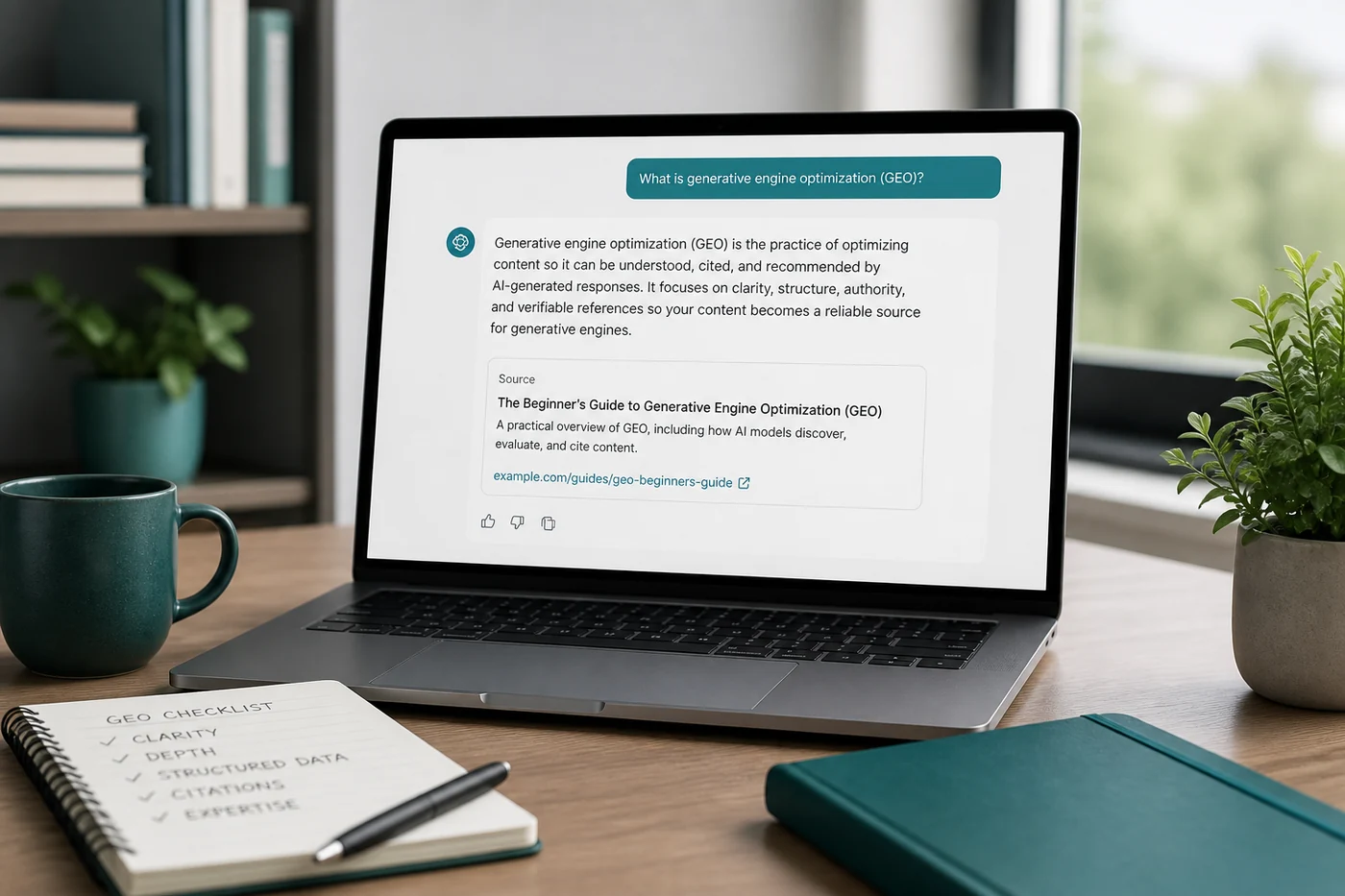
Getting cited in Perplexity starts with making your content accessible to its search system, but crawlability is only the first requirement. Your page also needs to answer a useful question, contain information worth extracting, establish clear entity relationships, support important claims and remain current enough to compete with other sources.
Perplexity describes itself as an AI-powered search engine that searches the live web and returns conversational answers backed by citations to original sources. It also says PerplexityBot respects robots.txt and will not index the full or partial text of pages that explicitly disallow it. (Perplexity AI)
That creates a relatively clear Generative Engine Optimization, or GEO, framework:
Make the page accessible → make the information retrievable → make the passage useful → make the source worth citing.
There is no documented switch that guarantees a Perplexity citation. Allowing the crawler makes citation possible. It does not make citation inevitable.
This guide explains how to improve the conditions that influence whether your pages can become useful sources in Perplexity.
What Does It Mean to Be Cited in Perplexity?
Being cited in Perplexity means a page from your website is used as a source in an answer and linked so the user can inspect the original material.
This is different from simply having your brand mentioned.
Perplexity says its responses include source citations, allowing users to verify the information and explore the underlying sources. Its answer engine searches the web, identifies sources, synthesizes their information and presents a direct answer rather than only returning a conventional list of links. (Perplexity AI)
There are several different visibility outcomes worth measuring:
| Visibility outcome | What it means |
|---|---|
| Indexed | Perplexity can discover information about the page or domain |
| Source inclusion | Information from your page contributes to the answer |
| Citation | Perplexity links the answer back to your page |
| Brand mention | Your company or product is named in the response |
| Referral | A user follows the source link to your website |
A website can perform well in one area and poorly in another.
For example, a recognizable company may receive frequent brand mentions while competitors receive the actual source citations. An informational publisher may earn citations without appearing in commercial recommendation queries.
Your GEO measurement should therefore separate mentions, recommendations, citations and referrals instead of treating “AI visibility” as a single metric.
Can Any Website Appear in Perplexity?
A public website can potentially contribute to Perplexity’s web search, but crawler accessibility matters.
Perplexity’s documentation states that its crawler, PerplexityBot, respects robots.txt. When a website disallows PerplexityBot, the crawler will not index the full or partial text content of those pages. (Perplexity AI)
Before changing content, establish whether Perplexity can access it.
Allow PerplexityBot
Check your site’s robots.txt file.
If PerplexityBot is accidentally blocked, your optimization work begins with a technical problem rather than a writing problem.
You should also check:
- CDN bot-management rules
- Web Application Firewall settings
- security plugins
- server-side bot restrictions
- rate limiting
- authentication requirements
A page loading successfully in your browser does not prove that a crawler can retrieve it.
Perplexity’s July 2026 documentation also says its search index may use third-party crawlers and that agreements with those providers require compliance with robots.txt, particularly for news publishers. (Perplexity AI)
What Happens If You Block PerplexityBot?
Blocking PerplexityBot does not necessarily make your entire domain invisible.
Perplexity says that when a page is blocked, it may still index limited information such as the domain, headline and a brief factual summary, while not indexing the page’s full or partial text. (Perplexity AI)
That distinction matters.
It would therefore be inaccurate to say:
“If you block PerplexityBot, Perplexity can know nothing about your site.”
A better statement is:
Blocking PerplexityBot restricts Perplexity from indexing the full or partial page text, substantially limiting what it can retrieve directly from that page.
For a publisher actively trying to earn citations, that restriction is usually counterproductive.
Keep Important Pages Technically Accessible
Crawler permission is only one part of technical accessibility.
An important page should also return a valid HTTP response, use the intended canonical URL, avoid accidental indexing restrictions and expose meaningful page content in a crawler-accessible form.
Your site’s existing technical framework already prioritizes:
- server-side rendering where needed
- clean URLs
- self-referencing canonicals
- accurate sitemaps
- true 404 responses
- direct internal links
- semantic heading hierarchies
- limited code bloat
Those remain useful foundations for AI retrieval as well as traditional search.
None of those should be described as a confirmed direct Perplexity ranking factor. Their value is more fundamental: they reduce ambiguity and technical retrieval friction.
How Does Perplexity Find and Use Sources?
Perplexity describes a process that goes beyond exact-match keyword search.
When a user asks a question, Perplexity says it first interprets the meaning and context of the query, then searches the internet, gathers information from sources, synthesizes the useful information and provides an answer with citations. (Perplexity AI)
That model has important implications for SEO.
You are not optimizing only for the literal phrase the user typed.
You are optimizing a document to become relevant to the information problem behind the query.
Perplexity Interprets the Question
Perplexity says its models attempt to understand the context and nuances of a user’s question. (Perplexity AI)
Suppose the user asks:
“Why does Perplexity recommend competitors instead of my SaaS?”
A useful source might need to cover concepts such as:
- brand visibility
- product category relevance
- source authority
- web mentions
- comparison content
- entity relationships
- current product information
A page repeating the phrase “rank in Perplexity” twenty times does not necessarily resolve any of those sub-problems.
This is why semantic coverage matters more than raw keyword frequency.
Perplexity Searches the Live Web
Perplexity says its system searches the internet in real time to produce current answers. (Perplexity AI)
That makes freshness especially important for queries involving:
- pricing
- software capabilities
- current executives
- regulations
- statistics
- product availability
- rankings
- market conditions
- recent events
If two pages are equally relevant but one contains obsolete facts, the stale page is less useful as evidence for a current answer.
“Freshness,” however, should not mean changing a date without updating the underlying information.
Substantive accuracy matters more than cosmetic recency.
Perplexity Synthesizes Multiple Sources
Perplexity is not simply a search-results page with an AI summary added on top.
Its Pro Search documentation says the system performs multiple searches across different source types and synthesizes information from a diverse set of high-quality sources. These can include webpages, academic papers, forums and videos depending on the question. (Perplexity AI)
This creates an important GEO principle:
Your page does not need to contain every possible fact. It needs to contribute something sufficiently useful to deserve inclusion in the synthesis.
That may be:
- an original statistic
- a direct definition
- a comparison
- a primary-source statement
- a unique observation
- a process
- a dataset
- a concise factual explanation
The strongest source is not always the longest page.
It is often the page that contributes the most useful piece of information for that part of the answer.
How to Increase Your Chances of Being Cited in Perplexity
No tactic below guarantees citation. These practices combine Perplexity’s documented crawler/search behavior with semantic SEO and information-retrieval principles.
1. Make Sure PerplexityBot Can Crawl the Page
Start with the obvious technical requirement.
If you want Perplexity to index the full text of a page, do not block PerplexityBot through robots.txt. Perplexity explicitly says the bot follows those directives. (Perplexity AI)
Then verify that server-side security does not contradict your robots.txt configuration.
Check the actual HTTP response rather than assuming the crawler sees what you see.
Crawler access is not a ranking victory.
It is eligibility.
2. Give Each Page a Clear Information Purpose
A strong page should have a recognizable central question.
For example:
How to Get Cited in Perplexity
is a clear informational purpose.
A page trying simultaneously to rank for Perplexity SEO, AI tools, ChatGPT rankings, SEO agencies, content marketing, backlinks and general AI news creates a much less coherent retrieval target.
Supporting topics should exist because they help resolve the central question.
The topic graph might look like:
Perplexity citations → crawler access → source retrieval → content usefulness → authority → freshness → measurement
Every major section should have a reason to exist inside that structure.
3. Put the Answer Close to the Question
If an H2 asks:
Does Perplexity respect robots.txt?
the first sentence below it should answer:
Yes. Perplexity states that PerplexityBot respects robots.txt directives.
That format reduces interpretation cost.
Compare it with an opening such as:
“Over the past several years, the changing AI landscape has created many questions for publishers…”
That introduction delays the information being sought.
Direct answers also create passages that remain meaningful if separated from the rest of the article.
4. Publish Information Worth Citing
This may be the most important content-level distinction.
A page cannot gain much information advantage by merely rewording what hundreds of existing sources already say.
Give the retrieval system something useful to incorporate.
Examples include:
Original data.
Analyze a meaningful set of Perplexity responses and document which source types receive citations.
Benchmarking.
Compare citation frequency across industries, page structures or content formats.
Primary observations.
Publish results from your own tests.
Comparison tables.
Reduce a complex decision into structured, attributable facts.
Definitions.
State precise explanations that resolve ambiguous terminology.
Processes.
Document how to perform a task from beginning to end.
First-party evidence.
Publish information about your own product, methodology or research that secondary publishers would otherwise need to cite you for.
Do not invent studies merely because “original research” sounds persuasive.
If you claim:
“We analyzed 500 Perplexity citations,”
you should have actually analyzed 500 Perplexity citations and be able to explain the method.
Information gain must be real.
5. Make Entity Relationships Explicit
Ambiguous writing weakens factual clarity.
Consider:
“It uses this to retrieve their pages.”
What is “it”? What is “this”? Whose pages are “their pages”?
Now compare:
“PerplexityBot crawls accessible webpages to help Perplexity build and update its search index.”
The second sentence clearly establishes the entities and their relationship.
Prefer explicit nouns when they carry important meaning:
- Perplexity
- PerplexityBot
- robots.txt
- canonical URL
- web publisher
- source citation
- Generative Engine Optimization
This does not mean repeating exact entity names unnaturally.
It means avoiding vague references at points where the relationship itself matters.
6. Support Important Facts With Primary Evidence
If you explain how Perplexity works, Perplexity’s own documentation should generally outrank a third-party blog as evidence.
If you discuss a scientific claim, use the original research where practical.
If you publish a statistic, identify the organization or dataset that produced it.
If you quote a company’s pricing or features, prefer that company’s primary documentation.
A source-selection system has more confidence-building material to work with when factual claims are traceable.
This also improves the article for human readers.
GEO should not become an excuse for unsourced certainty.
7. Keep Time-Sensitive Information Current
Because Perplexity actively searches current web sources, stale information can weaken a page for time-sensitive queries.
Audit pages regularly for:
- old prices
- discontinued products
- superseded statistics
- outdated screenshots
- changed APIs
- renamed features
- obsolete regulations
- outdated platform documentation
Perplexity’s own product documentation changes over time. For example, its 2026 help center distinguishes standard search, Pro Search and Research as different modes with different research depth. (Perplexity AI)
A guide that describes an older product structure as current may still rank somewhere on the web, but it is a weaker source for a current-answer engine.
8. Cover the Necessary Semantic Context
Topical depth does not mean adding unrelated sections until the page reaches 5,000 words.
It means answering the adjacent questions required to understand the central topic.
A comprehensive page about Perplexity citation visibility should reasonably cover:
- how PerplexityBot works
- how robots.txt affects crawling
- how Perplexity searches sources
- what makes content useful
- freshness
- primary evidence
- entity clarity
- technical accessibility
- competitor citation analysis
- measurement
It does not need an unrelated history of artificial intelligence.
Keep semantic expansion controlled.
Every supporting section should strengthen the answer to the main query.
9. Strengthen External Corroboration
Your own website establishes what you claim about your brand.
Other relevant websites can establish whether those same associations are independently visible across the web.
Useful forms of corroboration may include:
- relevant editorial coverage
- industry citations
- legitimate backlinks
- interviews
- original research referenced by others
- expert commentary
- trusted directories where appropriate
- comparison content
- customer and industry discussions
Do not reduce this to “buy more backlinks.”
Perplexity does not publicly provide a formula saying a particular backlink count guarantees citation.
The strategic objective is a stronger, more coherent external evidence graph around the entity.
If multiple credible sources consistently associate a company with a subject, product category or expertise area, that relationship is clearer than if the company exists only inside its own marketing copy.
10. Remove Technical Retrieval Friction
Your pages should be easy to reach, interpret and distinguish from duplicate versions.
Check:
- canonical URLs
- redirect chains
- sitemap coverage
- crawlable navigation
- status codes
- renderable main content
- heading hierarchy
- internal links
- duplicate URL variants
Your site’s current GEO development specification already establishes self-referencing canonicals, XML sitemaps, structured data, crawlable internal linking and mobile-first technical standards across the service architecture.
The same discipline should extend to informational pages.
Why Information Gain Matters for Perplexity
Perplexity synthesizes answers from multiple sources.
That makes incremental usefulness especially important.
Imagine five pages all say:
“Generative Engine Optimization helps brands become more visible in AI search.”
A sixth page publishes a study comparing 1,000 AI citations across ten industries and reports exactly which page types were cited most often.
The first five pages repeat an established concept.
The sixth provides something new that other sources cannot reproduce without citing or independently recreating the research.
That is information gain.
Useful information gain can take many forms:
- proprietary data
- benchmarks
- original testing
- expert analysis
- new categorizations
- better comparison frameworks
- updated statistics
- unique examples
- documented case studies
It does not have to be revolutionary research.
Even a well-designed comparison table can add significant value if competitors present the same information in fragmented form.
Your goal is to answer:
What does this page contribute that the existing source set does not already provide clearly?
If the answer is “nothing,” the article may still be useful, but its source-selection advantage is weaker.
Does Perplexity Prefer Authoritative Sources?
Perplexity says it searches authoritative or high-quality sources when constructing answers. Its help documentation describes the answer engine as identifying trusted sources and its Pro Search feature as synthesizing a diverse, high-quality source set. (Perplexity AI)
Do not translate this into an invented metric such as:
“You need a Domain Rating of 70 to rank in Perplexity.”
Perplexity does not publicly document such a threshold.
Authority is better evaluated through observable source characteristics:
- direct evidence
- subject expertise
- factual reliability
- relevant citations
- editorial reputation
- current information
- external corroboration
- clear authorship where relevant
A small specialist site can potentially offer stronger evidence for a niche question than a huge general publisher.
Authority is contextual.
What Types of Sources Does Perplexity Use?
Perplexity’s source environment is broader than conventional blog posts.
Its Pro Search documentation says searches can draw from:
- articles
- websites
- academic papers
- forums
- videos
- specialized databases
depending on the search mode and topic. (Perplexity AI)
That means your article may not be competing only against other SEO articles.
For some queries, you may be competing with:
Official documentation.
For scientific queries:
Academic literature.
For experiential questions:
Forums or community discussions.
For product information:
Manufacturer pages.
For breaking topics:
News publishers.
This changes the optimization question.
Instead of asking:
“How do I write a blog post longer than the top ten results?”
ask:
“What source type is most appropriate for this information need, and what can I publish that earns a legitimate place in that source set?”
Sometimes the answer is an article.
Sometimes it is a dataset.
Sometimes it is a tool, case study, comparison page, documentation page or original research report.
Perplexity Search vs Pro Search vs Research
Perplexity does not use one identical research process for every query.
Its current product documentation describes different modes with different depth.
Standard Search
Standard search is designed for relatively quick answers with citations.
Pro Search
Perplexity says Pro Search conducts multiple searches and synthesizes material from a diverse set of sources. It is intended for more complex questions and can use articles, academic papers, forums, videos and other source types. (Perplexity AI)
Research
Research mode is substantially deeper.
Perplexity says Research can perform dozens of searches, read hundreds of sources and iteratively reason through the material before generating a comprehensive report. (Perplexity AI)
This has an important GEO implication.
A webpage may be:
- a primary citation in a quick answer,
- one source among many in Pro Search,
- or one piece of evidence inside a much larger Research workflow.
Your goal should therefore be to produce distinct, attributable evidence, not merely a page that resembles the average search result.
Why Is Perplexity Citing Competitors Instead of Your Site?
When competitors appear repeatedly and you do not, diagnose the entire retrieval path before rewriting content.
| Potential issue | What to inspect |
|---|---|
| PerplexityBot blocked | robots.txt, CDN and firewall rules |
| Page inaccessible | HTTP response, rendering or authentication |
| Wrong intent | Whether the page resolves the actual question |
| Generic content | Original data, examples and information gain |
| Weak evidence | Primary sources and factual support |
| Stale information | Prices, features, dates and statistics |
| Entity ambiguity | Brand/product naming and relationships |
| Incomplete context | Missing supporting subtopics |
| Weak internal architecture | Contextual links from relevant pages |
| Limited corroboration | Relevant mentions and external citations |
Do not begin by assuming:
“We need more words.”
You may have 4,000 words and still lose to an 800-word source because that source contains the exact evidence the system needs.
A useful competitor citation analysis should compare:
Prompt → cited domain → cited URL → relevant passage → source type → unique evidence → your equivalent page
That process shows you what the cited page actually contributes.
It is much more useful than comparing keyword density.
This is also where a structured GEO Audit becomes commercially relevant: the objective is to determine why competing entities and pages are being retrieved while yours are not.
Does Schema Markup Help With Perplexity Citations?
Structured data can make page entities and relationships more explicit.
Organization schema can identify the business represented by a website. Article markup can identify an editorial page. Service markup can describe a commercial offering. BreadcrumbList can clarify hierarchy.
Those are useful semantic and technical signals across the broader web ecosystem.
However:
Perplexity does not publicly document Schema.org markup as a direct citation-ranking factor.
Do not tell a client:
“Add FAQ schema and Perplexity will cite you.”
That goes beyond the evidence.
Use schema because it provides clear machine-readable structure and because it supports a well-implemented semantic web architecture.
Your current site specification already assigns relevant schema types across service, category and editorial pages.
Follow that architecture consistently rather than adding arbitrary markup purely because it sounds “AI-friendly.”
Do Backlinks Help You Rank in Perplexity?
Relevant backlinks can contribute to discovery, authority and external corroboration across the web.
But Perplexity does not publicly provide a direct formula such as:
100 backlinks = higher citation probability.
That claim would be unsupported.
Focus instead on whether a link contributes meaningful context.
A research report cited by respected industry publishers produces a different evidence environment from a batch of unrelated directory links.
Ask:
- Who is referencing the entity?
- In what context?
- Is the source relevant?
- What relationship does the link or mention reinforce?
- Does it corroborate the same topic your site claims expertise in?
The objective is not just link quantity.
It is entity and topical coherence.
What Does Not Guarantee a Perplexity Citation?
Several popular GEO tactics are often overstated.
Allowing PerplexityBot does not guarantee citation.
It removes a crawling restriction.
Publishing 5,000 words does not guarantee citation.
Length is not information gain.
Adding FAQ schema does not guarantee citation.
Perplexity has not documented such a ranking rule.
Ranking first in Google does not guarantee Perplexity will cite the page.
Perplexity operates its own answer-engine workflow and search infrastructure.
Repeating “Perplexity SEO” throughout a page does not guarantee relevance.
Semantic usefulness matters more than raw repetition.
Buying backlinks does not guarantee AI visibility.
External authority needs context.
Mass-producing AI-written articles does not automatically create topical authority.
Your own technical guidance already emphasizes human review and substantive informational value instead of leaving AI-generated copy unedited.
The more reliable principle is simple:
Crawler access makes retrieval possible. Useful information makes citation more plausible.
How to Check Whether Perplexity Can Cite Your Website
Start by checking the technical layer.
Step 1: Inspect robots.txt
Confirm that PerplexityBot is not blocked on pages you want surfaced.
Step 2: Check Security Layers
Review your CDN, firewall and bot-management configuration.
Step 3: Verify the Page Response
Confirm:
200 OK- correct canonical
- no accidental access restrictions
- accessible main content
- stable URL
Step 4: Build a Fixed Prompt Set
Do not test only your brand.
Test commercial and informational questions your target customers actually ask.
For a GEO business, examples might include:
- best GEO services for SaaS
- how to improve Perplexity visibility
- how to get cited in AI search
- GEO audit services
- how to optimize content for answer engines
Step 5: Record Every Cited Domain and URL
Do not record only who was mentioned.
Capture the exact pages Perplexity uses as evidence.
Step 6: Compare Sources at Passage Level
Identify:
- what question the cited passage answers
- how directly it answers it
- what evidence it provides
- whether it contains unique data
- how fresh it is
- what entities it establishes
Step 7: Improve the Weakest Gap
Do not rewrite the entire site blindly.
Fix the specific retrieval problem.
Step 8: Repeat the Test
Run the same prompt set after meaningful improvements.
This gives you a much cleaner measurement framework than randomly checking whether your company name appears from week to week.
Perplexity Citation Optimization Checklist
Before publishing an important page, verify that:
- PerplexityBot can crawl it
- the page returns a valid response
- the canonical URL is correct
- the main content is retrievable
- the page has one clear central intent
- important questions receive direct answers
- key entities are explicitly named
- factual claims have appropriate evidence
- the page contributes useful information
- time-sensitive claims are current
- relevant internal pages link to it
- external references reinforce the topic where appropriate
Passing the checklist does not create a guaranteed citation.
It creates a stronger source.
Frequently Asked Questions
What Is PerplexityBot?
PerplexityBot is Perplexity’s web crawler. Perplexity says it uses the crawler to index web content for its search system and that PerplexityBot respects robots.txt. (Perplexity AI)
Does Perplexity Respect robots.txt?
Yes. Perplexity’s current documentation states that PerplexityBot follows robots.txt directives and will not index the full or partial page text when the crawler is disallowed. (Perplexity AI)
Can Perplexity Still Show My Website If I Block PerplexityBot?
Potentially, in a limited form. Perplexity says it may still index a blocked page’s domain, headline and a brief factual summary, even though it will not index the full or partial text content. (Perplexity AI)
Does Allowing PerplexityBot Guarantee a Citation?
No.
Crawler access allows Perplexity to retrieve your content. Perplexity does not state that crawler permission guarantees source inclusion or a citation.
Does Perplexity Search the Live Web?
Yes. Perplexity describes its answer engine as searching the web in real time and returning current answers supported by source citations. (Perplexity AI)
Does Perplexity Use Multiple Sources?
Yes. Perplexity’s Pro Search documentation says it conducts multiple web searches and synthesizes information from a diverse set of sources, while Research mode can perform dozens of searches and read hundreds of sources for deeper tasks. (Perplexity AI)
Does Schema Help With Perplexity Citations?
Schema can improve the explicit machine-readable structure of a webpage, but Perplexity does not publicly document a particular schema type as a direct organic citation-ranking factor.
Use structured data accurately, but do not treat it as a citation guarantee.
Do Backlinks Help With Perplexity Citations?
Relevant backlinks can strengthen discovery, topical authority and external corroboration, but Perplexity does not publish a direct backlink-count formula for citation selection.
Prioritize links and mentions that reinforce genuine topical relationships.
Why Does Perplexity Cite My Competitors?
Possible causes include crawler access, stronger query relevance, clearer answer passages, better evidence, fresher information, stronger entity signals, unique data or greater external corroboration.
The most useful diagnosis is to compare the exact page Perplexity cites against your corresponding page.
Final Takeaway
Getting cited in Perplexity is not about adding the phrase “Perplexity SEO” to every page.
Start with accessibility.
Make sure PerplexityBot can crawl the full content you want considered. Perplexity explicitly says its crawler respects robots.txt, and blocking it prevents full or partial text indexing. (Perplexity AI)
Then focus on usefulness.
Perplexity searches the live web, gathers information from multiple sources, synthesizes answers and provides citations so users can verify the underlying material. (Perplexity AI)
That rewards a straightforward publishing principle:
Give the answer engine something worth sourcing.
State important answers clearly.
Name entities precisely.
Use primary evidence.
Keep current facts current.
Publish original data where you genuinely have it.
Build topical context instead of repeating keywords.
Strengthen relevant external corroboration.
And when competitors are cited instead of you, analyze the source Perplexity actually chose rather than guessing at an invisible “AI ranking score.”
The objective of GEO is not to trick Perplexity into citing a page.
It is to make the page a more useful piece of evidence for the questions your audience is already asking.