GEO stands for generative engine optimization: the practice of making a brand’s content more likely to be mentioned and cited in AI-generated answers from ChatGPT, Perplexity, Gemini, Microsoft Copilot and Google AI Overviews. This glossary defines 42 terms used in GEO and AI search, grouped into five areas. Each definition is short enough to quote, and each links to the guide that covers the topic in depth.
What Does GEO Stand For?
In search marketing, GEO stands for generative engine optimization. The term comes from a 2023 research paper led by Princeton University researchers. It describes optimizing content for AI engines that generate answers rather than return a list of links.
GEO in Marketing: Two Meanings
In marketing, “GEO” has two common meanings. In AI search, it means generative engine optimization. In paid advertising and local marketing, “geo” is short for geographic, as in geotargeting or geofencing ads by location. This glossary covers the first meaning.
Why the Terms Overlap
GEO, AEO, AI SEO and LLMO describe overlapping work. Different agencies and tool vendors coined different labels for the same shift. The definitions below show where each term starts and stops.
Core Disciplines
The core disciplines are the names for optimizing content to appear in AI-generated answers. Each has a slightly different scope.
Generative Engine Optimization (GEO)
Generative engine optimization is the practice of improving how often AI engines mention and cite a brand in generated answers. It covers on-page content, structured data and off-page signals. Full guide: What Is Generative Engine Optimization?
Answer Engine Optimization (AEO)
Answer engine optimization is the practice of structuring content so that answer engines and search features return it as the direct answer to a question. AEO grew out of featured snippet and voice search work, and now overlaps heavily with GEO.
AI SEO
AI SEO is a broad label for search optimization aimed at AI-powered search features, including AI Overviews and AI Mode. Some practitioners also use it to mean SEO work done with AI tools, so check which meaning a speaker intends.
LLM Optimization (LLMO)
LLM optimization is optimization aimed specifically at large language model chat interfaces, such as ChatGPT and Claude. It is effectively a narrower synonym for GEO.
AI Visibility
AI visibility is the extent to which a brand appears in AI-generated answers for prompts in its category. It is measured through mention rate, citation rate and share of voice.
Search Engine Optimization (SEO)
Search engine optimization is the practice of improving a page’s ranking in traditional search results. GEO builds on SEO, because most AI engines retrieve from search indexes before they generate an answer. Full comparison: GEO vs SEO
How AI Engines Answer
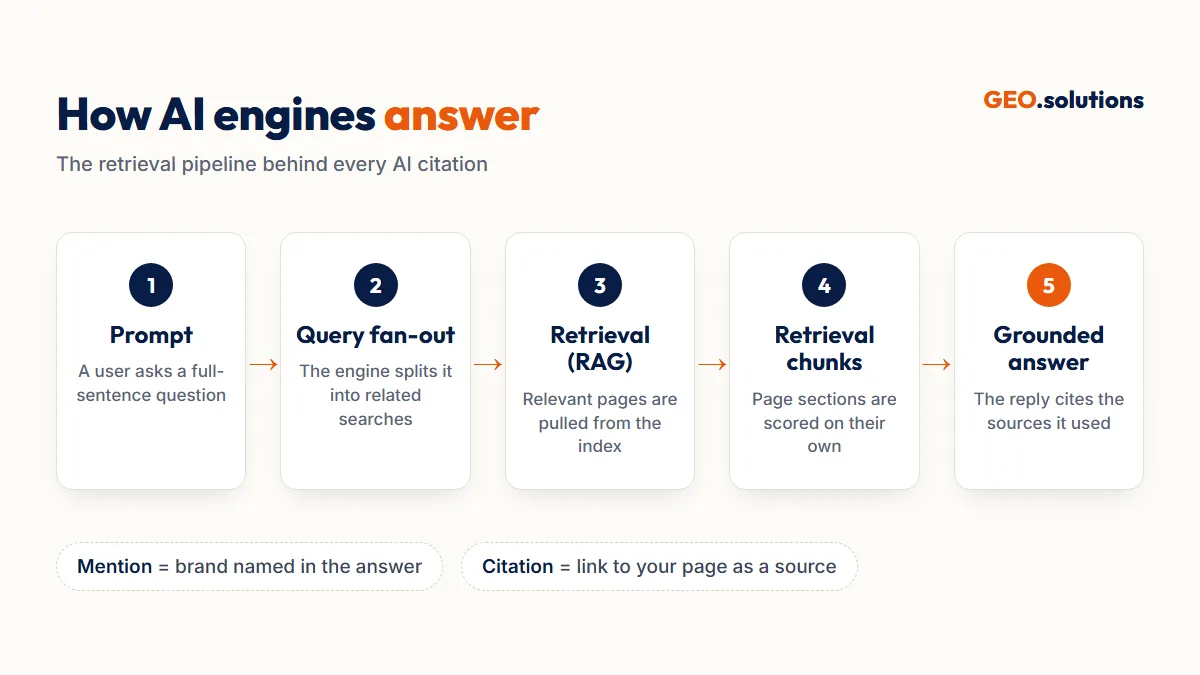
AI engines answer by retrieving relevant content, then generating a response grounded in what they retrieved. These terms describe that pipeline.
Large Language Model (LLM)
A large language model is an AI model trained on large amounts of text to predict and generate language. GPT, Gemini and Claude are examples. LLMs power every generative engine in this glossary.
Generative Engine
A generative engine is a search or chat system that writes an answer instead of only listing links. Examples include ChatGPT search, Perplexity, Gemini, Microsoft Copilot and Google AI Overviews.
Answer Engine
An answer engine is any system that returns a direct answer to a question. Examples include voice assistants, featured snippets and generative engines.
Retrieval-Augmented Generation (RAG)
Retrieval-augmented generation is a method in which an AI model first retrieves documents relevant to a query, then generates its answer from them. It was introduced in a 2020 paper by Facebook AI Research. RAG is why a page’s retrievability affects whether it gets cited.
Grounding
Grounding is the process of anchoring an AI answer in retrieved sources rather than in the model’s training memory alone. A grounded answer usually shows citations to the pages it drew from.
Query Fan-Out
Query fan-out is a technique in which an AI engine splits one question into several related searches across subtopics, then combines the results. Google states that AI Overviews and AI Mode both may use query fan-out. This is why pages can be cited for subtopics they rank for, even without ranking for the main query.
Retrieval Chunk
A retrieval chunk is a section of a page that an AI engine extracts and evaluates on its own, rather than reading the whole page. Answer-first writing makes each chunk quotable without context.
Hallucination
A hallucination is a confident AI statement that is false or unsupported by any source. Grounding and clear source content reduce hallucinations about a brand.
Knowledge Cutoff
A knowledge cutoff is the date after which a model’s training data contains no information. Engines with live retrieval can answer about recent events. Models answering from training data alone cannot.
Visibility and Measurement
GEO is measured by how often AI engines mention or cite a brand across a fixed set of prompts. These terms define what gets counted and where.
AI Citation
An AI citation is a link or source reference to a page inside an AI-generated answer. A citation sends buyers to the cited site. A mention without a citation does not.
Brand Mention
A brand mention is any instance of a brand’s name inside an AI answer, whether or not the brand’s site is cited.
Prompt
A prompt is the question or instruction a user types into an AI engine. Prompts are usually full sentences with context, such as “best CRM for a 10-person real estate team”, rather than short keywords.
Prompt Set
A prompt set is a fixed list of buyer prompts tested repeatedly to track AI visibility over time. A manual audit typically uses about 30 prompts. Method: How to Run a GEO Audit
Mention Rate
Mention rate is the share of tested prompts in which an AI engine names the brand: prompts with a mention ÷ total prompts.
Citation Rate
Citation rate is the share of tested prompts in which an AI engine cites the brand’s own URL: prompts with a citation ÷ total prompts.
Share of Voice (SOV)
Share of voice in AI search is a brand’s mentions divided by all brand mentions in the category across a prompt set. It shows a brand’s slice of AI answers compared with its competitors.
Google AI Overviews
Google AI Overviews are AI-generated summaries shown at the top of some Google search results, with links to supporting pages. Google states that pages need no special requirements to appear in them beyond being indexed and eligible to show a snippet.
Google AI Mode
Google AI Mode is a conversational search experience in Google Search that answers complex questions with generated responses and supporting links. Its traffic is reported within the standard “Web” search type in Google Search Console.
Zero-Click Search
A zero-click search is a search in which the user gets an answer on the results page and clicks no link. AI-generated answers increase zero-click behavior, which makes being cited inside the answer more valuable.
AI Referral Traffic
AI referral traffic is website visits that arrive from AI engines, such as chatgpt.com, perplexity.ai and copilot.microsoft.com. It can be segmented as its own channel in analytics tools like GA4.
Bing AI Performance Report
The Bing AI Performance report is a beta report in Bing Webmaster Tools. It shows how often Microsoft Copilot cites a site’s pages, and how many distinct pages it cites. Tracking tools compared: Best Generative Engine Optimization Tools
Content and Entity Signals
Content and entity signals tell AI engines what a page says, who a brand is and whether other sites trust it.
Entity
An entity is a distinct, identifiable thing that search engines and AI models recognize, such as a brand, person, product, place or standard. AI engines connect facts to entities, not to keywords.
Entity Building
Entity building is the work of making a brand a recognized, well-described entity across the web. It relies on consistent profiles, third-party mentions and listicle placements. Service: GEO Entity Building
Co-Occurrence
Co-occurrence is the repeated appearance of a brand alongside category terms or competitor names on third-party pages. Strong co-occurrence teaches AI engines that the brand belongs in that category.
Listicle Placement
A listicle placement is a brand’s inclusion in a third-party “best [category]” list. AI engines frequently cite listicles when answering recommendation prompts.
Answer-First Writing
Answer-first writing places the direct answer to a heading in its first one or two sentences. It makes each retrieval chunk quotable on its own. Before and after examples: Generative Engine Optimization Examples
Information Gain
Information gain is new information a page adds that other pages on the same topic do not have, such as original data, a tested method or a first-party example. Pages with information gain give AI engines something to cite that they can’t get elsewhere.
Topical Map
A topical map is a structured plan of every page a site needs to cover a topic completely, organized into core and supporting sections. It builds the topical authority that makes a site a trusted source on its subject.
Structured Data
Structured data is machine-readable markup, usually JSON-LD using the schema.org vocabulary, that labels what a page contains. Examples include Organization, Article, Product and FAQPage. Google requires the markup to match the visible text.
sameAs
sameAs is a schema.org property that links an entity’s markup to its profiles on other sites, such as LinkedIn, Crunchbase and Wikidata. It confirms that these profiles all describe the same brand.
E-E-A-T
E-E-A-T stands for experience, expertise, authoritativeness and trustworthiness. It is the framework in Google’s search quality rater guidelines for judging content quality. Named authors, cited sources and real credentials support it.
Crawlers and Technical Terms
AI engines can only cite pages their crawlers can reach and read. These terms cover access control and rendering. All 25 checks are listed in our GEO checklist.
robots.txt
robots.txt is a text file at a site’s root that tells crawlers which paths they may or may not access. A Disallow rule for an AI crawler can remove a site from that engine’s answers.
OAI-SearchBot
OAI-SearchBot is OpenAI’s crawler for ChatGPT search. OpenAI states that sites blocking it will not be shown in ChatGPT search answers, and that robots.txt changes take about 24 hours to take effect.
GPTBot
GPTBot is OpenAI’s crawler for collecting content that may train its models. Blocking GPTBot opts out of training but does not remove a site from ChatGPT search, which OAI-SearchBot controls separately.
PerplexityBot
PerplexityBot is Perplexity’s crawler for indexing pages that can appear in Perplexity answers. Sites that block it in robots.txt limit their eligibility for Perplexity citations.
Google-Extended
Google-Extended is a robots.txt token that controls whether Google may use a site’s content for Gemini model training and grounding. It does not affect a site’s inclusion in Google Search, including AI Overviews.
llms.txt
llms.txt is a proposed Markdown file at a site’s root that summarizes the site’s key content for language models. It was proposed in 2024. Google states that no AI text files are needed to appear in AI Overviews or AI Mode.
Server-Side Rendering (SSR)
Server-side rendering delivers a page’s content as complete HTML from the server, rather than building it with JavaScript in the browser. Content that only appears after JavaScript runs may not be read by some AI crawlers.
Put These Terms to Work on Your Site
GEO.solutions turns this vocabulary into a measured plan for your brand. The GEO Audit tests your buyer prompts across AI engines and reports your mention rate, citation rate and share of voice. It also lists the fixes that close your gaps. Starter audits cost $99 and deliver in 3 days.
Frequently Asked Questions
What does GEO stand for?
GEO stands for generative engine optimization in AI search marketing. It is the practice of making content more likely to be mentioned and cited in AI-generated answers. In paid advertising, “geo” can also be short for geographic, as in geotargeting.
What is GEO in marketing?
In marketing, GEO most often means generative engine optimization: optimizing a brand to appear in answers from ChatGPT, Perplexity, Gemini, Copilot and Google AI Overviews. In local and paid advertising, geo marketing means targeting audiences by location.
What is the difference between GEO and AEO?
GEO targets AI engines that generate full answers, such as ChatGPT and Perplexity. AEO targets any system that returns a direct answer, including featured snippets and voice assistants. In practice the two overlap, and most strategies cover both.
What is the difference between an AI citation and a brand mention?
A brand mention is the brand’s name appearing in an AI answer. An AI citation is a link to the brand’s page as a source. Citations send traffic. Mentions alone build awareness but send no visits.
Do I need an llms.txt file for AI search?
No. Google states that no AI text files or special markup are needed to appear in AI Overviews or AI Mode. Crawler access, indexable text and clear content matter more.