Generative engine optimization examples are real page changes that moved a brand from absent to cited in AI answers from ChatGPT, Copilot, Perplexity, Gemini and Google AI Overviews. This guide walks through five of them. Four come from GEO.solutions campaigns, measured in Bing Webmaster Tools’ AI Performance report across a three-month window that ran through July 2026. The fifth comes from the Princeton GEO study, the peer-reviewed benchmark test of which edits raise AI visibility.
Most GEO example lists describe what a brand did and stop there. Each example below shows three things: the page pattern before the change, the pattern after it, and the citation count the campaign recorded. You can copy the structure onto your own pages today.
What Counts as a Generative Engine Optimization Example?
A generative engine optimization example is a documented change to a page, paired with a measured shift in how often AI engines cite that page. You need both halves. A rewrite with no measurement is an opinion. A citation number with no page change is just a report.
Page-Level Change vs Campaign Result
A page-level change is the edit itself. It might be a new opening paragraph, an added comparison table, FAQ schema, or one long page split into a silo of focused pages. A campaign result is the citation count across every page that received those edits. This article focuses on the page-level change. For full campaign scope, services used and dashboard data, see our GEO case studies.
How Each Example Was Dated and Measured
Every result below comes from Bing Webmaster Tools’ AI Performance report (beta). The report records how often Microsoft Copilot cites a site’s pages. The reporting window is three months and runs through July 2026. Two limits apply:
- Bing labels the data as sampled and subject to refinement.
- The figures are totals for the window, not a before-versus-after delta.
The before and after snippets show the change pattern, not verbatim client copy. Client wording stays private.
Example 1: Turning a Comparison Page Into a Quotable Answer
An AI comparison publisher rebuilt its tool-comparison pages so the verdict sits in the first two sentences. That one structural change made each page quotable from a single retrieval chunk.
Before and After
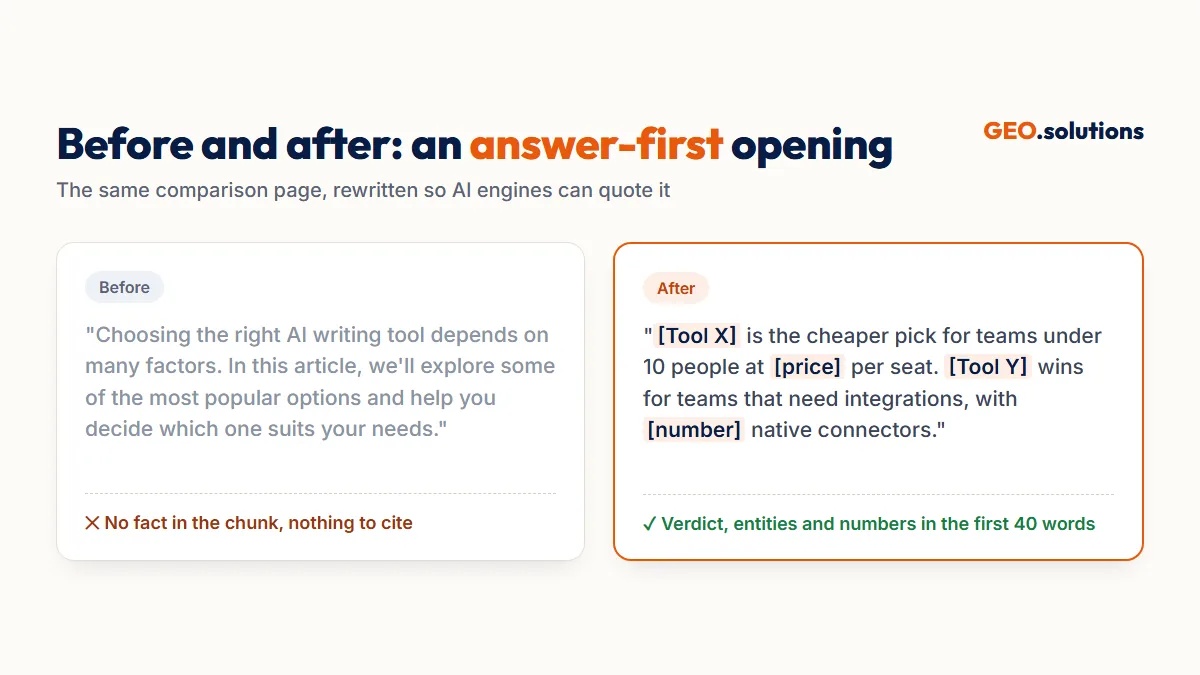
Before (common pattern):
“Choosing the right AI writing tool depends on many factors. In this article, we’ll explore some of the most popular options and help you decide which one suits your needs.”
After (shipped pattern):
“[Tool X] is the cheaper pick for teams under 10 people at [price] per seat. [Tool Y] wins for teams that need integrations, with [number] native connectors against [Tool X]’s [number].”
The before version delays the answer. An AI engine that retrieves that chunk finds no fact to cite. The after version names both entities, states the deciding attribute and gives numbers, all within the first 40 words.
Recorded Result
- 264.7K total Copilot citations in the window
- 44 average cited pages
- Daily citations peaking in the multi-thousand range, climbing from May to July 2026
- Services: GEO Content Creation, Entity Building, Authority package
The goal was to become the default source Copilot cites for product and tool comparison queries. The comparison format worked because comparison prompts ask for a verdict, and the rebuilt pages lead with one.
Example 2: Expanding Help Docs So AI Cites More Than the Homepage
A tech product brand had AI engines citing its homepage and little else. The fix was to make help docs, feature pages and guides citation-ready across its product and support topic clusters.
Before and After
Before (common pattern):
The feature page opens with a marketing line (“Powerful automation that works the way you do”). It lists benefits as adjectives and buries the setup steps in a video.
After (shipped pattern):
The same page opens with what the feature does and who it is for. It then gives:
- numbered setup steps in text
- a requirements table (plan tier, permissions, supported integrations)
- a short FAQ answering the three support questions the team received most
AI engines answer “how do I” and “does it support” prompts. A page that answers in text, with the steps visible to a crawler, can be cited. A video cannot be quoted.
Recorded Result
- 117.4K total Copilot citations in the window
- 178 average cited pages, with roughly 178 pages cited regularly
- Services: Content Optimisation, Content Creation, Growth package
The number to watch here is cited pages, not total citations. The brand went from a homepage-only footprint to 178 regularly cited pages. AI engines now treat its documentation as the reference source for its own product.
Example 3: Restructuring Service Pages With Answer-First Openings and FAQ Schema
A translation agency wanted measurable AI share of voice for service and language queries, without paying for an enterprise retainer. The work restructured existing service pages rather than publishing new ones.
Before and After
Before (common pattern):
“With years of experience and a passion for language, our team delivers high-quality translation services tailored to your unique needs.”
After (shipped pattern):
“Certified [language pair] translation for legal documents takes [number] business days for files under [word count] words. Each translation is completed by a native [target language] linguist and checked by a second reviewer.”
The page also gained an FAQ block marked up with FAQPage schema. It covers turnaround, certification and pricing questions, and each answer opens with the direct fact in sentence one.
Recorded Result
- 48.4K total Copilot citations in the window
- 42 average cited pages
- A steady baseline, then a clear uplift in July 2026 toward 1K+ daily citations
- Services: GEO Audit, Content Silo, Growth package
This example matters for service businesses because no new pages were needed. The same URLs began earning citations once two things changed. The answer moved to the top of the page, and the key details (language pair, document type, turnaround) were stated explicitly.
Example 4: Building a Compact Buying-Guide Silo Instead of Hundreds of Pages
A luxury diamond brand needed AI visibility without publishing hundreds of thin pages. The answer was a small education and buying-guide silo built around diamond purchase queries.
Before and After
Before (common pattern):
The site had product category pages with short descriptions. It also had a single long “diamond guide” covering cut, color, clarity, carat, certification and pricing on one URL.
After (shipped pattern):
A compact silo of focused pages, each owning one buying question. Examples include how cut grade affects sparkle, and what a grading certificate confirms. The pages link to each other and point up to the category pages.
A long page splits into many retrieval chunks, and each chunk has weak topical focus. A focused page gives AI engines one clear answer per question and a clean source to cite.
Recorded Result
- 2.3K total Copilot citations in the window
- 8 average cited pages
- Consistent daily citations across the full window
- Services: GEO Audit, Research Package, Starter campaign
These totals are smaller than Examples 1 to 3, and that is the point. Eight pages earned steady citations on a starter budget, in a luxury category where buyers research heavily before they purchase.
Example 5: Adding Sources and Statistics, as Tested by Princeton Researchers
The Princeton GEO study (Aggarwal et al., 2023) tested nine content edits on GEO-bench, a benchmark of 10,000 queries. Three edits performed best: citing sources, adding quotations and adding statistics. The top methods raised visibility by up to 40%.
Before and After in the Study
Before:
“Regular exercise improves heart health and reduces the risk of disease.”
After (statistics addition pattern):
“Adults who get [number] minutes of moderate exercise per week cut their cardiovascular disease risk by [percent], according to [named source, year].”
Keyword stuffing, the old SEO reflex, scored below the unedited baseline. On Perplexity it performed about 10% worse.
Why Lower-Ranked Pages Gain the Most
The study’s most useful finding is who benefits. For sources ranked fifth in search results:
- citing sources raised visibility by 115.1%
- adding quotations raised it by 99.7%
- adding statistics raised it by 97.9%
The same “cite sources” edit cut visibility for top-ranked sources by 30.3%. GEO gives smaller sites a real path into AI answers that classic rankings would not.
Patterns Shared by Every Example
All five examples repeat the same five moves. The table maps each move to where it appeared.
What Changed On the Page
Four of the five moves are on-page edits: answer position, entity density, format and focus. These are the cheapest changes to make. They are also the fastest to appear in citation data, because AI engines see the new version as soon as the page is recrawled.
What Changed Off the Page
Examples 1 and 4 also ran entity building or research work alongside the edits. Off-page signals tell AI engines the brand is a known entity worth citing. Examples include listicle placements and brand mentions on third-party sites. On-page edits make a page quotable. Off-page signals make the brand trusted enough to be quoted.
How to Apply These Examples to Your Own Pages
Start with the pages AI engines already retrieve, then fix the chunk they land on. The steps below follow the order used across all four GEO.solutions campaigns.
Audit Which Pages AI Engines Already See
Connect Bing Webmaster Tools and open the AI Performance report to see which URLs Copilot cites today. Then run your top 10 buyer prompts in ChatGPT, Perplexity and Gemini, and note which competitors appear instead of you.
Rewrite the Opening of Each Priority Page
Replace the first paragraph with a direct answer that names the entity, states the deciding attribute and gives a number. Then apply the other moves from the patterns table, one page at a time. Our GEO best practices checklist covers the full rule set.
Measure for One Full Window
Track total citations and cited pages for three months. Cited pages tell you whether AI engines trust more of your site. Total citations tell you how often they use it. New to the discipline? Start with what generative engine optimization is.
Conclusion
All five generative engine optimization examples share one idea. AI engines cite the page that states the answer plainly, with named entities and numbers, in a chunk they can lift whole. A comparison publisher reached 264.7K Copilot citations that way. A luxury brand earned steady citations from just eight pages.
Neither result needed a new domain or a large content budget. Both needed pages rewritten for retrieval rather than for skimming.
Get a Before and After Review of Your Own Pages
GEO.solutions reviews your pages using the same method behind the examples above. The GEO Audit does three things:
- tests your buyer prompts across AI engines
- flags the pages losing citations to competitors
- lists the quick-win rewrites
Starter audits begin at $99 and deliver in 3 days. Already know which pages need the work? GEO Content Optimisation rewrites five pages from $250.
Frequently Asked Questions
What is an example of generative engine optimization?
Rewriting a comparison page so the verdict appears in the first two sentences is a clear example. An AI comparison publisher made that change across its comparison pages and recorded 264.7K Copilot citations in a three-month window through July 2026.
How long do GEO changes take to show results?
GEO changes typically appear in citation data within a few weeks of the page being recrawled. One translation agency in this guide had a steady baseline for two months, then saw a clear uplift in the third.
Do GEO examples apply to small websites?
Yes. The Princeton GEO study found that pages ranked fifth in search gained the most, with cited sources lifting visibility by 115.1%. A luxury brand in this guide earned consistent AI citations from just eight pages.
What is the difference between GEO examples and GEO case studies?
GEO examples show the page-level change: the copy and structure before and after the edit. GEO case studies report the full campaign: services used, timeframe and total results across every page.
Does keyword stuffing help with generative engine optimization?
No. In the Princeton GEO study, keyword stuffing scored below the unedited baseline, and on Perplexity it performed about 10% worse. Named entities, statistics and cited sources all outperformed it.
How do you measure GEO results?
Bing Webmaster Tools’ AI Performance report shows how often Microsoft Copilot cites your pages and how many distinct pages it cites. For ChatGPT, Perplexity and Gemini, run a fixed set of buyer prompts on a schedule and record whether your brand appears.