To optimize content for AI search, create passages that answer specific questions clearly, make sense without the surrounding paragraphs, and support important claims with credible evidence. This approach helps search systems and AI answer engines understand what a page covers and identify information that may be useful in a generated response.
However, clear writing alone does not guarantee an AI citation. A page also needs to be accessible, relevant to the question, and supported by information that readers can verify.
This guide explains how to write content AI can cite, how to structure answer-first passages, and how to support claims with useful evidence. It also includes examples from our own website and separates documented search guidance from research findings and practical editorial recommendations.
Key takeaways
- Google says there are no additional technical requirements or special optimizations for appearing in AI Overviews and AI Mode beyond its existing Search requirements.
- An answer-first passage addresses one question directly before adding supporting detail.
- Research published at KDD 2024 found that adding relevant statistics and quotations improved source visibility in the researchers’ benchmark. Results varied by method and evaluation.
- Clear headings, precise entities, attributable evidence and self-contained explanations make content easier to understand.
- No writing format, word count, schema type or GEO technique guarantees a citation from an AI engine.
In this guide: What research tells us | Technical eligibility | Six writing principles | Before-and-after examples | Common mistakes | Testing | Checklist | FAQs
What Is Known About AI Search and Content Selection?
AI search platforms can retrieve information from multiple sources and use it to generate responses. Depending on the platform and query, an answer may include links or citations to supporting pages.
The exact selection process is not fully public. It is therefore important to distinguish between official documentation, independent research and editorial recommendations.
The KDD 2024 study is useful evidence, but its findings need context. The researchers reported improvements of up to 40% in their GEO-bench experiments. In a separate experiment using Perplexity.ai, they reported improvements of up to 37% on one of their visibility measures.
These figures describe results under the study’s experimental conditions. They are not a forecast of traffic, rankings or citations for an individual website. The researchers also found that the effectiveness of different techniques varied across domains and evaluation methods.
The study found that keyword stuffing offered little or no improvement in its experiments. This supports a practical conclusion: adding more keyword repetitions is not a substitute for useful information, credible evidence and clear writing.
The rest of this guide uses three labels:
- Documented: supported by official platform documentation.
- Research-backed: supported by published research, with its limitations.
- Editorial practice: a recommended writing approach, not a confirmed platform ranking factor.
Make Your Content Accessible First
Before focusing on passage structure, make sure the page can be discovered and accessed.
Even a well-written article cannot contribute to search visibility if the relevant crawler cannot access it or the page is not eligible to appear in the relevant search experience.
Use the following checks:
1. Check indexing and search eligibility. Google says a page must be indexed and eligible to appear with a snippet to qualify as a supporting link in AI Overviews or AI Mode. Indexing does not guarantee that Google will display the page.
2. Review crawler access. Check robots.txt rules and any CDN, firewall or hosting restrictions that could prevent legitimate search crawlers from accessing important content.
3. Understand OpenAI’s crawler controls. OpenAI documents OAI-SearchBot as the crawler used to surface websites in ChatGPT search features. GPTBot is used to crawl content that may be used to train OpenAI’s foundation models. These are separate controls. A website can allow OAI-SearchBot while disallowing GPTBot. OpenAI says robots.txt changes can take approximately 24 hours to affect its search systems. See OpenAI’s crawler documentation.
4. Keep important information in text. Do not place essential explanations, product details or research findings exclusively inside images, videos or elements that cannot be accessed as text.
5. Use internal links. Link important pages from relevant sections of your website. Descriptive internal links help visitors navigate your content and make pages easier for search systems to discover.
6. Check the page experience. Make sure the page works on mobile devices, loads reliably and presents its main information without unnecessary obstacles.
These checks support accessibility and search eligibility. They do not guarantee that an AI platform will retrieve, select or cite a particular page.
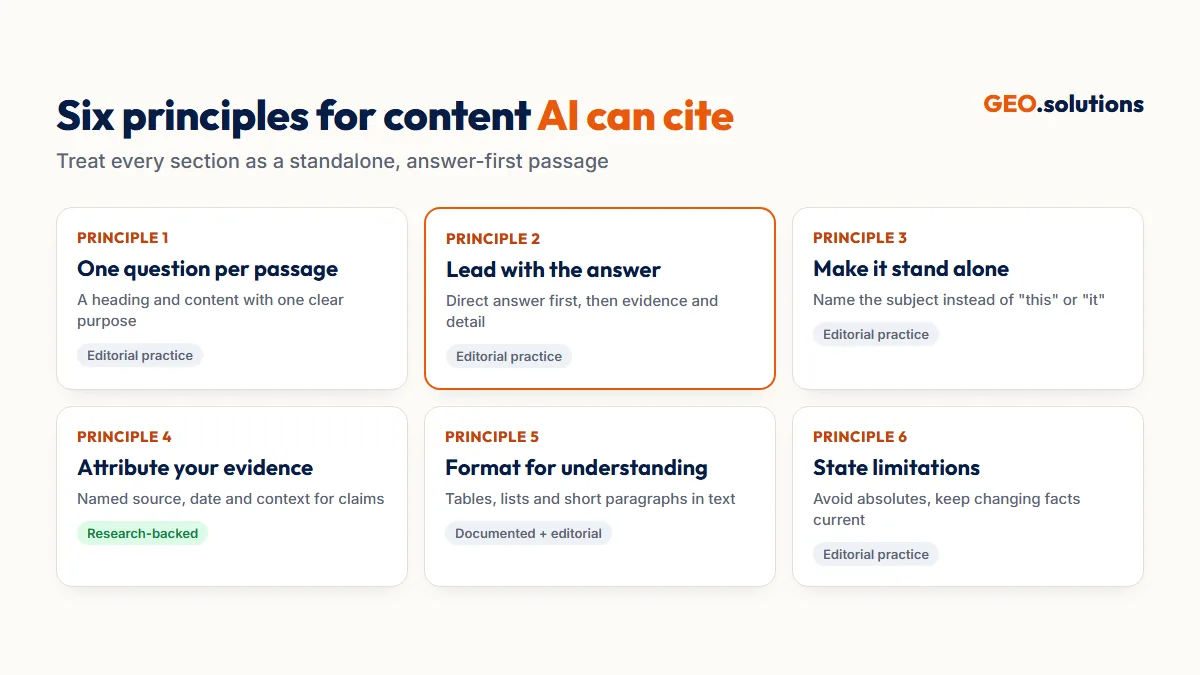
Six Principles for Writing Content AI Can Cite
A useful way to approach content creation is to treat each section as a potential standalone answer. A passage might consist of a heading followed by a paragraph, list or table. It should communicate one clear idea without depending on several unrelated sections.
1. Answer One Question Per Passage
Editorial practice
Start by identifying the question a reader expects the section to answer. Then make sure the heading and the content beneath it address that question.
For example, a section about structured data should explain what structured data does, how it relates to visible page content and whether it is required for AI search.
Avoid combining unrelated topics under broad headings such as “Other Important Factors”. A section covering schema, backlinks, content freshness and keyword research may contain useful information, but its central purpose is difficult to identify.
A more useful structure would separate those subjects:
- What is structured data?
- Does schema markup help AI search?
- How should you use internal links?
- Why does content accuracy matter?
This gives each section a defined purpose and helps readers find the information they need.
2. Lead With the Answer
Editorial practice
Put the direct answer in the opening sentence or two. Follow it with the explanation, evidence, conditions or examples.
Compare these examples:
Weak:
“There are many factors to consider when thinking about how content should be structured for modern search platforms.”
Stronger:
“Start each content section with a direct answer to its main question, then add the evidence and explanation needed to support it.”
The stronger example communicates a specific recommendation immediately. It does not force the reader to work through a general introduction before reaching the point.
Answer-first writing is particularly useful for definitions, comparisons, factual explanations and frequently asked questions.
There is no publicly documented requirement that every answer must contain a particular number of sentences. At GEO.solutions, we often use concise opening answers and expand them with supporting detail where the topic requires it. That is an editorial preference, not an AI platform rule.
3. Make Each Passage Understandable on Its Own
Editorial practice
A paragraph should remain clear when read outside the full article.
Avoid relying heavily on vague references such as “this”, “it”, “they” or “the above method”. Name the subject directly so the meaning is clear without the preceding paragraph.
Weak:
“This helps improve visibility because it makes the information easier to understand.”
Stronger:
“Descriptive section headings help readers identify the subject of each passage and understand how the information relates to their question.”
The second version identifies the subject and explains the relationship. It does not depend on an earlier sentence to establish what “this” means.
Also define unfamiliar terms when they first appear. If you discuss generative engine optimization, explain what GEO means before using the abbreviation throughout the article.
For information that can change, include a date, version or relevant timeframe. This is particularly important for software features, product specifications, pricing, regulations and platform documentation.
4. Support Important Claims With Attributable Evidence
Research-backed
A useful claim should be specific enough for a reader to assess and verify.
When using statistics, research findings or technical statements, identify the source and provide enough context to understand what the evidence actually demonstrates.
Compare:
Weak:
“AI search is growing rapidly, and more businesses are investing in GEO.”
Stronger:
“Google documents that AI Overviews and AI Mode may use query fan-out, which involves issuing multiple related searches across subtopics and data sources when developing a response.”
The stronger statement identifies the platform and links to its documentation. It does not make an unsupported claim about adoption or market growth.
The KDD 2024 GEO study also provides an example of how research should be presented. It evaluated a range of content changes and found that adding relevant statistics and quotations could improve visibility in its benchmark. However, the results varied across techniques and domains.
Use evidence responsibly:
- Name the study, organization or primary source.
- Include the publication year or date when available.
- Explain the context in which a statistic was measured.
- Link to the original source where possible.
- Avoid presenting experimental results as guaranteed outcomes.
- Do not invent statistics to make a passage appear more authoritative.
A well-attributed claim is more useful than a confident statement that readers cannot verify.
5. Use Formatting That Makes Information Easier to Understand
Documented guidance and editorial practice
Use headings, paragraphs, lists and tables to present information in the format that best suits the subject.
For example, use a table when comparing products, services, features or technical specifications. Use a numbered list when explaining a process. Use short paragraphs when developing an argument or explaining a concept.
Consider a section describing six service deliverables. Instead of placing all six in one long paragraph, give each deliverable a short label and a clear explanation.
This improves readability and makes the information easier to scan.
Google recommends keeping important content available in textual form and ensuring structured data matches the visible content. It also states that there is no special schema markup required to appear in its AI features.
Schema can still help describe page content to supported systems, but it should not be treated as a guaranteed citation technique. Use appropriate structured data only when it accurately represents the content visible to users.
6. State Limitations and Keep Changing Facts Current
Editorial practice
Good content explains what is known, what is uncertain and where the information comes from.
Avoid absolute statements when the evidence does not support them.
For example:
Overstated:
“Using answer-first content will get your website cited by AI search engines.”
More accurate:
“Answer-first content makes the main point easier to identify, but AI platforms do not publish a universal rule that guarantees a citation.”
The second statement gives useful advice without promising an outcome that cannot be controlled.
Review changing information before publication. Add a meaningful update date when it helps readers understand the currency of the information. Do not change a date simply to make an article appear fresh when its substance has not been reviewed.
Before-and-After Examples From Our Own Content
The following examples demonstrate how to improve clarity and evidence in a real article on the GEO.solutions website.
The original wording below was taken from our GEO best practices guide and recorded on November 3, 2026. The source page may change, so the quotation should be checked again before this article is published.
Example 1: Replace an Unsupported Generalisation
Before:
The consensus is clear: structured, declarative, and well-cited content is significantly more likely to be picked by automated scrapers and synthesis engines than traditional, narrative-heavy SEO articles.
What needs improvement?
- “The consensus is clear” does not identify the research or sources behind the statement.
- “Significantly more likely” suggests a measured difference without providing a measurement.
- “Automated scrapers and synthesis engines” is broad and does not identify the systems being discussed.
- The statement does not explain the evidence behind its conclusion.
After:
A 2024 study by Aggarwal and colleagues evaluated content optimization methods using a benchmark of 10,000 queries. The researchers found that adding relevant quotations, citations and statistics improved source visibility in their experimental setup. The findings varied by technique and domain, so they should be treated as research evidence rather than a prediction of results for an individual website.
Why the revised version is stronger: It identifies the study, explains what was evaluated and qualifies the finding. Readers can follow the source and understand the limits of the evidence.
Example 2: Separate Editorial Advice From Platform Claims
The same guide contains a statement about how AI engines process content.
Before:
AI engines prioritize conciseness. When user prompts seek a definition or comparison, the LLM retrieval agent looks for clear, declarative summary sentences at the absolute beginning of sections.
What needs improvement?
The wording presents a specific description of internal platform behavior as fact. The statement does not identify documentation or research that confirms this exact retrieval rule.
After:
Opening a section with a direct answer is a useful editorial practice for definitions and comparisons. It allows readers to understand the main point quickly and makes the passage easier to interpret when it is read outside the full article. However, this should not be presented as a confirmed rule used by every AI search platform.
Why the revised version is stronger: It retains the practical recommendation while avoiding an unsupported claim about how every AI engine works.
A Reusable Template for an Answer-First Passage
Use the following structure when creating a new section:
The template is a writing aid, not a required technical format. Adapt it to the question and the evidence available.
Worked Example: Explaining Two OpenAI Crawlers
Consider the question: “What is the difference between OAI-SearchBot and GPTBot?”
A weak opening might say:
“OpenAI has several bots, and it can be confusing to understand which ones matter for your website.”
A more useful passage would be:
OAI-SearchBot and GPTBot are separate OpenAI crawlers with different purposes. OpenAI documents OAI-SearchBot as the crawler used to surface websites in ChatGPT search features, while GPTBot is used to crawl content that may be used to train its foundation models. Website owners can manage these crawlers separately through robots.txt. OpenAI also states that changes to robots.txt can take approximately 24 hours to affect its search systems.
This passage answers the question immediately, names both crawlers, explains their different purposes and provides a link to the official documentation.
It also avoids suggesting that allowing one crawler guarantees a citation or recommendation.
Writing an entire content cluster with this level of clarity requires planning. For new pages developed around a consistent content strategy, explore our GEO content creation service.
Mistakes That Make Content Harder to Use
Even a well-researched article can become less useful when its structure or claims are poorly managed.
Avoid these common problems:
- Keyword stuffing: Repeating the same phrase unnaturally does not make an article more useful. The KDD 2024 study found little or no improvement from keyword stuffing in its experiments.
- Unsupported statistics: A number without a credible source, date or explanation can mislead readers.
- Vague headings: Generic headings make it harder to identify what each section explains.
- Unclear references: Excessive use of “this”, “that” and “it” can make individual passages difficult to understand.
- Unnecessary repetition: Repeating the same explanation across several sections adds length without adding value.
- Writing exclusively for machines: Google continues to recommend helpful, reliable, people-first content. The article should make sense to a human reader first.
- Important information hidden in images: Put essential explanations and facts in accessible text.
- Unsupported promises: Do not claim that a particular format, schema type or writing technique guarantees AI citations.
The objective is not to make every paragraph sound like a short answer. It is to make the information clear, relevant and useful in the context where the reader needs it.
How to Test Your Content in AI Search
After publishing, test whether the page appears in answers related to the questions it was designed to address.
Start with the main question answered by the article. Then test a few closely related questions that reflect the same topic and intent.
You can use ChatGPT search, Perplexity, Gemini and Google’s AI search features where available.
For each test, record:
Run the same question more than once where practical. AI-generated responses and displayed sources can vary between queries, sessions and user contexts.
If your page is not cited, do not immediately rewrite the entire article. First examine the answer, the sources being cited and the question being tested.
Consider whether:
- Your page directly answers the question.
- The relevant passage is easy to find.
- The claim is supported by credible evidence.
- The page provides information that adds something beyond generic explanations.
- The page is accessible to the relevant search crawler.
- Another page on your website already covers the same subject more effectively.
Use these observations to identify improvements. Treat testing as an editorial evaluation method, not a guaranteed way to reverse-engineer a platform’s ranking system.
Pre-Publish Checklist
Before publishing a new article, review the following:
- The page answers a clearly defined search intent.
- The primary keyword appears naturally in the title and opening section.
- The H1 accurately describes the article.
- Each major heading covers a distinct question or topic.
- The opening sentence under each important heading communicates the main point.
- Individual passages identify their subjects clearly.
- Important claims have credible sources.
- Statistics include their source, date and context.
- Limitations and uncertainties are stated where relevant.
- Tables and lists improve understanding rather than simply adding formatting.
- Important information is available in text.
- Internal links point to relevant, live pages.
- Structured data, if used, matches the visible page content.
- The page is accessible to relevant search crawlers.
- The article has been reviewed for repetition, unsupported claims and keyword stuffing.
- The publication or update date accurately reflects the editorial work performed.
For a wider overview of technical and editorial practices, read our guide to GEO best practices.
Where GEO.solutions Can Help
We provide GEO services, so we have a commercial interest in this subject. The writing principles in this guide can be applied independently, without purchasing a service.
If you are planning new content, our GEO content creation service supports the development of new pages with clear structure, relevant entities, attributable information and useful internal links.
If you already have published pages that need to be assessed or restructured, explore our GEO content optimization service.
The right approach depends on whether you are creating new content or improving existing pages. In either case, the objective should be to produce accurate, useful information that serves the reader and can be understood by search systems.
Frequently Asked Questions
How do I optimize content for AI search?
Make sure your page is accessible and eligible for search, then write sections that answer specific questions directly. Use descriptive headings, clear explanations, named entities and credible evidence. Keep important information in text and avoid unsupported claims. These practices improve clarity, but no published method guarantees that an AI platform will cite a particular page.
What is an answer-first passage?
An answer-first passage begins with a direct response to the question or subject in its heading. It then provides supporting details, evidence, examples or limitations. The passage identifies its subject clearly, so readers can understand it without relying on several preceding paragraphs. It is a practical editorial structure rather than a mandatory AI search format.
Does adding statistics help AI engines cite content?
A 2024 GEO study found that adding statistics, citations and quotations could improve source visibility in its experimental benchmark. The results varied by technique and domain. The researchers also tested Perplexity.ai using uploaded source texts. These findings support using relevant evidence, but they do not establish a guaranteed citation or traffic improvement for every website.
Do I need schema markup to be cited by AI search engines?
Google states that no special schema markup, machine-readable file or AI-specific text file is required to appear in AI Overviews or AI Mode. If you use structured data, it should accurately match the visible content on the page. Other platforms may use different systems, and their complete citation-selection requirements are not publicly documented.
How long should a passage be for AI search?
There is no publicly documented passage length required by Google, ChatGPT, Perplexity or Gemini. Write enough to answer the question accurately and provide the necessary context. A short answer may be suitable for a simple definition, while a technical explanation may require examples, evidence and qualifications. Avoid adding words simply to reach a target length.
How is writing for AI citation different from traditional SEO writing?
The fundamentals overlap. Both approaches benefit from useful content, clear organization, relevant information and accessible pages. Writing for AI search places additional editorial emphasis on making individual passages understandable on their own and supporting claims with attributable evidence. These practices complement SEO; they do not replace keyword research, technical SEO or user-focused content planning.
Will following these rules guarantee an AI citation?
No. AI platforms do not publish a universal formula that guarantees a page will be selected or cited. Responses can vary according to the query, platform, available sources and other factors. Clear writing, credible evidence and accessible pages are useful practices, but they cannot promise a citation, search ranking or increase in traffic.