Refreshing content for AI citations means updating the facts, answers and dates on existing pages so AI engines keep choosing them as sources. It works because AI engines lean toward recently updated pages. In Seer Interactive’s 2026 study of 47,097 citations across ChatGPT, Gemini and Perplexity, 75% of cited pages had been updated within the past year.
This guide covers which pages to refresh first, what to change on each one and how often to repeat the work. It also covers how to handle dates so a refresh counts with both Google and AI engines.
Why Freshness Affects AI Citations
AI engines cite recently updated content more often than traditional search results do. Three large studies point the same way, though the strength of the effect varies by engine.
What the Citation Data Shows
- Ahrefs (July 2025, 17 million cited URLs): AI-cited content was on average 25.7% fresher by publish date than Google’s organic results. ChatGPT showed the strongest preference for newer pages.
- Seer Interactive (July 2026, 7,683 dated pages): 75% of cited pages were updated within the past year and 88% within two years. Of the pages updated within a year, more than half were last touched in the previous three months.
- AirOps (August 2025, 4,000+ ChatGPT-cited pages): 35.2% of cited pages were updated in the past three months. For commercial queries, 83% of citations went to content updated within the past year.
All three studies measure correlation. They show that cited pages tend to be fresh, but they do not prove that an update alone causes a citation.
Where Freshness Matters Less
Freshness isn’t equally important everywhere. In the Ahrefs data, Google AI Overviews was the only source that cited older content than Google’s organic results. In the Seer data, Perplexity was the most forgiving of older pages: 65% of its citations were updated within a year, against 78% for Gemini. Ahrefs also found that the average cited page was still about 2.9 years old. A strong page that is kept accurate can earn citations for years.
What Counts as a Real Refresh
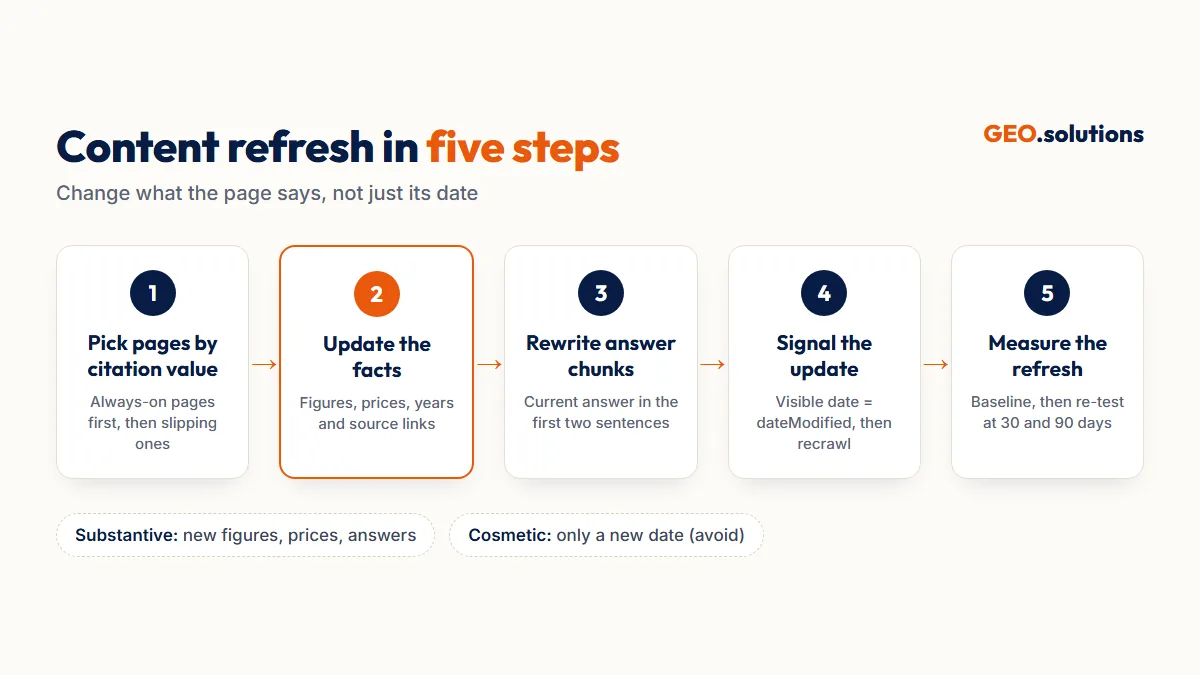
A real refresh changes what the page says. A cosmetic refresh only changes its date. AI engines quote facts, so the facts are what you have to update.
Substantive vs Cosmetic Changes
Substantive changes include new figures, current prices, a rewritten answer, a new section covering a subtopic buyers now ask about, or a corrected claim. Cosmetic changes include swapping the year in the title, rewording sentences without new information, or moving the date forward. Google’s John Mueller has warned against changing publish dates without matching content changes.
Why Refreshing Beats Republishing
Seer’s data shows that refreshing old URLs works. Of pages with both dates on record, 72% looked fresh by update date, but only 42% had been published in the past year. More than a quarter of the “fresh” cited pages were first published over two years ago. Updating an established URL keeps its links and history and still gives AI engines a current page.
Step 1: Pick Pages by Citation Value, Not Age
Refresh the pages that already earn citations or should earn them, not simply the oldest pages on the site. An old page nobody cites doesn’t need refreshing. A cited page with outdated figures does.
Protect Your Always-On Pages First
Seer found that pages cited consistently across all four months of its study had a median update age of about 0.47 years, meaning they had been updated within roughly the last six months. Pull your cited URLs from the Bing AI Performance report and your prompt tracking sheet. Then refresh the steady performers before their figures go stale.
Rescue Pages That Are Slipping
Next, find pages whose citation counts or AI referral traffic have dropped over the last two to three months. Re-run your buyer prompts to see which competitor page took the citation and what it says that yours doesn’t. The method is covered in How to Run a GEO Audit.
Step 2: Update the Facts AI Engines Quote
Update every number, price, date and named product on the page, because these are the details AI engines lift into answers. An outdated figure can be quoted against you, or skipped in favor of a competitor’s current one.
Replace Figures, Prices and Year References
Check every statistic against its original source and swap in the latest release. Update prices, plan names, feature lists and screenshots. Remove “this year” phrasing, and state the year outright, such as “in 2026.”
Re-Check Every Source Link
Confirm that each outbound link still works and still supports the claim. Replace dead links, and swap secondary sources for the primary study or official documentation wherever one exists.
Step 3: Rewrite the Answer Chunks
Rewrite the opening of each section so its first two sentences answer the heading with current facts. AI engines retrieve sections one chunk at a time, so each chunk has to stand on its own.
Lead Each Section With the Current Answer
If the right answer has changed since publishing, put the new answer first. Don’t add an “Update:” note at the bottom. A buyer asking “how much does X cost” should get today’s price in the first sentence.
Add the Subtopics Buyers Now Ask About
Google states that AI Overviews and AI Mode use query fan-out, breaking one question into several related searches. Add sections for the follow-up questions that have emerged since publishing, such as a new competitor, a new regulation or a new use case. Each added section gives the page one more way to be cited.
Step 4: Signal the Update Honestly
Show the update date clearly, mark it up correctly and tell crawlers the page has changed. Do this only after a substantive change.
Match the Visible Date to dateModified
Google recommends a visible, labeled date, such as “Last updated,” plus dateModified in Article or BlogPosting structured data. Keep the two dates identical. Leave datePublished as the original date, and never set a future date.
Prompt a Recrawl
Update the page’s lastmod value in your XML sitemap. Submit the URL for recrawling in Google Search Console and Bing Webmaster Tools, or ping Bing through IndexNow. A refresh does nothing until crawlers see it, and Copilot answers draw from Bing’s index.
Step 5: Measure the Refresh
Record citations and AI referral traffic before the refresh, then compare them over the same length of time afterward. Without a baseline, you can’t tell a working refresh from normal variance.
Log a Baseline Before You Edit
For each page, write down its Bing AI Performance citations for the last 30 days, AI referral sessions in GA4, and the prompts in your tracking set that currently cite it. Note the date of the refresh.
Re-Test After 30 and 90 Days
Re-run the same prompts and pull the same reports 30 days after the recrawl, then again at 90 days. Compare against pages you didn’t refresh during the same period, so seasonal changes aren’t mistaken for refresh results.
How Often to Refresh: Cadence by Page Type
Refresh commercial and data-heavy pages quarterly, and review evergreen guides every 6 to 12 months. No study sets one universal schedule, so the cadence below matches each page type to how fast its facts change.
Adjust for How Fast Your Industry Moves
Fast-moving sectors, such as SaaS, finance and AI tools, need the shorter end of each range. Slower sectors, such as education and research, can keep evergreen pages longer, provided the facts still hold. In the Seer data, freshness rates also varied by vertical, from 69% for pet retail to 80% for retail energy.
Refresh on Triggers, Not Just the Calendar
Refresh straight away when something on the page stops being true. Typical triggers include:
- a price or plan change
- a product launch or discontinuation
- a new regulation or standard
- a new edition of a study the page cites
- a competitor taking your citation for a priority prompt
Our GEO checklist includes a visible-freshness check you can run each quarter.
Conclusion
AI engines cite pages they can trust to be current. Across the three largest studies, the pages that get cited are mostly updated within the past year, and many within the past three months. The fix isn’t a new date stamp. It’s current facts, rewritten answer chunks and an honest dateModified, applied first to the pages that already earn citations.
Refresh by citation value, follow the cadence that matches each page type and measure every refresh against a baseline.
Get Your Priority Pages Refreshed
GEO.solutions refreshes pages for AI citation using this method: current facts, answer-first rewrites, corrected schema and recrawl requests. GEO Content Optimisation starts at $250 for five pages, so you can begin with your most-cited URLs.
Frequently Asked Questions
Does updating content help AI citations?
Updated content is cited more often. Seer Interactive found that 75% of pages cited by ChatGPT, Gemini and Perplexity had been updated within the past year. The studies show correlation, so the update has to improve the facts, not just the date.
How often should I refresh content for AI search?
Refresh pricing, comparison and statistics pages every 3 months, how-to guides every 6 months and evergreen guides every 12 months. Refresh immediately when a fact on the page stops being true.
Can I just change the date on a page?
No. Changing the date without changing the content is a cosmetic update. Google’s John Mueller has warned against it. AI engines quote facts, so an old figure under a new date still loses to a competitor’s current figure.
Which AI engine cares most about freshness?
ChatGPT showed the strongest preference for fresh content in Ahrefs’ 17-million-citation study. Google AI Overviews was the only source citing older content than organic results. In Seer’s data, Perplexity was the most forgiving of older pages.
Is it better to update an old page or publish a new one?
Updating an established page is usually better when the topic is the same. It keeps the URL’s links and history while giving AI engines a current version. In Seer’s data, more than a quarter of fresh cited pages were first published over two years ago.
How do I tell Google and AI engines a page was updated?
Show a visible “Last updated” date, set the same date in dateModified structured data and update the sitemap lastmod. Then request recrawling in Google Search Console and Bing Webmaster Tools.