By the GEO.solutions team | Last updated: 21 November 2026
Nearly every article about GEO makes it sound easier than it is.
You see promises of instant citations, effortless entity building and a straight line from implementation to measurable ROI.
Real Generative Engine Optimization programmes are rarely that simple.
AI-generated answers can change. A page can rank well in Google without being cited by an AI system. Different platforms can produce different results for the same prompt. Brand recognition takes time to develop. And proving that an AI interaction influenced a conversion can be considerably harder than proving where a traditional organic visit came from.
These challenges don’t mean GEO doesn’t work. They mean it needs to be approached as an ongoing process of:
Measurement → Content Optimisation → Entity Development → Authority Building → Adaptation
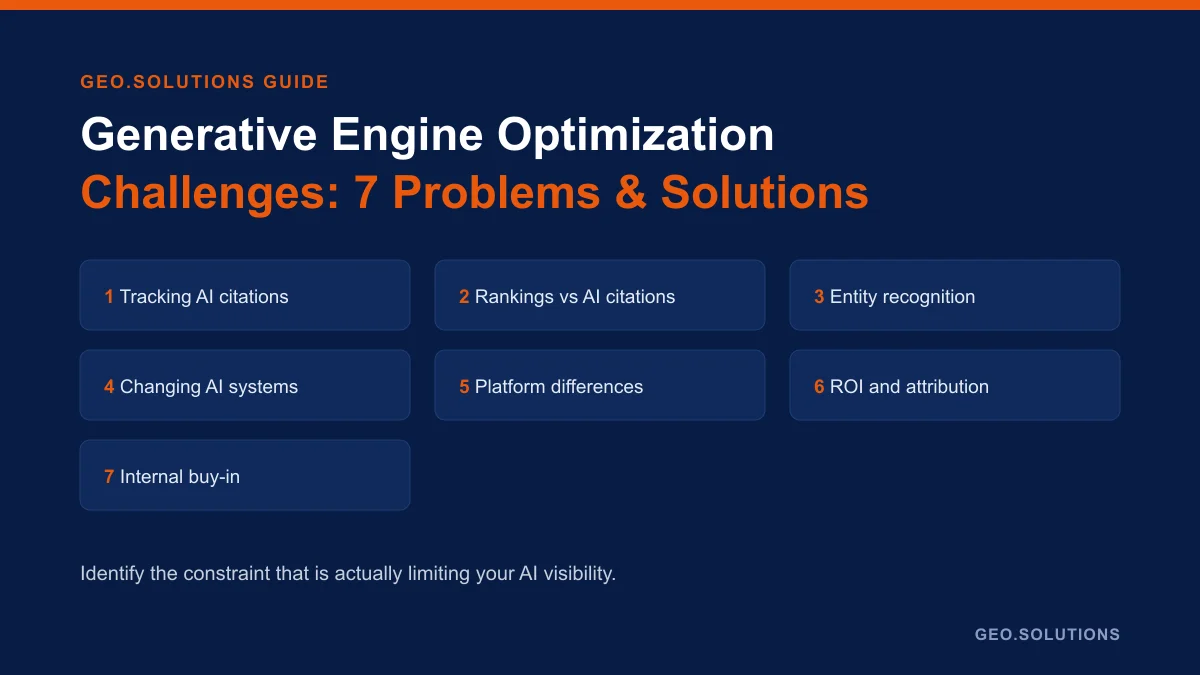
This guide covers the seven most common Generative Engine Optimization challenges, explains why they happen and provides practical solutions for each.
In this guide: The 7 challenges | Citation tracking | Rankings vs citations | Entity recognition | Changing AI systems | Platform differences | ROI and attribution | Internal buy-in | Prioritising problems | FAQs
The 7 Most Common Generative Engine Optimization Challenges
Businesses implementing GEO commonly encounter:
- Tracking AI citations consistently
- Getting AI citations despite strong traditional search rankings
- Building recognisable and consistent brand entities
- Adapting to changes in AI retrieval and answer systems
- Managing differences between AI platforms
- Measuring GEO ROI and attribution
- Securing internal buy-in and budget
Not every business will experience these challenges equally.
A local business with a small website may have a very different GEO problem from an international SaaS company with thousands of pages.
The first step is therefore not to implement every possible GEO tactic. It’s to:
Identify which constraint is actually limiting your visibility.
Challenge 1: Tracking AI Citations Is Complex
One of the first problems teams encounter is deceptively simple:
How do you know when an AI system is actually citing your website?
Traditional SEO has established measurement systems:
- Rankings
- Impressions
- Clicks
- CTR
- Organic traffic
- Backlinks
GEO adds another measurement layer. You may need to track:
- Brand mentions
- Website citations
- Cited URLs
- Competitor citations
- AI platform
- Prompt
- Search intent
- Answer context
- Citation accuracy
And unlike a traditional ranking position, an AI response can vary from one observation to another.
Why AI Citation Monitoring Is Difficult
There isn’t one universal reporting system that provides a complete record of every AI citation across every generative search experience.
Instead, businesses generally need to establish a representative prompt set and measure the results consistently. For example:
Illustrative example only. Actual visibility varies by prompt, platform, date and retrieval context.
This creates a structured visibility dataset rather than relying on individual screenshots.
Solution: Build a Repeatable GEO Monitoring System
Start with a defined set of commercially important prompts.
A practical starting point for a smaller programme might be 20 to 30 high-value prompts, then expand the dataset as your market, content coverage, products, competitors and reporting requirements grow.
Record:
- Prompt
- Platform
- Date
- Brand mention
- Website citation
- Cited URL
- Competitor citations
- Topic
- Search intent
- Accuracy
Test the core prompt set on a consistent cadence. For high-value or rapidly changing queries, that may mean weekly monitoring. Other prompt groups may require less frequent review.
At larger scale, dedicated monitoring tools can reduce manual work.
If the first problem is that you don’t know your current visibility baseline, start with a GEO audit.
Challenge 2: Content That Ranks on Google May Not Get Cited by AI
This is one of the most confusing GEO problems.
A page can rank highly in Google and still receive little or no visibility in AI-generated answers. That doesn’t necessarily mean the page is bad. It means:
Traditional search ranking and AI citation are different outcomes.
Search engines and generative systems can use overlapping information while retrieving, evaluating and presenting that information differently.
A page’s Google position therefore shouldn’t be treated as proof that it is automatically ready for AI citation.
Why High Rankings Don’t Guarantee AI Citations
Consider two pages.
Page A
- Strong traditional rankings
- Good keyword targeting
- Strong backlinks
- Clear technical SEO
- Limited topical depth
Page B
- Lower traditional ranking
- Strong topical coverage
- Clear definitions
- Explicit entity relationships
- Detailed supporting information
- Strong contextual references
Page B may contain information that is useful to an AI system answering a particular question even if Page A ranks higher for the corresponding traditional search query.
The exact signals and weighting vary by platform and query. The important lesson isn’t that one set of signals always beats another. The lesson is:
Don’t use Google rankings as your only GEO diagnostic.
Solution: Audit Existing Content for AI Visibility
Review important pages for:
- Direct answers
- Clear definitions
- Explicit entity names
- Logical headings
- Supporting context
- Topical depth
- Internal links
- Accurate structured data
- Author and organisation information
- Relevant external references
- Freshness
You don’t necessarily need to rewrite every page. In many cases, restructuring an existing page can make its information clearer and easier for retrieval and answer-generation systems to use.
If the problem is specifically the quality or structure of existing content, see GEO content optimisation.
Challenge 3: Entity Recognition Takes Time to Build
One of the most underestimated GEO challenges is getting AI systems to consistently understand:
Who is this company, what does it do, and what is it known for?
A brand isn’t just a domain. It can have relationships with:
- Products
- Services
- People
- Locations
- Organisations
- Categories
- Publications
- Industry concepts
If those relationships are unclear or inconsistent across relevant sources, establishing a precise entity representation can become more difficult.
Common Entity Problems
Businesses may have:
- Different brand names across websites
- Conflicting company descriptions
- Inconsistent addresses
- Multiple product names
- Different service descriptions
- Weak organisation information
- Missing or inaccurate structured data
- Limited third-party recognition
For example, your website might describe the company as “A Generative Engine Optimization agency.” A directory might describe it as “An SEO consultancy.” And a social profile might call it “A digital marketing agency.”
None of those descriptions is necessarily incorrect. But collectively, they may provide a less precise representation of the organisation.
Solution: Build Entity Consistency
Review how your organisation is represented across relevant sources. Align, where appropriate:
- Brand name
- Organisation description
- Services
- Products
- Key people
- Locations
- Website
- Social profiles
- Relevant third-party profiles
- Structured data
Use appropriate structured data such as Organization, Person, Product or LocalBusiness when those types accurately describe the entity and page.
Don’t add schema simply because a schema type exists. The markup should reflect information that is genuinely present and accurate.
For organisations that need structured entity development beyond their own website, see GEO entity building.
Entity building is a long-term process. It should be treated as foundational infrastructure rather than a one-time campaign.
Challenge 4: AI Retrieval and Answer Systems Change
Traditional SEO already requires adaptation to algorithm changes. GEO introduces additional uncertainty because AI platforms can change:
- Retrieval systems
- Source-selection systems
- Answer formats
- Search interfaces
- Models
- Crawling behaviour
- Citation presentation
- Search features
A page that receives citations today may receive fewer tomorrow even if nothing on your website changed. That doesn’t automatically mean the optimisation failed. The surrounding retrieval environment may have changed.
Why AI Visibility Can Be Less Predictable
Traditional ranking data can often be represented as:
Position 5 → Position 4 → Position 3
AI visibility can sometimes look more like:
Cited → not cited → cited → different URL cited
That makes individual fluctuations less useful than sustained patterns.
Solution: Measure Trends Instead of Individual Answers
Use:
- Consistent prompt sets
- Multiple relevant AI platforms
- Repeated observations
- Topic-level analysis
- Competitor comparisons
- Citation history
Don’t redesign your GEO strategy because of one unusual AI response. Instead ask:
Is the change persistent across a meaningful set of prompts and observations?
That is a much stronger diagnostic signal.
Not sure whether a drop in AI citations is a real trend or normal fluctuation? Our team can review your prompt data with you. Call +44 7478 036140 to talk to our team.
Challenge 5: GEO Works Differently Across AI Platforms
Another common misconception is:
“If we’re optimised for ChatGPT, we’re optimised for AI search.”
Not necessarily. Different AI platforms can use different retrieval systems, source-selection processes, interfaces and answer-generation behaviour. As a result, your visibility may vary.
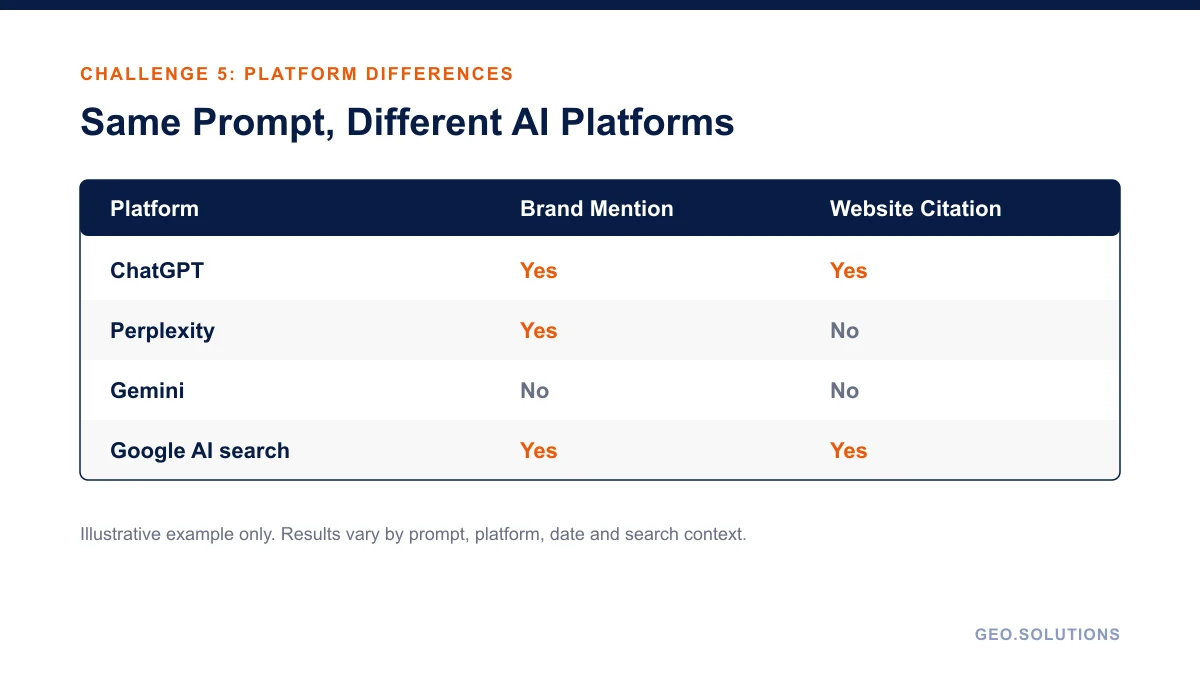
Illustrative example only. Actual results vary by prompt, platform, date and search context.
One platform’s result shouldn’t automatically be treated as a proxy for the entire AI-search ecosystem.
Solution: Measure the Platforms That Matter
Track the platforms relevant to your audience. For each platform, monitor where possible:
- Brand mention rate
- Citation rate
- Cited URLs
- Competitor visibility
- Accuracy
- Referral traffic
Then report both overall AI visibility and platform-specific visibility.
This allows you to identify where the biggest gaps exist without assuming that every AI platform behaves identically.
Challenge 6: Measuring GEO ROI and Attribution Is Difficult
This is often where internal scepticism begins. A stakeholder asks:
“How much revenue did GEO generate?”
The answer isn’t always straightforward. Traditional analytics already has attribution limitations. AI discovery adds another layer. A user may:
- Discover your company in an AI answer
- Not click
- Search for your brand later
- Visit through Google
- Return directly
- Become a customer
Analytics may attribute the eventual conversion to another channel. That doesn’t prove AI had no influence. It means the available attribution system may not observe every stage of the journey.
Solution: Measure GEO at Multiple Levels
Don’t rely on revenue alone. Use a measurement ladder.
Measuring AI Referral Traffic
AI referral traffic should be analysed as one part of the wider measurement system. Where analytics reporting identifies AI-assistant traffic, monitor:
- Sessions
- Users
- Engagement
- Landing pages
- Key events
- Leads
- Purchases
- Revenue
If your analytics platform provides source-level information, analyse individual AI platforms where useful. The important distinction is:
AI referral traffic measures identifiable visits from AI platforms; it does not capture every instance of AI influence.
A user may discover your brand in an AI answer without clicking and later return through another channel.
Challenge 7: Internal Buy-In for GEO Budget
This is less technical than the other challenges, but it can be one of the hardest to solve. Stakeholders already understand:
- Organic traffic
- Rankings
- Leads
- Revenue
- Conversion rates
GEO introduces less familiar metrics:
- AI citations
- AI share of voice
- Brand mentions
- AI referral traffic
A marketing team may understand the opportunity while a finance or executive stakeholder asks:
“What did we actually get for the investment?”
That’s a legitimate question.
Solution: Translate GEO Into Business Metrics
Don’t report only: “We gained 400 AI mentions.”
Instead show: “AI citation visibility increased from 14% to 21%, AI-assistant sessions increased 31%, and identifiable AI-referral leads increased from 12 to 19.”
Then explain what remains uncertain. For example: “AI-originated referral traffic produced 19 identifiable leads. Additional AI influence may exist in journeys later attributed to organic, direct or other channels.”
That’s a much more defensible business case than claiming every conversion was caused by an AI interaction.
Buy-in follows evidence, not enthusiasm.
For businesses that need ongoing implementation rather than a one-off audit, see GEO packages.
Does Generative Engine Optimization Work for All Types of Websites?
There is no universal answer. GEO can be relevant to many website types, including:
- SaaS companies
- B2B businesses
- Ecommerce
- Publishers
- Professional services
- Local businesses
- Educational organisations
- Software companies
- Specialised information websites
But the size and measurability of the opportunity varies. GEO tends to be more measurable when:
- Users research before making decisions
- The business has meaningful expertise
- The website contains useful information
- The brand has identifiable entities
- There is meaningful search demand
- Competitors are already appearing in AI answers
GEO may be harder to justify when:
- The website contains very little unique information
- The business has minimal online presence
- The offering is extremely new
- There is little relevant AI-search demand
- The site is technically inaccessible
- Users rarely research the category before taking action
So the correct answer to “Does generative engine optimization work for all types of websites?” is:
GEO principles can apply broadly, but the opportunity, implementation requirements and measurable business impact vary significantly by website and market.
A good strategy should establish that opportunity before significant investment.
What These GEO Challenges Have in Common
The seven challenges point towards one important conclusion:
GEO isn’t a single optimisation task.
It combines several interconnected systems:
- Content provides useful information
- Architecture organises that information
- Entities establish what the information is about
- Authority provides external validation
- Measurement identifies visibility and competitive gaps
- Analytics connects identifiable AI traffic with business outcomes
If one layer is weak, the entire programme can become harder to evaluate. This is why GEO should be approached as a system rather than a collection of isolated tactics.
How to Prioritise Your GEO Problems
You don’t need to solve all seven challenges simultaneously. Start with these questions.
1. Can We Measure Our Current AI Visibility?
If not, establish a baseline. A GEO audit can help establish the current visibility and competitive picture.
2. Are AI Systems Finding and Citing Our Content?
If not, investigate content, architecture, technical accessibility and authority.
3. Do AI Systems Understand Our Brand Correctly?
If not, investigate entity consistency and external entity signals.
4. Are Competitors Consistently Appearing Instead?
If yes, analyse their cited content, topical coverage, entity signals and authority.
5. Are AI Platforms Sending Qualified Visitors?
If yes, connect that traffic to business outcomes.
6. Can Leadership Understand the Value?
If not, improve the reporting model.
This prevents teams from applying every available GEO tactic without first identifying the actual constraint.
A Practical GEO Problem-Solving Framework
Use this sequence when diagnosing a GEO problem:
- Identify: What exactly is underperforming?
- Measure: How large is the gap?
- Diagnose: Is the problem related to content, architecture, entity recognition, authority, platform behaviour or measurement?
- Prioritise: Which issue has the greatest potential business impact?
- Implement: Apply the relevant optimisation.
- Re-measure: Compare results against the original baseline.
This turns GEO from trial-and-error into an iterative process.
What Not to Do When GEO Results Are Weak
When AI visibility falls, don’t immediately:
Publish Dozens of New Articles
The problem may be entity recognition, authority or content structure rather than content volume. If genuinely missing topics are identified, use research to determine what should be created before scaling content production. See GEO content creation.
Change Everything Simultaneously
If ten variables change at once, it becomes difficult to identify what affected the result.
Optimise for One AI Platform
A strategy that performs well on one platform may not produce the same result elsewhere.
Treat Every Fluctuation as an Algorithm Update
AI responses can naturally vary.
Use Mentions as Proof of Revenue
Visibility and revenue are related but not identical.
Assume Traditional Rankings Guarantee AI Citations
They don’t. Instead, identify the specific failure point first.
When Should You Consider Professional GEO Support?
You don’t necessarily need an agency for every GEO task. A small team may be able to handle:
- Basic content restructuring
- Prompt monitoring
- Simple reporting
- Initial entity consistency checks
More complex programmes may benefit from specialist support when they involve:
- Large content libraries
- Multiple markets
- Multiple AI platforms
- Competitive visibility monitoring
- Complex entity ecosystems
- Technical site changes
- Large-scale authority development
- Ongoing measurement and reporting
The right question isn’t “Can we outsource GEO?” It’s:
“Which parts of our GEO system can we execute internally, and where would specialist expertise reduce time, uncertainty or implementation risk?”
Final Takeaway: GEO Has Challenges, and That’s Why Strategy Matters
GEO isn’t a magic switch.
You can publish excellent content and still struggle to earn citations. You can rank well in Google and remain underrepresented in AI answers. You can increase brand mentions without generating measurable traffic. And you can generate AI referral traffic without being able to attribute every influenced conversion.
Those limitations don’t make GEO ineffective. They make measurement, sequencing and realistic expectations essential.
The strongest approach is to treat GEO as an ongoing system:
Audit → Build the right content architecture → Optimise existing content → Strengthen entity recognition → Build relevant authority → Measure visibility and business outcomes → Diagnose gaps → Improve
The objective isn’t to eliminate every uncertainty in AI search. It’s to build a system that can identify problems, prioritise them, test solutions and measure what changes.
Building these foundations early gives a business more time to develop consistent visibility, authority and measurement as the AI-search landscape evolves.
Need Help Identifying Your GEO Challenges?
If you don’t know which of these problems is affecting your website, start with a GEO audit. Use the baseline to identify your highest-priority:
- Visibility gaps
- Content gaps
- Entity gaps
- Authority gaps
- Measurement gaps
If the audit identifies research or topical architecture as the main constraint, explore GEO research packages. If external authority is the limiting factor, see GEO link building.
If you want help working out which of these seven challenges is holding your website back, our team can walk through it with you. Call +44 7478 036140 to talk to our team.
Frequently Asked Questions
What are the biggest challenges in implementing generative engine optimisation?
The most common challenges are tracking AI citations, getting cited despite strong traditional rankings, building entity recognition, adapting to changes in AI systems, managing platform differences, measuring ROI and securing ongoing internal support.
Does generative engine optimisation work for all types of websites?
GEO can apply to many website types, but the opportunity varies by industry, search demand, information quality, competition and the role AI plays in the customer’s research process. A GEO audit can help determine whether the opportunity is meaningful for a specific website.
Why does my website rank on Google but not appear in AI answers?
Traditional rankings and AI citations are different outcomes. AI systems can retrieve and synthesise information using signals beyond conventional search position. Review content clarity, topical coverage, entity signals, authority and actual AI visibility rather than assuming a high Google ranking guarantees a citation.
How long does it take to overcome GEO challenges?
There is no universal timeframe. Some measurement and content improvements can be implemented quickly, while entity recognition, authority development and sustained visibility changes can require ongoing work. Establish a baseline and compare consistent reporting periods rather than relying on a fixed timeline.
Does GEO work differently on ChatGPT, Gemini and Perplexity?
Yes. Different AI platforms can use different retrieval, source-selection, ranking and answer-generation systems. Measure the platforms that matter to your audience rather than treating visibility on one platform as representative of every AI search experience.
How can I identify the biggest GEO problem on my website?
Start with a structured GEO audit. Test representative prompts, record citations and competitors, review content and technical accessibility, evaluate entity consistency and compare visibility with your business priorities. The objective is to identify the highest-impact constraint rather than applying every GEO tactic at once.