Choose a GEO agency by asking how it measures AI visibility, what it delivers, how it diagnoses missing citations and what it refuses to promise. The answers separate real practitioners from repackaged SEO. GEO is new enough that almost anyone can claim it. Centerfield’s survey of 878 US marketers found only 33% rated their own understanding of GEO as good or expert, which makes buyers easy to oversell.
This guide gives you 10 questions to ask any GEO agency, consultant or freelancer. Each comes with what a strong answer sounds like and the red flag to watch for. A scorecard at the end helps you compare proposals side by side.
What a GEO Agency Should Do for You
A GEO agency should improve how often AI engines mention and cite your brand, and prove it with repeatable measurement. That covers four areas of work: diagnosis, on-page content, off-page mentions and tracking.
The Core Work
- Diagnosis: testing buyer prompts across AI engines and finding why competitors get cited instead of you.
- On-page content: answer-first rewrites, sourced facts and schema.
- Off-page mentions: placements on the listicles, review sites and forums that AI engines cite.
- Tracking: appearance rate, citations and AI referral traffic, reported on a fixed schedule.
Agency, Consultant or Freelancer
An agency runs all four areas with a team, and suits brands that need steady output. A GEO consultant or expert usually diagnoses the problem and directs your in-house team, which suits companies with writers and SEO staff already in place. A freelancer typically handles one area, such as content or placements, at lower cost. The 10 questions below apply to all three.
The 10 Questions to Ask a GEO Agency
Ask these questions on the first call, and ask for written answers where possible. Vague answers to questions 1 to 3 are usually enough to rule a provider out.
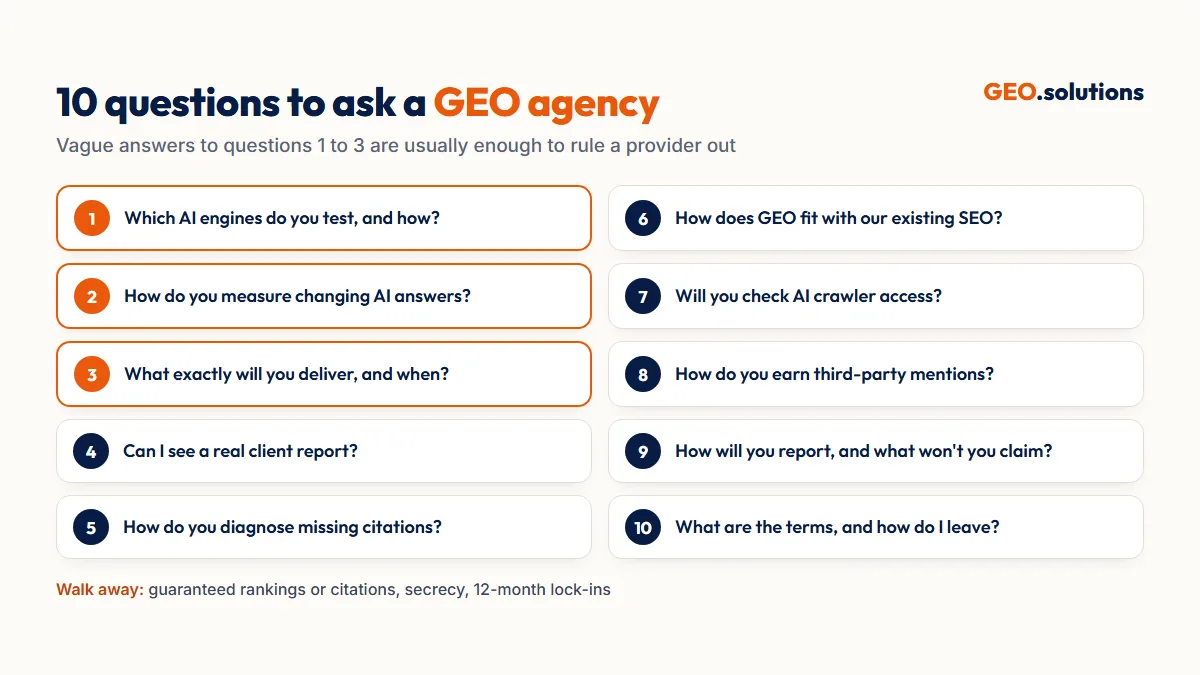
1. Which AI engines do you test, and under what conditions?
Good answer: They name at least five engines: ChatGPT, Perplexity, Gemini, Microsoft Copilot and Google AI Overviews. They test from logged-out sessions with memory off and a fixed location, and run each prompt more than once.
Red flag: They test only ChatGPT, or check from their own logged-in accounts. Each engine draws on different sources, and personalized sessions skew results. The full method is in How to Run a GEO Audit.
2. How do you measure visibility when AI answers change every run?
Good answer: They track appearance rate, meaning how often your brand shows up across repeated runs of a fixed prompt set, rather than position.
Red flag: They report your “rank in ChatGPT.” In a 2026 SparkToro and Gumshoe study of nearly 3,000 runs, the same brand list repeated less than 1% of the time. A single screenshot proves nothing.
3. What exactly will you deliver, and when?
Good answer: Specific counts and dates, such as “15 articles, 5 listicle placements and one citation report per month,” or “30 prompts across 5 engines, delivered in 5 days.”
Red flag: “Ongoing optimization” with no numbers. If they can’t count it, you can’t hold them to it.
4. Can I see a real report from a current client?
Good answer: A redacted citation or share-of-voice report with dates, prompts, engines and source data, such as figures from Bing Webmaster Tools’ AI Performance report.
Red flag: Only case-study slides with percentages and no dates, baselines or measurement source.
5. How do you work out why we aren’t being cited before changing anything?
Good answer: They diagnose each priority prompt separately, checking crawler access, the facts on the page, missing page types and third-party mentions. Then they match a fix to each cause.
Red flag: A standard rewrite package applied to every page. In C-SEO Bench, a research benchmark, only 3 of 54 combinations of generic optimization method and domain produced a significant gain. Common failure patterns are covered in GEO Challenges and Common Mistakes.
6. How does your GEO work fit with our existing SEO?
Good answer: GEO builds on SEO. Pages still need to be indexed, crawlable and strong in search, because AI engines retrieve from search indexes. Google states that pages need no special requirements to appear in AI Overviews beyond being indexed and eligible for a snippet.
Red flag: They tell you SEO is dead, or sell special “AI files” and markup as a shortcut. Google says no AI text files or special markup are needed for AI Overviews or AI Mode.
7. Will you check that AI crawlers can reach our site?
Good answer: Yes, as a first step. They check robots.txt for OAI-SearchBot, PerplexityBot, Googlebot and Bingbot, and review CDN and firewall rules. OpenAI states that sites blocking OAI-SearchBot will not be shown in ChatGPT search answers.
Red flag: They skip technical access and go straight to content. A blocked crawler cancels every other fix.
8. How do you earn third-party mentions, and can I see where they land?
Good answer: They name the placement types (category listicles, review platforms and community threads), show example placements and report every URL.
Red flag: Hidden networks, bulk link packages or “thousands of mentions.” Google’s own guidance on hiring an SEO warns against providers who talk about link popularity schemes. Placements AI engines can’t verify carry no weight.
9. How will you report results, and what won’t you claim?
Good answer: They report citations and appearance rate as visibility metrics, and report AI referral traffic and leads separately. They’re clear that a citation count alone doesn’t prove revenue.
Red flag: Guaranteed revenue or a guaranteed number of citations. A July 2026 critical survey of GEO research rated the link from citation scores to revenue as very low confidence.
10. What are the contract terms, and how do I leave?
Good answer: Clear monthly scope, no long lock-in, simple cancellation and read-only access to your accounts. Google advises granting an SEO read-only Search Console access during an audit, not full access. You keep all content and reports.
Red flag: A 12-month minimum term, cancellation fees, or asking for admin access to everything on day one.
Red Flags That End the Conversation
Walk away from any GEO provider that guarantees results, can’t explain its method or contacts you out of the blue with urgent claims.
Guaranteed Rankings or Citations
Google’s guidance on hiring an SEO says it directly: “No one can guarantee a #1 ranking on Google.” AI answers are even less predictable than rankings, so a guaranteed spot in ChatGPT or AI Overviews is a promise no one can keep.
Secrecy and Cold Outreach
Google also warns against providers who are “secretive or won’t clearly explain what they intend to do,” and against unsolicited emails from agencies. A real GEO method can be explained in plain language before you pay.
How to Compare GEO Agency Proposals
Score each proposal on the same criteria, then run a small paid test with your top choice before signing a retainer.
Use a Weighted Scorecard
Multiply each score by its weight and add them up. A provider that scores 1 on measurement method shouldn’t win on price alone.
Run a Paid Test First
Buy a fixed-price audit or a small project before committing to monthly fees. A test shows how the provider communicates, how clear its reports are and whether the diagnosis matches what you see yourself. When to move from a project to a retainer is covered in GEO Retainer vs One-Off Project. For a ranked shortlist of providers to put through these questions, see Best Generative Engine Optimization Agencies.
Conclusion
The right GEO agency measures appearance rate across repeated tests on five engines, and diagnoses each missing citation before changing anything. It delivers counted work on a schedule and keeps visibility metrics separate from revenue claims. It also refuses to guarantee rankings, and it lets you leave easily.
Ask all 10 questions, score the answers and test before you sign.
Ask Us the Same 10 Questions
GEO.solutions publishes its prices, deliverables and turnaround times so you can check every answer before a call. Start with a fixed-price GEO Audit to see our method on your own brand. The Starter tier costs $99 and the Pro tier $290, with no contract.
Frequently Asked Questions
How do I choose a generative engine optimization agency?
Ask how they measure AI visibility, what they deliver and when, how they diagnose missing citations and what they won’t promise. Score proposals on the same criteria, then run a small paid test before signing a retainer.
What questions should I ask a GEO agency?
Ask which AI engines they test and how, how they handle answers that change every run, and what they deliver. Ask to see a real client report, how they diagnose problems and how GEO fits with your SEO. Then ask about crawler checks, off-page placements, reporting and contract terms.
Should I hire a GEO agency or a GEO consultant?
Hire an agency if you need steady output across content, off-page work and tracking. Hire a GEO consultant or expert if you have an in-house team and need diagnosis and direction rather than execution.
Can a GEO agency guarantee AI citations?
No. AI answers change on nearly every run. A 2026 SparkToro study found the same brand list repeated less than 1% of the time. Treat any guaranteed citation or ranking as a red flag.
What does a GEO agency cost?
Costs vary by scope. Fixed-price audits can start under $100, and monthly retainers run from around $1,500 into the thousands. Compare deliverables per dollar, not headline price.
How do I know if my GEO agency is working?
Your appearance rate across a fixed prompt set should rise across engines, and AI referral traffic and leads should follow. Judge it over at least a three-month window.