Keyword research tells you what people type into search engines. AI prompt research helps you understand what potential customers ask AI assistants when researching problems, comparing solutions, or choosing a provider.
It is an important planning step in Generative Engine Optimization (GEO). By understanding buyer questions, businesses can create more relevant content, identify information gaps, and investigate their visibility across AI search platforms.
However, AI companies do not publish complete databases of user prompts. You cannot simply download every question people ask ChatGPT or Perplexity about your industry.
Instead, prompt research combines customer enquiries, Google Search Console data, public discussions, competitor research, and AI-assisted discovery.
This guide explains how to find buyer prompts, organize them into meaningful categories, prioritize opportunities, and use the findings to build a stronger GEO content strategy.
What Is AI Prompt Research?
AI prompt research is the process of identifying, collecting, and analyzing questions people may submit to AI assistants about a particular industry, product, service, or brand.
Unlike traditional keyword research, which often focuses on short search phrases, prompt research examines conversational questions containing additional context.
For example, a buyer researching GEO services might search Google for:
- GEO agency pricing
- White label GEO services
- GEO content optimization
The same buyer might ask an AI assistant:
- Which agency offers white label GEO services I can resell to my clients?
- What should I ask a GEO provider before signing a contract?
- Which GEO services are suitable for a B2B SaaS company?
These questions reveal additional requirements, business situations, and purchasing considerations.
The goal of AI prompt research is to discover the questions your potential customers are likely to ask AI assistants and use those insights to plan content and investigate brand visibility.
A structured prompt set supports three activities:
- Content planning: Identify questions your website should answer.
- AI visibility measurement: Test whether AI assistants mention, recommend, or cite your brand.
- Competitor research: Discover which competitors and sources appear in relevant AI answers.
AI Prompt Research vs. Traditional Keyword Research
Both approaches help businesses understand audience needs, but they focus on different types of information.
Prompt research does not replace keyword research. Combining both helps connect established search demand with the detailed questions buyers ask AI assistants.
For a broader comparison, read our guide to GEO vs. SEO.
Where to Find Prompts Buyers Ask AI: 7 Sources
No single source provides every question potential customers submit to AI assistants. Use multiple sources to build a more reliable research database.
1. Google Search Console
Google Search Console shows the queries that already bring visitors to your website.
Open the Performance report and examine the Queries tab. Look for longer questions containing words such as:
- What
- How
- Which
- Compare
- Alternatives
- Cost
- Versus
For example, a query such as “which agency offers white label GEO services?” can be expanded into:
“Which agency offers white label GEO services that marketing agencies can resell to their clients?”
Treat Google queries as evidence of audience interest, not verified ChatGPT prompts.
2. Google Autocomplete and People Also Ask
Enter your main keyword into Google and examine autocomplete suggestions and People Also Ask questions.
For example, searching for “GEO agency” may help identify related questions about pricing, services, comparisons, and implementation.
Record relevant questions and their collection dates because suggestions can change.
3. Reddit, Quora, and Industry Communities
Online communities reveal how customers describe their problems and evaluate solutions.
Look for discussions involving:
- Product recommendations.
- Service comparisons.
- Pricing concerns.
- Implementation challenges.
- Customer experiences.
Identify recurring questions across independent discussions rather than relying on a single conversation.
4. Customer Enquiries and Sales Conversations
Your own customer interactions can provide valuable research evidence.
Review sales calls, enquiry emails, support tickets, and customer feedback.
Identify what potential customers want to know before choosing a provider.
For example:
“Can you improve our visibility in ChatGPT without rebuilding our website?”
This can become a structured prompt:
“How can a business improve its ChatGPT visibility without rebuilding its existing website?”
Remove confidential customer information before using external AI tools.
5. Competitor Websites
Review competitor service pages, FAQs, comparison articles, and educational guides.
Identify which customer questions they answer and compare their coverage with your own website.
For GEO businesses, relevant subjects may include AI visibility tracking, GEO audits, entity optimization, prompt research, and AI citation monitoring.
The objective is to identify content gaps rather than reproduce competitor material.
6. AI Assistants
ChatGPT, Gemini, and Claude can help generate additional prompt ideas.
Use this instruction:
Prompt:
“Act as a B2B market researcher. Identify questions potential customers might ask ChatGPT, Perplexity, and Gemini before choosing a GEO agency. Group the questions into informational, commercial, comparison, and transactional intent. Include pricing, services, technical requirements, AI visibility tracking, and implementation. Avoid repetitive questions and do not invent search-volume figures. Label all generated prompts as hypotheses requiring validation.”
AI-generated suggestions are research hypotheses, not verified customer data. Validate them against other sources before including them in your final database.
7. AI Answers and Citations
Test relevant questions directly across ChatGPT, Perplexity, Gemini, and other AI search platforms.
Record:
- Brands mentioned.
- Businesses recommended.
- Websites cited.
- Competitors appearing in responses.
- Product and service attributes discussed.
AI responses vary by platform, location, date, and wording. A single test cannot establish stable visibility or actual prompt demand.
How to Build a GEO Prompt Research Framework
After collecting questions, organize them into a structured research system.
Follow these six steps.
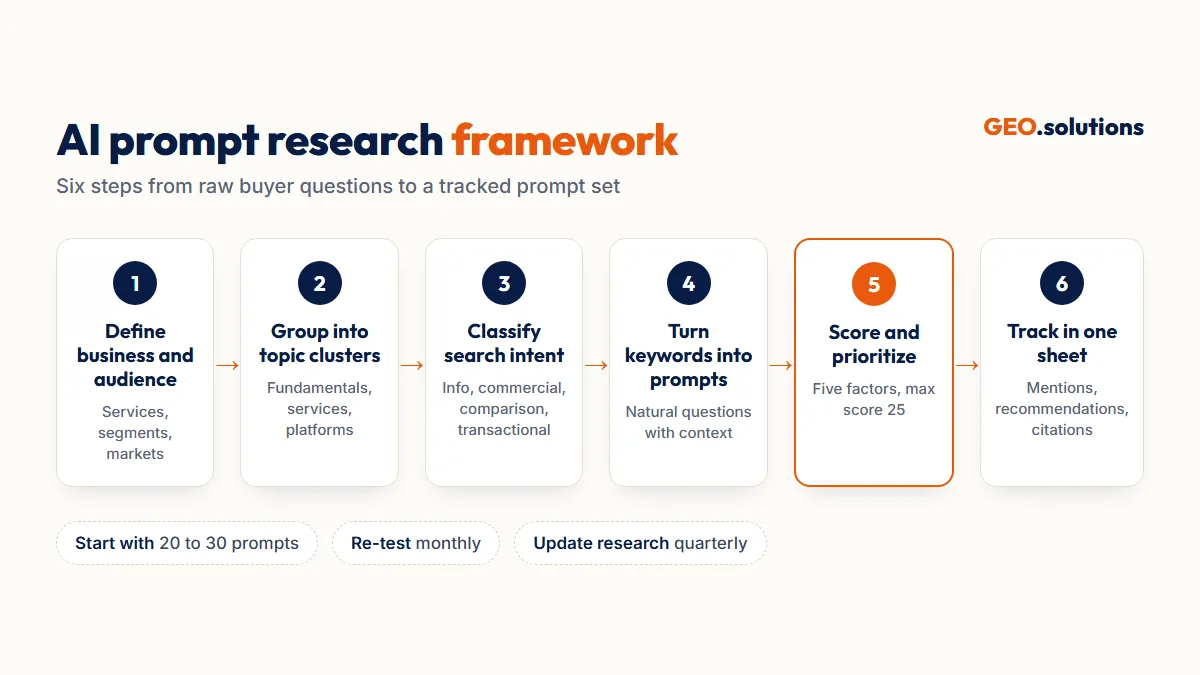
Step 1: Define Your Business and Target Audience
Document your services, customer segments, target industries, geographic markets, and customer problems.
For a GEO agency, potential audiences might include:
- Marketing agencies looking for white label GEO services.
- B2B SaaS companies.
- E-commerce businesses.
- Professional service providers.
- Business owners comparing GEO agencies.
Start with topics directly related to the services you provide.
Step 2: Organize Prompts Into Topic Clusters
Group related questions into meaningful categories.
This creates a structured foundation for topical mapping.
Step 3: Classify Search Intent
Assign each prompt an intent based on the user’s objective.
- Informational: What is generative engine optimization?
- Commercial: Which GEO services are suitable for B2B companies?
- Comparison: What is the difference between GEO and traditional SEO?
- Transactional: Where can I order a GEO audit?
Covering different intent categories helps your content address multiple stages of the customer journey.
Step 4: Convert Keywords Into Natural Prompts
Transform existing keywords into realistic questions while keeping the original keyword for SEO planning.
Include relevant context without making questions unnecessarily long.
Step 5: Prioritize Prompts
Not every question has the same business value.
Score each prompt from 1 to 5 across these five factors:
Add the scores to create a maximum priority score of 25.
This is an internal prioritization framework, not an industry-standard GEO metric.
A working set of 20–30 prompts is a practical starting point for manual testing.
Step 6: Create a Prompt Tracking Spreadsheet
Store your research in one central spreadsheet.
Recommended columns include:
This creates a reusable research asset for content planning and AI visibility analysis.
How to Test Your Prompt Set
After building your prompt library, test the selected questions across relevant AI platforms.
Follow a consistent process:
- Record a baseline: Note whether your brand appears, receives recommendations, or is cited.
- Use identical prompts: Test the same wording across selected platforms.
- Separate measurements: Track mentions, recommendations, and citations independently.
- Repeat important tests: AI responses can vary between runs.
- Maintain a stable set: Keep original prompts for historical comparisons.
- Review regularly: Re-test monthly and update the wider research database quarterly.
A spreadsheet is sufficient for an initial manual process. Paid tools can provide additional tracking and historical reporting capabilities.
For deeper measurement, explore our GEO audit services.
From Prompt Research to Topical Authority
Prompt research becomes more valuable when its findings are converted into a structured content strategy.
Group related prompts into topic clusters and assign them to suitable website pages.
For example:
Before creating new pages, check whether existing content already addresses the same intent.
Connect related pages through internal links and build comprehensive coverage around your main services.
This is where GEO and AEO Research Packages can support your content planning. Our packages provide structured topical maps with topic clusters, keywords, search intent, and publishing priorities.
Review the package page for current options, deliverables, and pricing.
Frequently Asked Questions
What is AI prompt research?
AI prompt research identifies questions and requests potential customers may submit to AI assistants. It organizes them by topic and intent to support content planning, competitive research, and AI visibility testing.
How do I find prompts buyers ask AI?
Use Google Search Console, customer enquiries, sales conversations, Reddit, People Also Ask, and competitor websites. AI assistants can generate additional ideas, but validate those suggestions against real evidence.
What is the difference between prompt research and keyword research?
Keyword research focuses on search phrases and estimated search demand. Prompt research examines conversational questions, buyer context, and how AI platforms mention, recommend, or cite businesses.
Is there search volume for AI prompts?
There is no universal public database of verified prompt counts across major AI platforms. Some tools provide estimated demand, which should be evaluated according to their methodology and data sources.
How many prompts should I track?
There is no standard number. A focused set of 20–30 relevant prompts is a practical starting point for manual testing. Expand it as new research opportunities emerge.
What is GEO keyword research?
GEO keyword research identifies relevant keywords, entities, questions, and search intents that support visibility in generative search. It combines traditional keyword research with conversational prompt discovery.
Turn Buyer Questions Into a Stronger GEO Strategy
AI prompt research helps businesses understand what potential customers want to know when researching products, comparing services, and evaluating providers through AI assistants.
By combining customer evidence, Search Console data, competitor research, and AI-assisted discovery, you can develop a more useful understanding of buyer intent.
The next step is to organize those questions into topic clusters, prioritize the most relevant opportunities, and create content that answers them clearly.
Start with the questions your customers ask. Build content around the answers they need. Then use research-backed topical mapping to strengthen your long-term AI search visibility.
Explore our GEO Research Packages to turn your research into a structured content strategy.