Start by moving 10% to 20% of your SEO budget to generative engine optimization, then scale based on measured results. That range matches what companies already spend. Conductor’s 2026 investment report found enterprises put an average of 12% of digital marketing budgets into AEO and GEO in 2025, and 94% plan to increase that in 2026.
This guide covers what companies spend on GEO, how to split your search budget by stage and how to reallocate a real $5,000 monthly budget. It also covers how to measure GEO ROI when most AI engines report no data.
How Much Are Companies Spending on GEO?
Most companies that invest in GEO spend roughly 10% to 20% of their marketing or search budget on it, but many still spend nothing. Three 2026 surveys show the range.
What the Numbers Agree On
All three surveys land within a narrow band of 9% to 20%. No survey shows companies moving most of their search budget to GEO. GEO is being added alongside SEO, not replacing it.
The Gap Between Leaders and Laggards
The averages hide a split. Conductor found that high-maturity organizations are 2 times more likely than medium-maturity ones to significantly increase GEO investment, and 3 times more likely than low-maturity ones. Centerfield found 63% of marketers invest no time, budget or staff in GEO at all. Companies that start now are competing against a minority, not the whole market.
How Much of Your SEO Budget to Move to GEO
Move 10% of your SEO budget in a test phase, raise it to 20% to 30% once results are measured, and settle on the share your data supports. The split below is our recommendation, sized to the survey range above.
Signals to Move More Budget
- Your appearance rate across a fixed prompt set rises in two or more AI engines.
- AI referral sessions in GA4 grow and convert to leads or sales.
- Competitors appear in AI answers for your highest-value prompts and you don’t, which shows demand you aren’t capturing.
Signals to Hold or Pull Back
- Citations rise but AI referral traffic and leads stay flat after a full measurement window.
- Your buyers rarely use AI assistants. Check with a short customer survey or a “how did you hear about us” field before scaling.
- Basic SEO problems, such as indexing or site speed, are still unresolved. Those come first, because AI engines retrieve from search indexes.
How to Adjust Your SEO Budget for AI Search
Keep funding the SEO work that AI engines depend on, and fund GEO-specific work from the reallocated share. Much of the overlap is already paid for.
What to Keep Funding in SEO
- Technical SEO: Crawling, indexing and rendering. Google states that pages only need to be indexed and eligible for a snippet to appear in AI Overviews.
- Core content: Service, product and category pages.
- Link building: Domain authority still affects which pages search engines rank and AI engines retrieve.
The full comparison of where the two disciplines overlap is in GEO vs SEO.
What to Fund From the GEO Share
- Prompt and citation tracking: Testing buyer prompts across ChatGPT, Perplexity, Gemini, Copilot and AI Overviews.
- Answer-first rewrites: Rewriting existing pages so each section leads with a quotable, sourced answer.
- Off-page entity building: Listicle placements, review platforms and community mentions that AI engines check before recommending a brand.
- Comparison and pricing content: The page types buyers ask AI assistants about most directly.
Worked Example: Reallocating a $5,000 Monthly SEO Budget
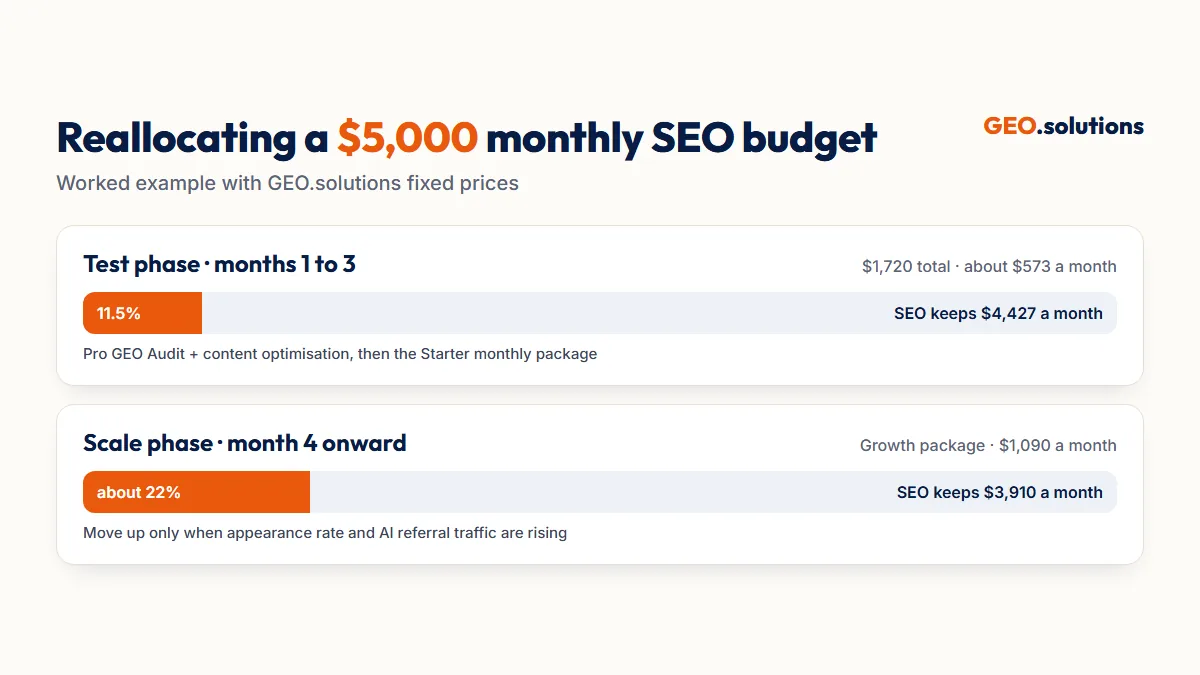
A company spending $5,000 a month on SEO can run a full GEO test for about 11% of that budget, then scale to about 22%. The figures below use GEO.solutions‘ fixed prices. For what other providers charge, see our GEO agency pricing guide.
Test Phase: Months 1 to 3
The total is $1,720 over three months, which averages about $573 a month, or 11.5% of the budget. The remaining $4,427 a month stays in SEO.
Scale Phase: Month 4 Onward
If the test window shows rising appearance rates and AI referral traffic, move to the Growth package at $1,090 a month. That’s about 22% of the budget. It adds 6 articles, 5 listicle placements, 5 forum mentions and a citation audit each month. SEO keeps $3,910 a month.
How to Measure GEO ROI
GEO ROI equals AI-attributed revenue minus GEO cost, divided by GEO cost. The hard part isn’t the formula, it’s attribution. In the Centerfield survey, only a third of marketers were highly confident they could tell whether traffic came from AI search or traditional search.
The ROI Formula
GEO ROI = (AI-attributed revenue − GEO cost) ÷ GEO cost
For example, if AI referral traffic produces $6,000 in attributed revenue over a quarter with $1,720 in GEO spend, ROI is ($6,000 − $1,720) ÷ $1,720 = 2.49, or 249%. Use the same window for revenue and spend, and include only revenue you can actually attribute.
Attribution Methods That Close the Gap
- GA4 AI referral segment: Group sessions from chatgpt.com, perplexity.ai, gemini.google.com and copilot.microsoft.com into one channel. Track their conversions separately.
- Self-reported attribution: Add “ChatGPT or another AI assistant” as an option on lead forms and checkout surveys. Many AI-influenced buyers arrive later through branded search or direct visits, and GA4 won’t credit those to AI.
- Leading indicators: Track appearance rate across your prompt set and Bing AI Performance citations as early signals. Report them as visibility, not revenue. The method is in How to Run a GEO Audit.
What the Conversion Data Says About GEO ROI
The conversion evidence is mixed: recent data shows AI traffic converting better, while earlier and broader studies show it converting worse. Budget for GEO as a growing channel, not a guaranteed return.
Studies Showing AI Traffic Converts Better
- Adobe Analytics (Q1 2026, US retail): In March 2026, AI traffic converted 42% better than non-AI traffic, and revenue per visit was 37% higher. In March 2025, AI traffic had converted 38% worse. Q1 AI traffic rose 393% year over year.
- Visibility Labs (2025, 94 ecommerce sites): ChatGPT traffic converted at 1.81%, against 1.39% for non-branded organic search.
Studies Showing It Doesn’t
- INFORMS Marketing Science study (August 2024 to July 2025, 973 ecommerce sites): ChatGPT traffic was about 0.2% of sessions and converted below Google organic search.
- The 2026 critical survey of GEO research: It rated the link from citation scores to clicks or revenue as very low confidence. Other GEO challenges are covered in GEO Challenges and Common Mistakes.
The trend favors AI traffic, and it’s moving fast. But AI referrals are still a small share of total traffic for most sites, so judge ROI on your own data, not industry averages.
Conclusion
Companies that invest in GEO spend roughly 9% to 20% of their marketing or search budget on it. Start at about 10% of your SEO budget, measure for a full three-month window and scale toward 20% to 30% only when appearance rates and AI referral revenue rise together.
Keep the SEO foundation funded, because AI engines retrieve from search indexes. Measure ROI with the formula above, and use self-reported attribution to catch the AI-influenced buyers your analytics miss.
Plan Your GEO Budget With Fixed Prices
GEO.solutions publishes every price, so you can set a GEO budget without a sales call. The GEO packages run from $590 to $3,490 a month, with one-time audits from $99. There are no contracts, and you can upgrade or cancel from your dashboard.
Frequently Asked Questions
How much should I budget for generative engine optimization?
Start with about 10% of your SEO budget for a three-month test, then scale to 20% to 30% if results hold. Conductor found enterprises spent an average of 12% of digital marketing budgets on AEO/GEO in 2025.
How do I adjust my SEO budget for AI search?
Keep funding technical SEO, core pages and link building, because AI engines retrieve from search indexes. Move a share into prompt tracking, answer-first rewrites, off-page mentions and comparison content.
Should I replace SEO with GEO?
No. GEO depends on SEO. Google states that pages only need to be indexed and eligible for a snippet to appear in AI Overviews, so indexing and rankings still feed AI visibility. Add GEO alongside SEO.
How do you measure the ROI of generative engine optimization?
Divide AI-attributed revenue minus GEO cost by GEO cost. Attribute revenue through a GA4 AI referral segment and self-reported “how did you hear about us” answers, and track citations as a leading indicator.
Does AI search traffic convert better than organic search?
Recent data says yes. Adobe found AI traffic to US retailers converted 42% better than non-AI traffic in March 2026. Earlier studies found the opposite, so test it on your own site.
What is a good GEO ROI?
There’s no published benchmark for GEO ROI yet. Compare it against your SEO and paid search ROI over the same period, and keep scaling while GEO returns match or beat those channels.
Sources
- Business Wire: Conductor 2026 AEO/GEO CMO Investment Report
- Digiday: Marketers shift growing shares of search spending to GEO
- Search Engine Land: Marketers aren’t ready for GEO (Centerfield survey)
- TechCrunch: AI traffic to US retailers rose 393% in Q1 (Adobe)
- Relevant Audience: Why ChatGPT traffic converts worse than Google search
- Google Search Central: AI features and your website