AI engines skip most brands for one of four reasons: they can’t reach the pages, the pages give them nothing specific to quote, other sites don’t vouch for the brand, or the brand is measuring the wrong thing. Generative engine optimization fixes all four. But GEO is harder to run than SEO, because AI answers change from one run to the next, and no major engine except Bing reports citations directly.
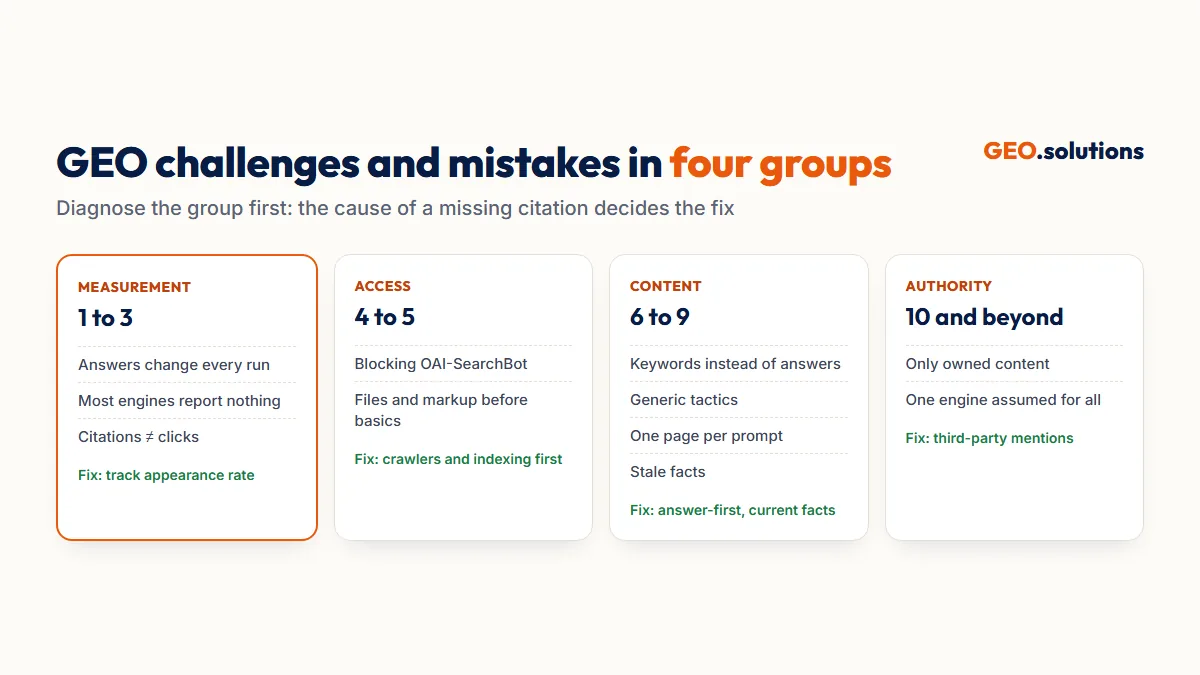
This guide covers 10 GEO challenges and mistakes, grouped into measurement, access, content and authority, with a fix for each. It starts with the question most buyers ask first: does GEO actually work?
Does Generative Engine Optimization Work?
Yes for getting cited, with weaker evidence so far for clicks and revenue. A July 2026 critical survey of 45 GEO studies, posted on arXiv, rated the evidence at three levels:
- High confidence: content changes can affect whether a page that has already been retrieved gets cited.
- Low confidence: any single white-hat technique reliably improves discoverability across every engine.
- Very low confidence: citation counts reliably predict clicks or revenue.
What the Evidence Supports
The Princeton-led GEO study found that adding statistics, quotations and cited sources raised a page’s visibility in generated answers by up to 40%, in a controlled test. Bing’s AI Performance report also shows real citation volume. Across four GEO.solutions campaigns, it recorded more than 433,000 Microsoft Copilot citations in one three-month window. Citations happen, and page changes influence them.
What It Doesn’t Prove Yet
The “up to 40%” figure comes from a test in which pages were already selected as sources. It doesn’t measure whether a page gets retrieved in the first place, or whether citations bring traffic. The link from citations to revenue is still being studied. Treat GEO as a visibility channel you can measure, not as a guaranteed revenue lever, and track clicks and leads alongside citations.
Measurement Challenges
The hardest part of GEO is measuring it, because AI answers are not stable the way search rankings are. Three challenges follow from that.
Challenge 1: AI Answers Change Every Time You Ask
In a 2026 SparkToro and Gumshoe study, 600 volunteers ran 12 prompts nearly 3,000 times across ChatGPT, Claude and Google’s AI. The same list of brands came back twice less than 1% of the time, and in the same order about 1 time in 1,000. Ranking position in AI answers is close to meaningless.
Fix: Track how often you appear, not where. The same study found visibility percentage to be the stable signal, with some brands appearing in 60% to 90% of answers for a given intent. Run each prompt several times and record your appearance rate. The full method is in How to Run a GEO Audit.
Challenge 2: Most Engines Report Nothing
Google Search Console has no separate AI Overviews report. Google counts that traffic within the standard “Web” search type. ChatGPT, Perplexity and Gemini offer no citation dashboard at all. Bing’s AI Performance report is the only first-party citation count from a major engine.
Fix: Combine three data sources: Bing AI Performance citations, AI referral traffic segmented in GA4, and a fixed prompt set you test each month. Each source covers a gap the others leave.
Challenge 3: Citations Don’t Map Cleanly to Clicks
A citation is a source link, not a visit. Many users read the AI answer and never click. The 2026 survey rated the link from citation scores to clicks or revenue as very low confidence.
Fix: Report citations as a visibility metric. Report leads and revenue separately, using AI referral sessions and “how did you hear about us” answers on forms. Don’t promise revenue from a citation count alone.
Access and Eligibility Mistakes
An AI engine can’t cite a page it can’t crawl, index or read. These mistakes cancel every other GEO effort.
Mistake 4: Blocking the Crawler That Powers AI Search
Many sites blocked AI bots wholesale to stop model training, and in doing so removed themselves from AI search. OpenAI states that sites blocking OAI-SearchBot will not be shown in ChatGPT search answers. GPTBot, which collects training data, is a separate crawler.
Fix: Allow OAI-SearchBot, PerplexityBot, Googlebot and Bingbot in robots.txt. To opt out of training, block GPTBot specifically. Re-check after any CDN or firewall change, because bot protection rules often block AI crawlers without anyone noticing.
Mistake 5: Chasing Files and Markup Before Fixing the Basics
Teams add llms.txt files and special schema while key pages still aren’t indexed. Google states that no AI text files or special markup are needed to appear in AI Overviews or AI Mode. A page only needs to be indexed and eligible to show a snippet.
Fix: Confirm indexing, canonical tags, internal links and server-rendered text first. Add structured data after that, and make sure it matches the visible content.
Content Mistakes
Most content fails in AI search because it gives engines nothing specific to quote. These mistakes come from carrying SEO habits into GEO.
Mistake 6: Writing for Keywords Instead of Answers
Keyword stuffing scored below the unedited baseline in the Princeton GEO study, and about 10% worse on Perplexity. Pages that repeat a phrase but never state a fact give AI engines nothing to cite.
Fix: Open each section with a direct answer that names the entity, the deciding attribute and a number. Add sourced statistics and named examples. Before and after versions are in Generative Engine Optimization Examples.
Mistake 7: Applying Generic Tactics Without Diagnosing the Failure
Generic “GEO rewrites” often miss the real cause of a missing citation. In C-SEO Bench, a benchmark covered in the 2026 survey, only 3 of 54 combinations of method and domain produced a statistically significant gain. In another benchmark, SAGEO Arena, optimizing body text alone reduced final citation by 6%.
Fix: Find out why a specific prompt goes to a competitor before changing anything. The cause may be crawler access, missing facts, a missing comparison page or missing third-party mentions. Each needs a different fix.
Mistake 8: Creating One Page per Prompt
Some teams publish a thin page for every prompt variation. AI engines group similar prompts by intent: SparkToro found that varied prompts with the same intent returned similar brand sets. Twenty near-duplicate pages split the signals one strong page would carry.
Fix: Build one page per intent, and cover the related subtopics as sections on that page. Create a separate page only when the answer is truly different, such as a pricing page compared with a how-to guide.
Mistake 9: Letting Facts Go Stale
Outdated prices, old statistics and discontinued features cost citations. Ahrefs’ analysis of 17 million citations found AI-cited content was 25.7% fresher than Google’s organic results. Changing the date without changing the content doesn’t count as an update.
Fix: Refresh the pages that already earn citations, starting with pricing, comparison and data pages every quarter. The cadence by page type is in Refreshing Content for AI Citations.
Authority and Coverage Challenges
AI engines check what other sites say about a brand, and each engine checks different sources.
Challenge 10: Relying Only on Owned Content
Your own site is a small share of what AI engines cite. In Seer Interactive’s 2026 citation study, most cited comparison, review and marketplace pages were third-party sites, and the author estimated owned content at about 2% of citations. A brand only its own website talks about is easy to skip.
Fix: Earn mentions where AI engines look. That means “best [category]” listicles, review platforms, and Reddit and forum threads in your category. This off-page work is the core of GEO entity building.
Optimizing for One Engine and Assuming the Rest
A result in ChatGPT doesn’t carry over to Copilot or AI Overviews. Copilot draws on Bing’s index, and AI Overviews draw on Google’s. Volatility differs too. A study cited in the 2026 survey found only 18% of pages stayed the same in AI Overviews across two months, against 45% in Google’s organic results.
Fix: Test every priority prompt in ChatGPT, Perplexity, Gemini, Copilot and AI Overviews. Score each engine separately so a gap in one isn’t hidden by a strong result in another.
How to Tell If GEO Is Working
GEO is working when your appearance rate rises across a fixed prompt set, and AI referral traffic follows. Judge it over months, not days.
Signals to Track
- Appearance rate per engine, across the same prompts, test conditions and repeat runs
- Bing AI Performance citations and the number of cited pages
- AI referral sessions and leads in GA4
- The number of third-party listicles and threads that mention your brand
A Realistic Timeframe
On-page fixes can show up in citation data within weeks of a recrawl. Off-page mentions take longer, because third-party pages have to be published and then crawled. Measure for at least one full three-month window before judging results. Keep a set of untouched pages as a comparison, so seasonal swings aren’t mistaken for GEO results.
Conclusion
GEO works for winning citations. Most failures come from fixable mistakes: blocked crawlers, keyword-era content, stale facts, no third-party proof and the wrong metrics. AI answers vary run to run, so measure appearance rate across repeated tests, not rank. Then track clicks and leads separately, because a citation count alone doesn’t prove revenue.
Diagnose before you rewrite. The cause of a missing citation decides the fix.
Find Out Why AI Engines Skip Your Brand
GEO.solutions diagnoses the exact failure behind each missing citation. The GEO Audit tests your buyer prompts across AI engines, separates access, content and authority gaps and lists the fixes in priority order. The Starter audit costs $99 and delivers in 3 days.
Frequently Asked Questions
Does generative engine optimization work?
Yes for getting cited. Research shows content changes can affect whether AI engines cite a page. The evidence that citations lead to clicks and revenue is weaker so far, so track leads alongside citations.
What are the biggest challenges in implementing GEO?
The biggest challenges are measurement and diagnosis. AI answers change on every run, most engines report no citation data, and generic tactics often miss the real cause of a missing citation.
Why does ChatGPT recommend different brands each time?
AI engines generate each answer fresh, so lists vary. In a 2026 SparkToro study, the same brand list repeated less than 1% of the time. How often you appear across many runs is the stable measure.
What is the most common GEO mistake?
Blocking AI crawlers is the most damaging mistake, because it cancels every other effort. Sites that block OAI-SearchBot don’t appear in ChatGPT search answers. Writing for keywords instead of answers is the most common content mistake.
How long does GEO take to show results?
On-page fixes can appear in citation data within weeks of a recrawl. Off-page mentions take longer. Measure across at least one three-month window before judging results.
Is GEO just SEO with a new name?
No, but the two overlap. GEO relies on SEO basics like crawling and indexing, then adds answer-first content, third-party mentions and citation tracking across AI engines.
Sources
- A Critical Survey of Generative Engine Optimization (Martinez, July 2026)
- Search Engine Land: AI recommendation lists rarely repeat (SparkToro/Gumshoe)
- GEO: Generative Engine Optimization (Aggarwal et al.)
- Ahrefs: AI Assistants Prefer to Cite Fresher Content
- Seer Interactive: Content Recency’s Impact on AI Visibility in 2026
- Percepture: GEO Challenges (SERP competitor)
- Google Search Central: AI features and your website
- OpenAI: Overview of OpenAI Crawlers