How to Rank in ChatGPT for Local SEO

Local SEO Guide

How to Rank a Local Business in ChatGPT Search

Published: June 2026 · Reading Time: 11 mins · Author: Muhammad Ehsan Khan
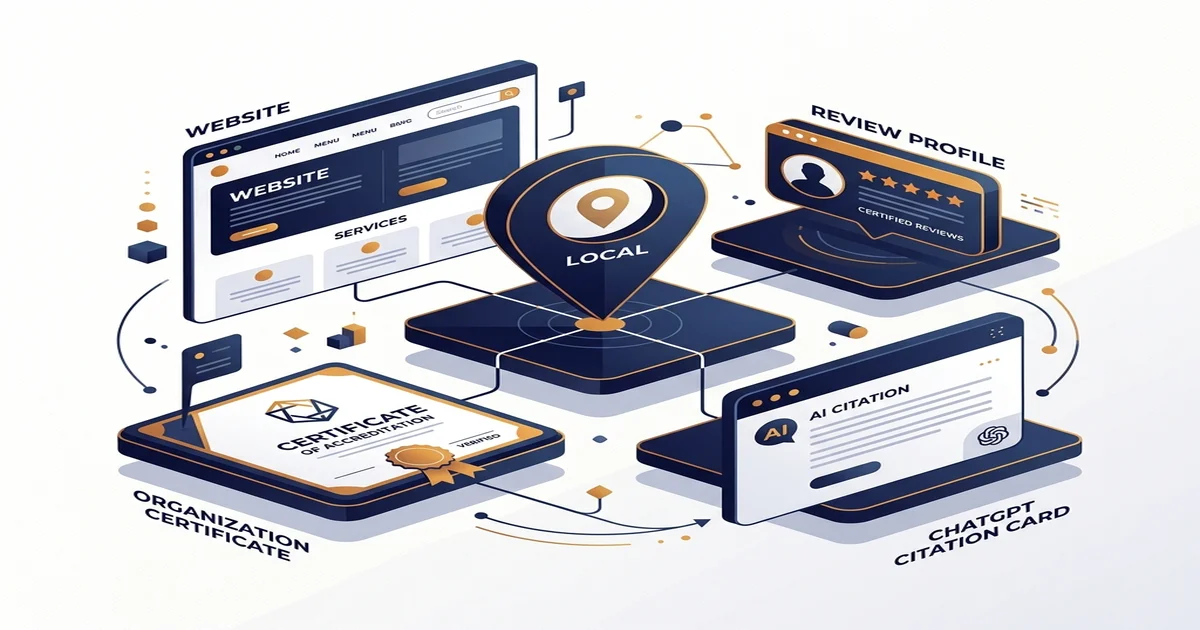
Local SEO signals that help a business appear in ChatGPT Search recommendations

Editorial Boundary

OpenAI does not publish fixed ranking weights, a citation-selection formula, or a private recommendation score. This guide separates official documentation, an observed local-provider retrieval test, and practical actions that improve crawl access, discovery, relevance, verification, and conversion.

A local business improves its chance of appearing in ChatGPT Search when its website is crawlable, discoverable through search, directly relevant to the user’s service and location, tied to a clear real-world business entity, and supported by verifiable reviews, credentials, profiles, and local proof. No public checklist can guarantee a recommendation, because OpenAI does not publish fixed ranking weights or a guaranteed placement system. The practical goal is to become easy to find, easy to verify, easy to cite, and safe to recommend.

This guide uses three evidence labels:

  • Documented behavior: confirmed in official OpenAI, Google, or Bing documentation.
  • Observed behavior: recorded during a live local-provider search and verification test.
  • Practical inference: an action that logically improves discovery, clarity, verification, or conversion, without being presented as a private ChatGPT ranking factor.

The core principle: Keyword relevance can put a business into the candidate pool. Independent verification can raise recommendation confidence. Clear factual pages make the business easier to cite.

1. What “Ranking in ChatGPT” Means for a Local Business

ChatGPT Search does not present one permanent local ranking list. The result can change with the wording of the prompt, the user’s location, the search queries generated from the prompt, current search results, and the sources available at that moment. A local business should measure four separate outcomes rather than treating visibility as one position.

Visibility level What it means What to measure
Discovery ChatGPT or a search provider finds the website, listing, or profile. Impressions, indexed pages, candidate appearance, crawler access
Citation A page is linked as evidence for a statement in the answer. Cited URL, supported claim, referral traffic
Recommendation The business is selected as a suitable provider for the user’s request. Appearance in provider lists, order, stated reason for selection
Conversion The user has enough confidence to call, book, request a quote, or visit. Calls, forms, bookings, qualified leads, revenue

These outcomes are connected but not identical. A website may be discovered without being cited. A page may be cited for a price, service, or opening-hour fact without the business being recommended. A business may also be recommended through a well-maintained profile or directory while its own website receives no citation. This is a core reason why brands perform a local GEO audit to identify visibility bottlenecks.

2. What OpenAI Publicly Documents About ChatGPT Search

OpenAI states that ChatGPT Search can rewrite a user’s prompt into one or more targeted queries. After reviewing the initial results, it may send additional, more specific queries to search providers. OpenAI also states that general location derived from an IP address may be used to improve local results, and precise device location may be used when a user enables it. [1]

A prompt such as “Who provides mold removal in Kansas City?” can therefore lead to searches around related service, location, urgency, trust, and property-type needs, such as:

  • mold-remediation companies in Kansas City
  • mold removal Kansas City, Missouri
  • emergency mold-remediation service Kansas City
  • residential mold removal near Kansas City
  • certified mold-remediation contractors Kansas City
  • Kansas City mold-removal reviews

The lesson is direct: a site should not rely on one exact keyword. It needs pages and profiles that answer the related questions ChatGPT may search while trying to satisfy the original request. Similar query-expansion mechanisms are detailed in our foundational guide on What is Generative Engine Optimization (GEO).

3. The Local-Provider Retrieval Pattern Observed in Testing

In a mold-removal test, the broad request returned a mixed pool rather than a clean list of providers. The pool included remediation companies, inspection-only firms, directories, government guidance pages, news pages, social profiles, and restoration companies. The search then became more specific, and individual businesses were checked through their websites, public profiles, review sources, and service pages.
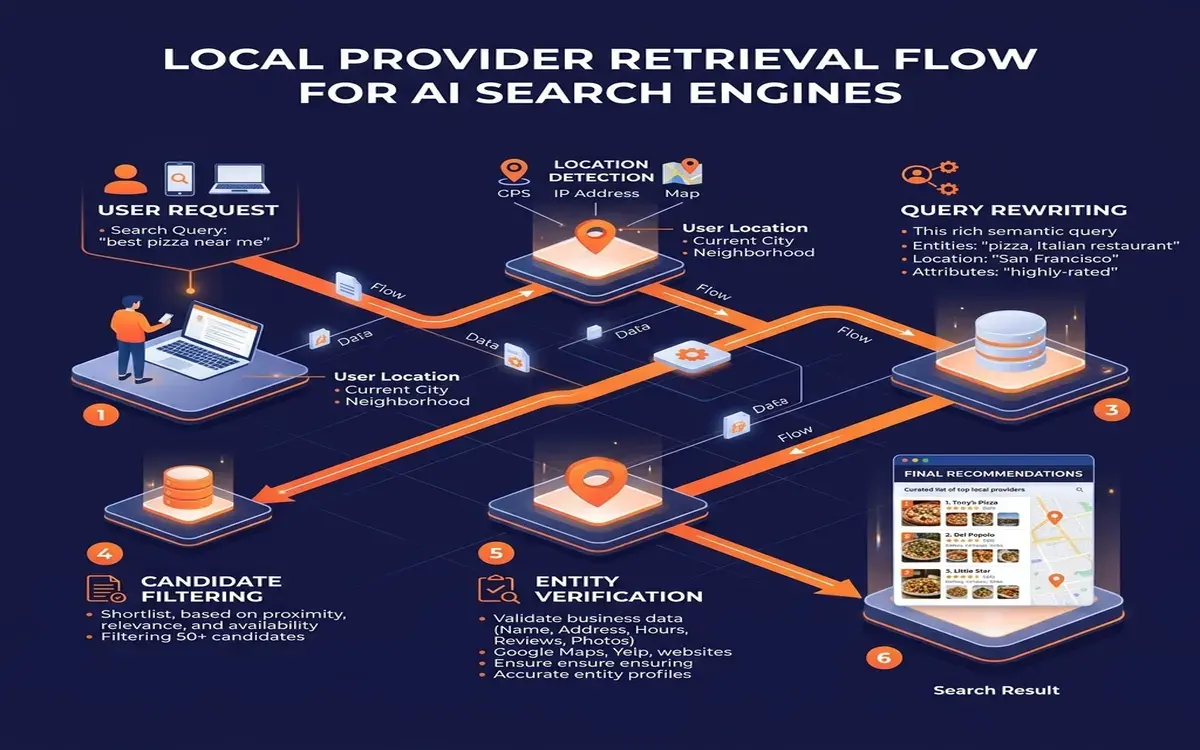
Observed retrieval flow of local providers inside ChatGPT Search
The observed local-provider retrieval and validation flow inside ChatGPT Search

This flow is an observed working model, not a published OpenAI algorithm. It is useful because it shows where a local business can fail: the business may never enter the candidate pool, may not match the exact need, may be hard to connect to a real entity, or may contain claims that cannot be confirmed.

4. Why a Highly Relevant Local Website Can Still Be Missed

Our retrieval test showed that an exact-match domain can be highly relevant but absent from the initial results. The site was reviewed only after its URL was supplied directly. That does not prove the site was penalized. It shows that relevance alone does not guarantee discovery or recommendation.

A relevant site may be missed when:

  • it does not surface for the rewritten search queries;
  • its important pages are not indexed or have a limited search footprint;
  • OAI-SearchBot or another search crawler is blocked;
  • business names, phone numbers, addresses, or URLs conflict across profiles;
  • the site lacks links connecting it to licensing, reviews, trade bodies, or a registered entity;
  • the initial result pool is limited and established competitors occupy it.

An exact-match domain can make the subject clear, but the domain name does not prove that the company is established, licensed, insured, reviewed, local, available, or suitable for the user. To compare how these criteria differ from traditional SEO requirements, check our comparative guide on Generative Engine Optimization vs SEO.

5. The Seven-Stage Local ChatGPT Visibility Model

Stage Requirement Failure example
1. Crawl eligibility The page is public and accessible to relevant crawlers. robots.txt, firewall, CAPTCHA, or noindex blocks access
2. Search discovery The page or profile appears in search systems used during retrieval. important URL is not indexed or lacks query coverage
3. Query relevance The page matches service, location, property type, urgency, and need. generic page does not state exact service or area
4. Entity resolution The website connects to one stable real-world business. conflicting names, numbers, addresses, or legal details
5. Independent verification Outside sources support reviews, credentials, identity, and service claims. badges and ratings have no public source
6. Recommendation suitability The business fits the user’s requirements. provider does not serve the area or property type
7. Citation suitability A page directly supports a factual statement in the answer. marketing language does not prove the stated fact

A strong local SEO program should audit every stage. Improving only content will not fix a crawler block. Adding reviews will not repair conflicting phone numbers. Addressing each of these requirements matches the standard checklist in our Generative Engine Optimization Best Practices.

6. Technical Foundation: Crawl Access and Indexing

6.1 Allow OAI-SearchBot

OpenAI identifies OAI-SearchBot as the crawler used to surface websites in ChatGPT Search. Sites that opt out will not be shown in ChatGPT Search answers, although a navigational link may still appear in some cases. OpenAI recommends allowing the crawler in robots.txt and allowing requests from its published IP ranges. [2]

User-agent: OAI-SearchBot
Allow: /

OAI-SearchBot and GPTBot have different purposes. OAI-SearchBot controls search visibility. GPTBot relates to content that may be used to improve OpenAI’s generative models. OpenAI states that these controls are independent. A site can allow search access while blocking GPTBot. [2]

6.2 Check the CDN, Firewall, and Bot Protection

A correct robots.txt file does not help when the hosting layer blocks the crawler. Review Cloudflare, hosting security, rate limits, and managed firewall rules. Test for 403 Forbidden responses, rate limits, and blocked OpenAI IP ranges. OpenAI publishes OAI-SearchBot’s user-agent string and IP range file dynamically. [2]

6.5 Maintain Google and Bing Discovery

OpenAI states that ChatGPT Search may send rewritten queries to search providers, including Bing. Good Bing and Google discoverability is therefore a sensible part of a ChatGPT Search strategy. [1] Utilize XML sitemaps, IndexNow, and search console submissions to speed notification. [5][6]

7. Business Entity, NAP, and Profile Consistency

A local business needs one stable identity that can be matched across the website and external sources. The system should not have to guess whether two names or numbers refer to the same company.

7.1 Use One Canonical Business Record

Use the same accurate information across the site and public profiles: public business name, address, verified telephone number, city, state, postal code, and license details. A different phone number on the footer, FAQ, schema, and Google profile creates a preventable verification problem. We handle this alignment as part of our GEO Entity Building services.

7.2 Complete the Google Business Profile

Google says local results are mainly based on relevance, distance, and prominence. Accurate profile data, categories, hours, services, reviews, and links support Google local visibility, which can also help a business become easier to discover and verify during wider search retrieval. [4] Our team handles complete Google Business Profile optimization under our GEO Entity Building service.

8. Service and Location Page Architecture

8.1 Build One Strong Primary Service-and-Location Page

A primary local service page should state the company, service, location, property types, availability, service boundaries, and contact method in the opening section. A direct opening is easier to interpret than a generic statement such as “We protect what matters most.” Brand language can follow after the service, location, and operating facts are clear.

8.2 Answer Customer Decision Questions

Customers often ask specific questions that matter more to them than a broad “best company” claim. These also give retrieval systems factual criteria for deciding whether the provider fits the request:

  • Do you serve my location? Named cities, suburbs, states, and radius limits.
  • Do you handle my problem? Specific services, materials, and property exclusions.
  • Do you remove it or only inspect it? Clear boundaries between inspection and remediation.
  • Are you licensed or certified? Issuer, license number, and direct verification link.

9. Citation-ready Content and Verifiable Claims

A citation supports a specific statement. The cited page should show the company, the fact, and the context clearly. If an answer says a company offers 24-hour emergency service across Kansas City, the source page should state all three facts. “We are always here for you” is not strong evidence for 24/7 availability.

9.1 Add Visible Fact Blocks

Tables are not a published ChatGPT ranking factor. They are useful because they reduce ambiguity for users and make business facts easier to scan, compare, and extract. We strongly recommend implementing structured tables as detailed in our GEO Content Creation guidelines.

9.2 Connect Every Trust Claim to Its Source

Local service websites often weaken their own credibility by publishing badges and numbers without verification. Link review ratings to the public review profile. Link certifications to the issuing organization or public directory. Show license and certificate numbers where public verification is available. One-click verification standard should be your design guideline.

10. Recommendation Confidence and External Proof

A provider can be a strong keyword match but a weak recommendation. Recommendation confidence rises when the service fit and location fit are backed by stable business data and independent proof.

Build Independent Corroboration: Placements in BBB profiles, state licensing databases, trade associations, and chamber profiles contribute to the brand’s entity authority score. This corroboration strategy is analyzed in depth in our guide on the Best GEO Tools for tracking citations.

11. Structured Data and Developer Implementation

Google states that LocalBusiness structured data can describe business details such as location and opening hours, while Organization structured data can help disambiguate an organization and its administrative details. [7][8] Structured data can support machine understanding, but OpenAI does not list schema as a guaranteed ChatGPT citation or recommendation factor. If you need assistance writing or validating these schema blocks, our GEO Content Optimisation service handles complete schema deployment.

<script type="application/ld+json">
{
  "@context": "https://schema.org",
  "@type": "LocalBusiness",
  "@id": "https://example.com/#business",
  "name": "ABC Mold Services",
  "legalName": "ABC Mold Services LLC",
  "url": "https://example.com/",
  "telephone": "+1-816-555-0123",
  "email": "service@example.com",
  "address": {
    "@type": "PostalAddress",
    "streetAddress": "123 Example Street",
    "addressLocality": "Kansas City",
    "addressRegion": "MO",
    "postalCode": "64101",
    "addressCountry": "US"
  },
  "areaServed": [
    {"@type": "City", "name": "Kansas City"},
    {"@type": "City", "name": "Overland Park"}
  ]
}
</script>

12. Tracking, Testing, and a 90-day Action Plan

OpenAI states that ChatGPT referral URLs include the parameter utm_source=chatgpt.com. Create an analytics segment for that source and measure landing pages, calls, forms, bookings, and revenue. [3] To see real-world performance metrics, check out our latest GEO Case Studies showing how local visibility directly drives calls and qualified leads.

Period Main work
Days 1-15 Audit OAI-SearchBot access, robots.txt, canonicals, Google/Bing indexing, NAP, and profile ownership.
Days 16-30 Improve the homepage and primary service-location page; add direct opening answers, visible facts, and LocalBusiness markup.
Days 31-60 Build high-intent service pages and location pages; publish local case studies; verify licences; request genuine reviews.
Days 61-90 Build relevant local references; track OAI-SearchBot and ChatGPT referrals; run prompt tests; update pages.

13. Common Mistakes and FAQs

Ensure you avoid these classic mistakes: blocking OAI-SearchBot by mistake at your CDN level, having mismatched address records across reviews and your main domain, or relying on thin template city pages. Explore our comprehensive managed GEO service packages to let our specialists handle audit, optimization, and tracking for you.


Frequently Asked Questions

Does ChatGPT have a fixed local ranking position? +

No public fixed position exists. Results can change with the prompt, location, current search results, query rewriting, and available sources.

Will allowing OAI-SearchBot make my business rank? +

It makes the site eligible for search crawling and inclusion, but it does not guarantee discovery, citation, or recommendation.

Do I need to allow GPTBot to appear in ChatGPT Search? +

No. OpenAI states that OAI-SearchBot and GPTBot controls are independent. A site can allow SearchBot while disallowing GPTBot.

Are reviews a direct ChatGPT ranking factor? +

OpenAI does not publish a review-weight formula. Public reviews can still help users and retrieval systems verify that the business exists and has served customers.

Does schema guarantee a ChatGPT citation? +

No. Schema can clarify business data for search systems, but OpenAI does not publish it as a guaranteed citation factor.

Muhammad Ehsan Khan

Written by: Muhammad Ehsan Khan

Engineer, SEO Consultant, and Semantic SEO Explorer. Specializing in advanced search strategies, LLM citation optimization, and entity-building architectures.
What Is AI Search Optimization? The Definitive Guide for 2026

AI Search Guide

What Is AI Search Optimization? The Definitive Guide for 2026

Published: June 2026 · Reading Time: 12 mins · Author: Muhammad Ehsan Khan

AI search optimization is the discipline of structuring a brand’s digital presence to earn citations across all AI search surfaces — including ChatGPT, Perplexity, Gemini, Google AI Overviews, Microsoft Copilot, and Claude. It contains 3 distinct sub-disciplines: Generative Engine Optimization (GEO), Answer Engine Optimization (AEO), and LLM optimization. 37% of consumers now start their searches with AI platforms rather than traditional search engines (Search Engine Land, January 2026) — making AI search optimization the fastest-growing digital marketing discipline of 2026.

What Is AI Search Optimization?

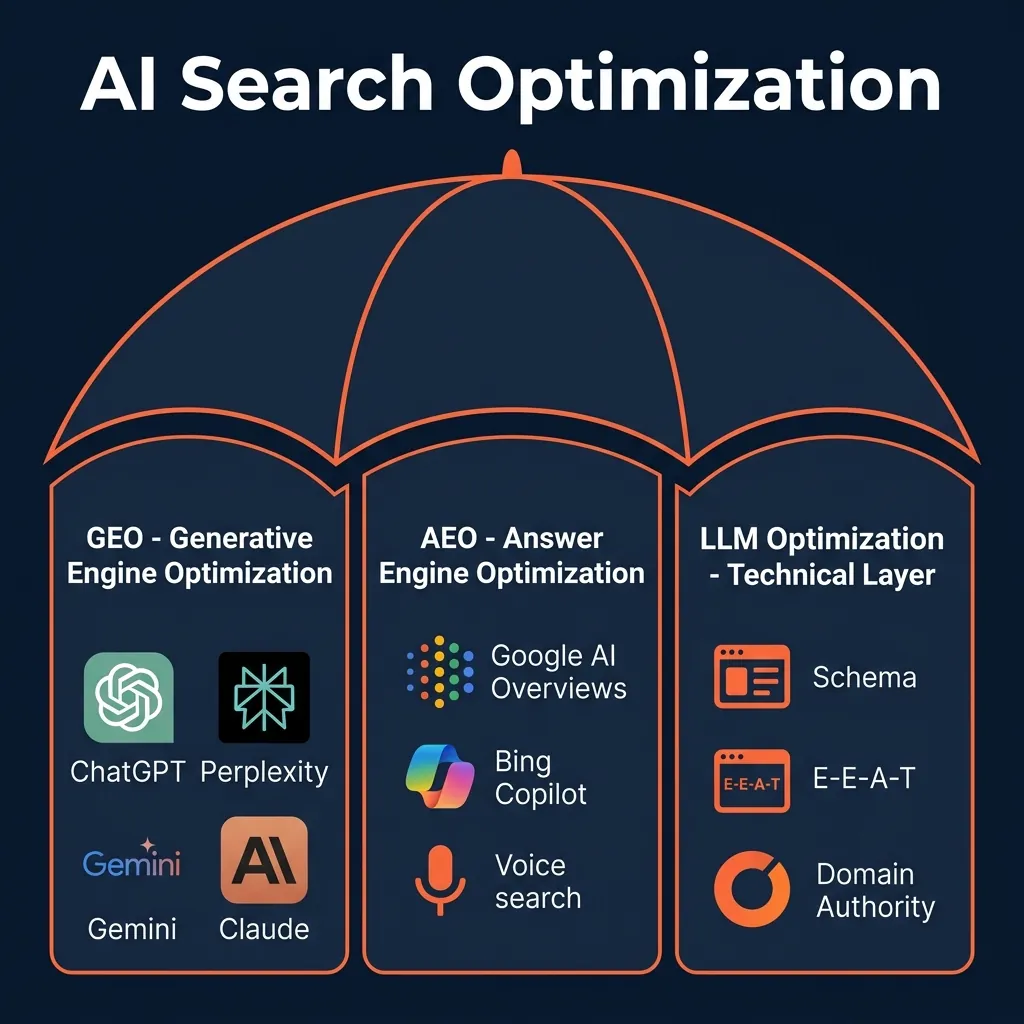
AI search optimization is the umbrella discipline covering all strategies that help brands earn citations, mentions, and recommendations across AI-powered search platforms. It is not a synonym for AEO, and it is not interchangeable with GEO — it is the parent discipline containing both as distinct sub-disciplines. See GEO specifically →

AI Search Optimization umbrella containing GEO, AEO and LLM Optimization sub-disciplines
AI search optimization contains 3 distinct sub-disciplines: GEO (generative platforms), AEO (answer engines), and LLM optimization (technical layer).

AI Search Optimization: Formal Definition

AI search optimization is the practice of designing, structuring, and publishing content and brand signals so that AI language models and answer engines cite the brand when generating responses to user queries. The term covers every AI search surface: generative platforms (ChatGPT, Perplexity, Gemini, Claude), answer engines (Google AI Overviews, Bing Copilot, voice assistants), and the technical infrastructure shared across all platforms. Unlike traditional SEO — which targets ranked positions in a list of results — AI search optimization targets citation inclusion inside AI-generated answers, a fundamentally different output and success metric. It is an industry-practitioner term, not an academic designation, and it functions as the umbrella containing GEO and AEO as distinct, complementary sub-disciplines.

The 3 Disciplines Within AI Search Optimization

AI search optimization contains 3 distinct disciplines, each targeting a different AI search surface:

  • Generative Engine Optimization (GEO) — optimises content to earn citations in platforms that generate full written answers from multiple sources: ChatGPT, Perplexity, Gemini, and Claude. GEO is the broadest-coverage discipline, addressing 6 AI platforms simultaneously. What Is Generative Engine Optimization? →
  • Answer Engine Optimization (AEO) — optimises content to be extracted and surfaced by AI answer engines that pull direct answers from existing pages: Google AI Overviews, Microsoft Bing Copilot, and voice assistants. AEO requires structured, FAQ-rich content and FAQPage schema markup.
  • LLM Optimization (Technical Layer) — the entity, authority, and technical signals that serve both GEO and AEO simultaneously: schema markup, E-E-A-T signals, domain authority, entity consistency, and brand mentions in AI training sources.

These 3 disciplines are not alternatives to each other. A complete AI search optimization strategy implements all 3 layers in a coordinated campaign.

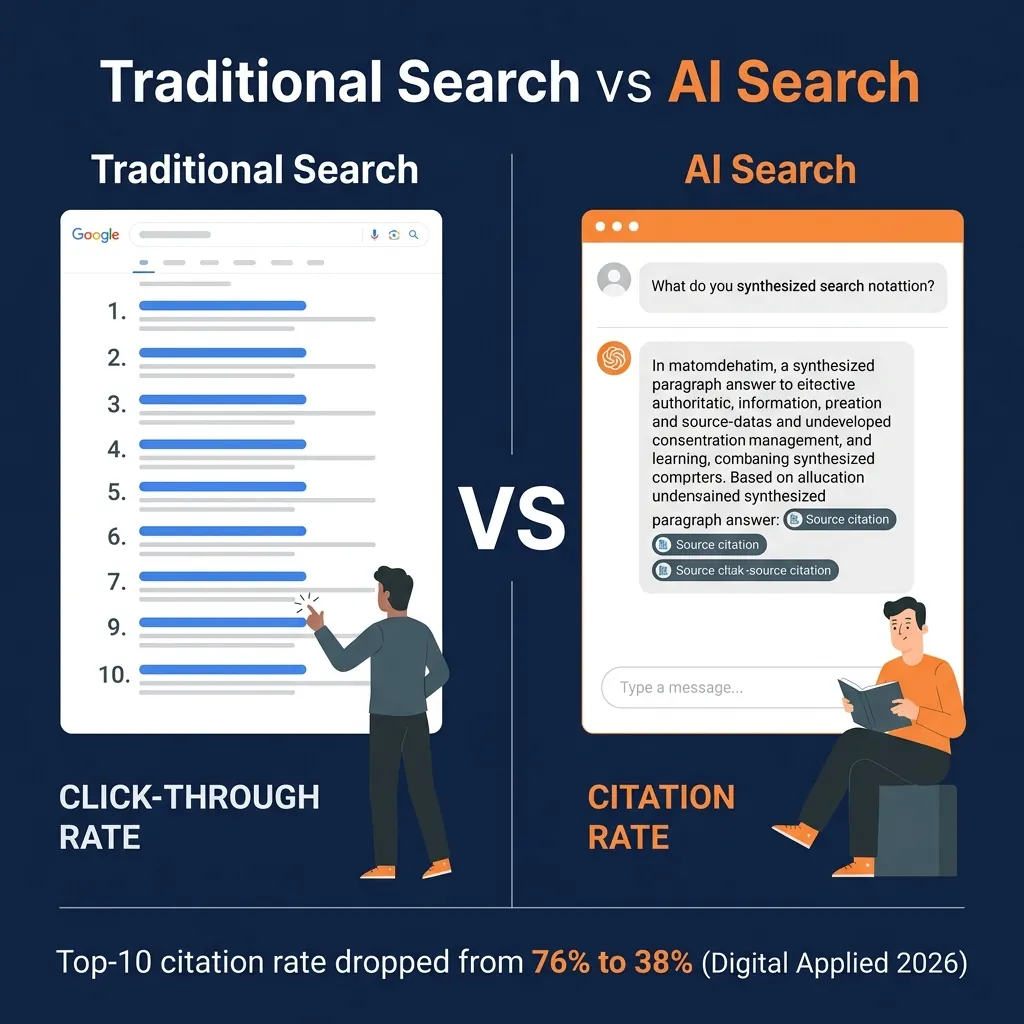
Traditional search delivers a ranked list of results; AI search generates a single synthesised answer citing 2–7 sources. 3 specific differences define AI search versus traditional search results.

Traditional Search vs AI Search: Key Differences

37% of consumers now start searches with AI platforms rather than traditional search engines (Search Engine Land, January 2026). That shift requires understanding exactly what separates AI search from the Google-centric model most marketing teams still optimise for:

Dimension Traditional Search AI Search
Output formatList of 10 ranked linksSingle synthesised answer citing 2–7 sources
User experienceUser clicks through to websitesUser receives direct answer inside the AI platform
Success metricCTR from ranked position (%)Citation rate (% of AI responses citing the brand)
Source selectionTop-10 ranking algorithmRAG retrieval from diverse sources — not only top-10
Click requirementRequired for user to access contentOptional — most users consume AI answers without clicking
Traditional search vs AI search comparison — ranked links vs AI-generated cited answers
The top-10 citation rate in AI responses has dropped from 76% to 38% (Digital Applied, 2026) — first-page Google rankings no longer predict AI citation.

Why Traditional Rankings No Longer Guarantee AI Visibility

The top-10 citation rate in AI responses has dropped from 76% to 38% (Digital Applied, 2026). That figure means ranking on Google’s first page now fails to predict AI citation in more than half of all cases. AI engines pull from diverse source types — Reddit threads, niche authority sites, structured databases, Q&A platforms, and digital PR publications — not only from pages ranking in the traditional top 10. A brand that ranks in position 1 on Google for a commercial query can simultaneously be absent from every AI-generated answer for that same query if it lacks the citation signals AI engines require.

The implication is direct: ranking strategy and AI citation strategy must be built and executed separately. One is measured by CTR; the other is measured by citation rate across AI platforms. Our GEO audit addresses this citation gap by assessing your current AI visibility.

The Core Components of AI Search Optimization

AI search optimization consists of 3 core disciplines: GEO, AEO, and LLM optimization. Each addresses a specific layer of how AI engines select, retrieve, and cite brand content. Explore our full suite of AI search optimization services to see how we build coverage across all 3 layers. If you run a local firm, read our specific playbook on ChatGPT Local SEO to rank your business.

Generative Engine Optimization (GEO)

Generative Engine Optimization is the primary discipline within AI search optimization — covering 6 AI platforms simultaneously: ChatGPT, Perplexity, Gemini, Google AI Overviews, Microsoft Copilot, and Claude. GEO optimises content to be cited inside fully generated answers, where AI platforms synthesise responses from multiple sources rather than extracting a direct quote from a single page. According to a peer-reviewed study by Princeton University, Georgia Tech, and IIT Delhi (KDD 2024), GEO strategies increase AI visibility by up to 40%. GEO is the broadest-coverage discipline of the 3 and the primary implementation for brands seeking comprehensive AI search presence. Learn more in our Complete Guide to GEO.

Answer Engine Optimization (AEO)

Answer Engine Optimization targets AI answer engines that extract and surface direct answers from existing content, rather than synthesising new written responses. Primary platforms include Google AI Overviews, Microsoft Bing Copilot, and voice assistants. Google AI Overviews now appear in 13–25% of all Google search queries (Digital Applied, 2026) — making AEO a high-priority discipline for any brand receiving significant Google traffic. AEO and GEO share core content structure requirements: answer-format openings, FAQ blocks, and structured data markup. GEO additionally requires entity building in LLM training sources, which AEO alone does not address. Review our comparison guide of AEO vs GEO vs SEO to understand how they work together.

Technical and Entity Signals

The technical layer of AI search optimization serves both GEO and AEO as shared infrastructure. 4 signal types function as retrieval indicators across all AI search platforms: schema markup (Article, FAQPage, HowTo — machine-readable structure for RAG systems), site crawlability (AI retrieval bots require fast, accessible pages with no robots.txt restrictions), E-E-A-T signals (named authors, expertise credentials, factual accuracy signals evaluated across all platforms), and heading hierarchy (H1→H2→H3 structure that AI crawlers use for content segmentation during retrieval). Implementing these technical signals across existing pages does not require new content — it requires structured restructuring and schema deployment through our specialised GEO Content Optimisation service.

GEO as the Primary AI Search Optimization Strategy

GEO is the primary AI search optimization strategy for brands targeting ChatGPT, Perplexity, Gemini, and the full AI search landscape. Of the 3 disciplines within AI search optimization, GEO covers the broadest platform surface and includes the entity signals that train AI engines to actively recommend a brand — not merely retrieve its content when it matches a query. Check our GEO services and packages to find the right strategy for your business.

Why GEO Leads AI Search Optimization in 2026

3 reasons GEO leads AI search optimization as the primary discipline:

  1. Broadest platform coverage. GEO covers all 6 major AI search platforms simultaneously (ChatGPT, Perplexity, Gemini, AI Overviews, Copilot, Claude). AEO covers Google AI Overviews and Bing Copilot. LLM optimization covers technical infrastructure. GEO is the only single discipline that addresses the complete AI search landscape in one execution.
  2. Includes entity building. GEO is the only AI search discipline that includes systematic brand mention placement in AI training sources — the signal that trains AI engines to recommend a brand proactively, not just retrieve it reactively when a specific page happens to rank.
  3. Aligns with Google’s official 2026 guidance. Google’s first official AI search guidance (Search Central, May 15, 2026) states: “AI Overviews and AI Mode are rooted in the same core ranking and quality systems as regular Search.” This confirms that GEO’s content structure and domain authority signals apply directly to Google AI Overview and AI Mode ranking criteria. We offer specialised GEO packages that cover all 6 platforms simultaneously.

How GEO Covers All 6 AI Platforms Simultaneously

GEO campaigns address the citation signals of all 6 AI search platforms in a single execution. Each platform operates at significant scale:

  • ChatGPT — 700M+ weekly active users (OpenAI, August 2026). Uses RAG with browsing enabled. Requires answer-format content, direct factual statements, and entity presence in training corpora.
  • Google AI Mode — 75M daily users, 100M+ monthly users by early 2026. Uses Google’s core ranking systems combined with RAG retrieval and query fan-out. The fastest-growing AI search surface by user volume.
  • Google AI Overviews — appears in 13–25% of all Google search queries. Uses structured data, E-E-A-T signals, and core search ranking criteria for source selection.
  • Perplexity — fastest-growing dedicated AI search engine by engagement. Prioritises content with direct answers, cited statistics, and clear source attribution.
  • Microsoft Copilot — powered by Bing index plus AI synthesis. Domain authority, Bing indexation status, and structured content are primary citation signals.
  • Claude (Anthropic) — increasingly used for professional and research queries. Entity authority, factual accuracy, and named source attribution are primary citation signals.

A managed GEO service covers all 6 platforms in one campaign. We provide monthly GEO packages from $590/month covering all platforms.

Best Practices for AI Search Optimization in 2026

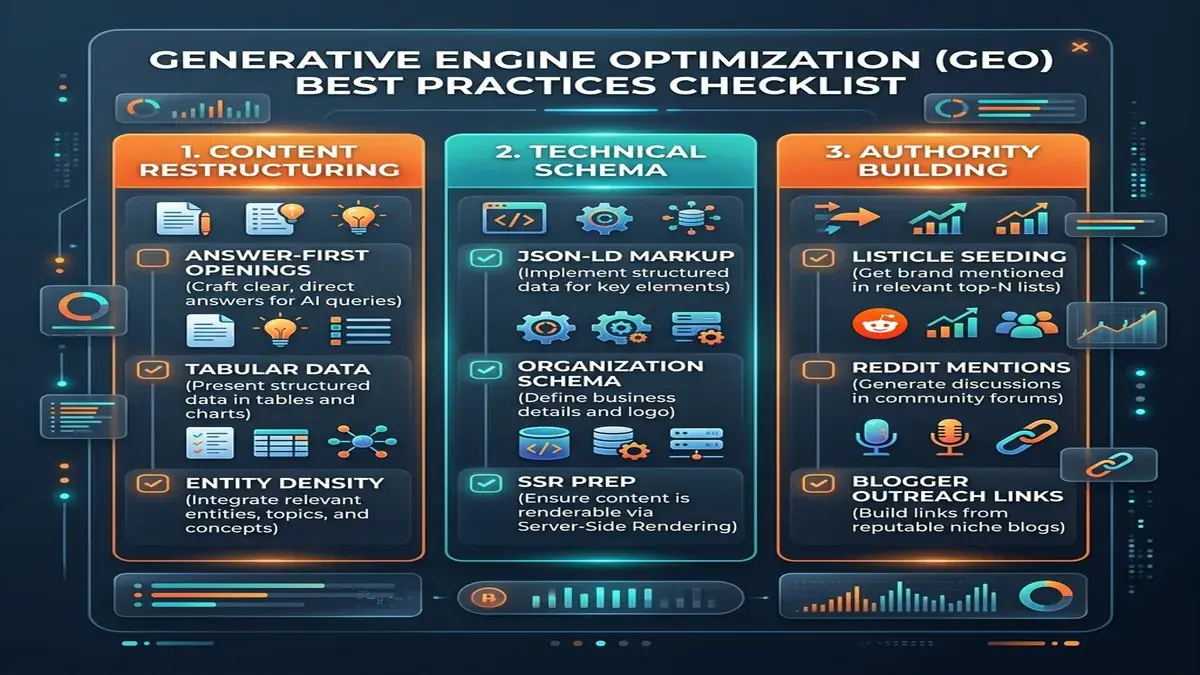
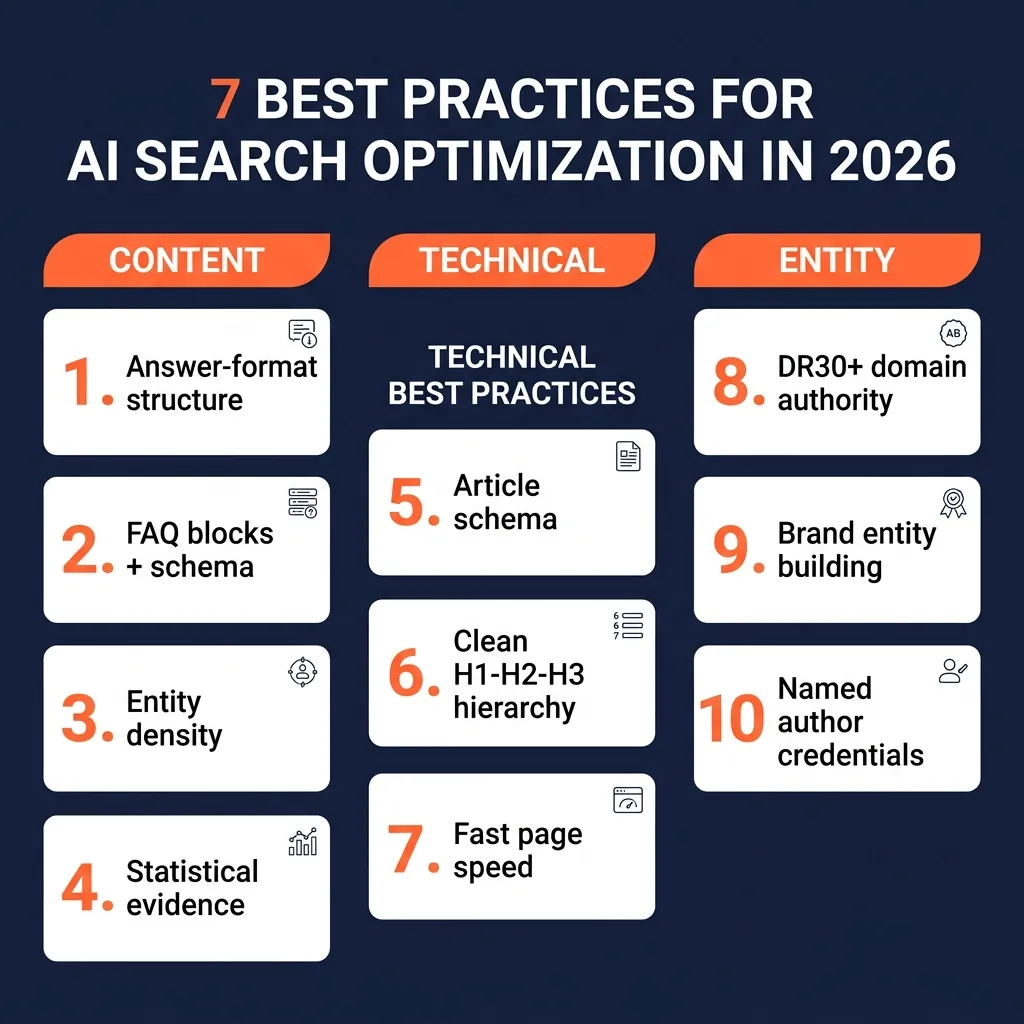
7 best practices for AI search optimization cover 3 categories: content, technical, and entity. Implementing all 7 across key pages provides comprehensive citation signal coverage for both GEO and AEO platforms. You can check our checklist of Generative Engine Optimization Best Practices for a step-by-step walkthrough, or use our AI-optimised content creation techniques.

7 best practices for AI search optimization in 2026 — content, technical and entity categories
7 best practices for AI search optimization across 3 categories: content structure, technical signals, and entity authority.

Content Best Practices for AI Search Optimization

4 content best practices that increase AI citation probability across all platforms:

  1. Answer-format structure. Place a direct, complete answer in the first 150 words of every page and every section. RAG retrieval systems evaluate opening content for relevance before processing the full article (enrichlabs.ai, 2026). The standard: a 40-word featured-snippet-style answer at the opening of every H2 section.
  2. FAQ blocks with FAQPage schema. Include a structured FAQ section in every long-form page, with FAQPage schema markup. Each FAQ answer must be self-contained — 2–3 sentences, complete without requiring context from the rest of the article.
  3. Entity density and specificity. Use named, specific entities throughout rather than generic nouns. “ChatGPT” outperforms “AI tool.” “Princeton University study” outperforms “research shows.” “7Eagles client data across 35+ active accounts” outperforms “data shows.”
  4. Statistical evidence with source attribution. Cited statistics with named sources increase AI citation probability by up to 40% (Princeton University, Georgia Tech, IIT Delhi, KDD 2024). Include at least 2 cited statistics per 500-word content block. You can get professional AI-optimised content built exactly to these standards.

Technical Best Practices for AI Search Optimization

4 technical best practices that ensure AI engines can retrieve and process pages effectively:

  1. Article + FAQPage schema markup. Deploy Article schema on all blog posts and FAQPage schema on all long-form content pages with Q&A sections. Google’s May 2026 official guidance explicitly confirms structured data supports inclusion in AI Overviews and AI Mode.
  2. Clean heading hierarchy (H1→H2→H3). AI crawlers use heading structure to segment and categorise content during retrieval. Every H2 must address a distinct attribute of the page’s macro topic; every H3 must address a sub-attribute of its parent H2.
  3. Fast page load speed. AI retrieval bots require accessible pages within standard crawl timeouts. Core Web Vitals targets: LCP under 2.5 seconds, no render-blocking resources on critical path.
  4. Canonical and crawlable URLs. Confirm AI bots are not blocked by robots.txt rules, login walls, or paywalls. AI systems cannot cite content they cannot retrieve.

Our dedicated GEO Content Optimisation service handles all 4 technical signals on your existing pages.

Entity and Authority Best Practices

3 entity and authority best practices that build long-term AI citation consistency:

  1. Domain authority at DR30+. AI engines use domain authority as a trust signal to determine which sources to cite consistently. Sites with DR below 30 are cited less frequently across ChatGPT, Perplexity, and Google AI Overviews even when content quality and structure are high.
  2. Brand entity building across AI training sources. Brand mentions in DR30+ brand listicles, Reddit and Quora community discussions, review platforms (G2, Trustpilot, Capterra), and industry databases contribute to the brand’s entity authority score in LLM training data. Fewer than 12% of marketing teams have a documented AI search strategy (GenOptima, 2026).
  3. Named author with verifiable credentials. Content attributed to a named expert with a professional bio, LinkedIn profile, and industry credentials is cited more frequently than anonymous content across AI platforms. Build authority with our GEO Entity Building services starting from $220.

AI Search Optimization Techniques That Work Now

3 AI search optimization techniques produce measurable citation results in 60–90 days: answer-format content structure, entity building and brand citation placement, and schema markup for AI retrieval. Each technique addresses a different layer of the citation selection mechanism. We implement these using advanced AI-optimised content creation tools and workflows.

Answer-Format Content Structure

The highest-impact single technique in AI search optimization is structuring every page to deliver a direct, complete answer in the first sentence after each heading. The mechanism: RAG retrieval systems evaluate the first 200 words of any page for relevance before processing the full article (enrichlabs.ai, 2026). Content that front-loads extractable answers earns higher retrieval rates than content that builds toward a conclusion.

The 4-component answer-format structure applies to every H2 and H3 section:

  1. [Heading] — direct question or declarative statement targeting a specific query
  2. [Direct answer] — 40-word complete response in sentence 1 (featured-snippet-style, self-contained)
  3. [Supporting evidence] — specific data, research citation, or mechanism explanation
  4. [Specific entity + value] — named entity with specific attribute and value (e.g., “Princeton University, 2024: 40% AI visibility increase”)

Applying this structure to existing key commercial and informational pages increases AI citation probability without requiring new pages or new content — it is a restructuring task that you can outsource to our team for content creation built to answer-format standards.

Entity Building and Brand Citation Placement

Entity building is the technique of systematically placing brand mentions across the sources where LLMs train. A brand mentioned 5 times across high-authority, contextually relevant sources is cited far more often in AI-generated answers than a brand whose only web presence is its own website.

Effective entity building placements include:

  • DR30+ brand listicles that rank the brand among named competitors in its category
  • Reddit and Quora community mentions in relevant topic threads (with natural brand attribution)
  • Review platform profiles on G2, Trustpilot, and Capterra with detailed product or service descriptions
  • Industry directories and databases relevant to the brand’s category
  • Digital PR placements in specialist media publications that AI engines recognise as authoritative source domains

Entity building packages start from $220 per campaign. Explore our GEO Entity Building solutions to scale your external brand presence.

Schema Markup for AI Retrieval

Schema markup is the technique of wrapping page content in machine-readable structured data that RAG retrieval systems parse directly. 3 required schema types for comprehensive AI search optimization:

  1. FAQPage — on all long-form articles and service pages that include a question-and-answer section. Allows AI engines to extract individual Q&A pairs as self-contained citation units.
  2. Article — on all blog posts and content articles. Signals content type, publication date, author, and source organisation — factors that AI citation systems evaluate when assessing source authority and freshness.
  3. BreadcrumbList — on all pages. Establishes the URL hierarchy, which AI crawlers use to understand content relationships and topic authority across a site.

Google’s official May 2026 AI search guidance explicitly confirms that structured data supports inclusion in Google AI Overviews and AI Mode. Our GEO Content Optimisation service includes full schema implementation for all pages.

How to Measure AI Search Optimization Performance

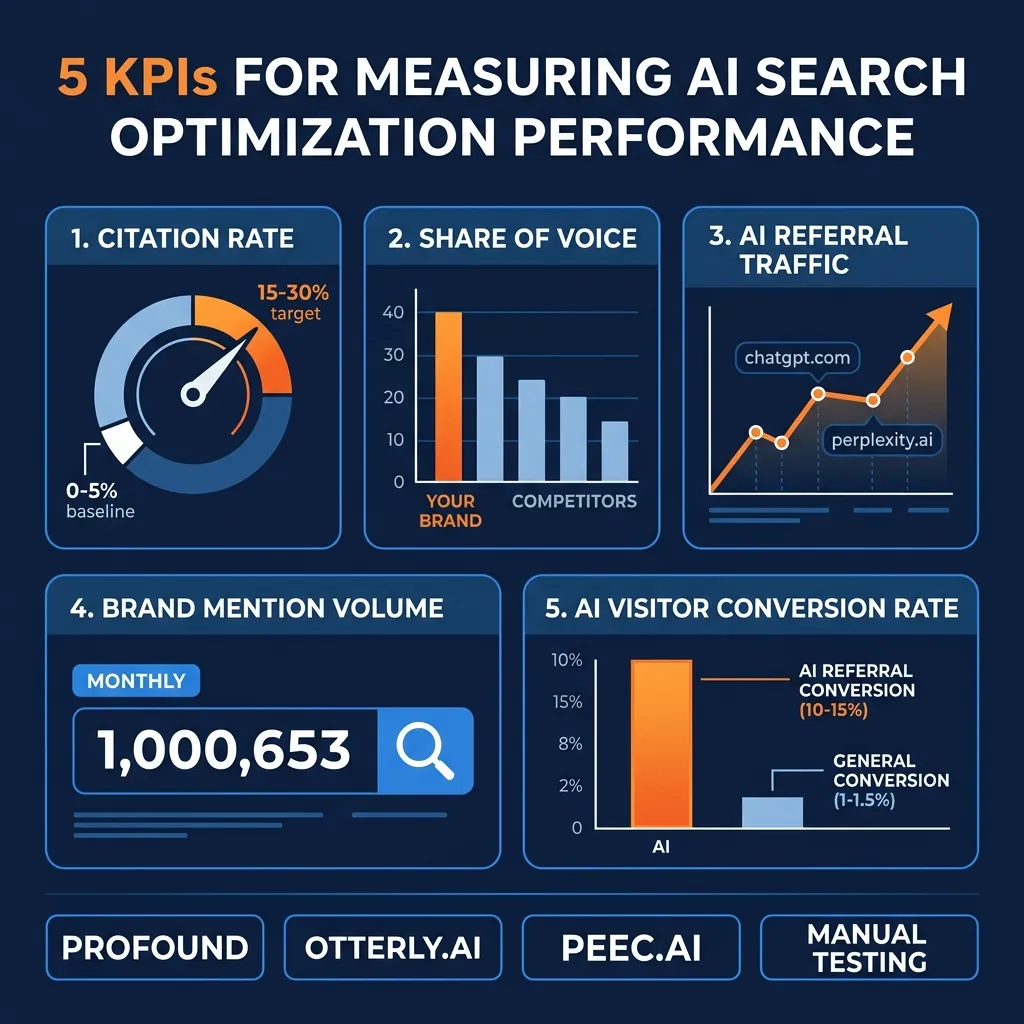
AI search optimization performance is measured across 5 KPIs and tracked using 4 specialist tools. Traditional web analytics (GA4) captures only the traffic element of AI search performance. Full measurement requires dedicated AI citation monitoring alongside standard web metrics. Discover the best GEO tools for tracking AI citations in our comprehensive comparison.

5 KPIs for measuring AI search optimization performance with Profound, Otterly.ai and Peec tools
5 KPIs for AI search optimization: citation rate, share of voice, AI referral traffic, brand mention volume, and AI visitor conversion rate.

Key AI Search Optimization KPIs

5 KPIs for measuring AI search optimization performance:

  1. Citation rate — the percentage of sampled AI responses that include a brand mention. Baseline for most brands before AI search optimization: 0–5%. After 3–6 months of consistent GEO execution: 15–30% across primary query sets are achievable.
  2. Share of voice — the brand’s citation mentions as a proportion of all competitor mentions across AI responses for the same query set.
  3. AI referral traffic — sessions originating from AI platforms, tracked as a distinct source category in Google Analytics 4. Growing source categories include perplexity.ai, chatgpt.com, and AI Overview-attributed sessions.
  4. Brand mention volume — total AI answer appearances across all 6 platforms over a defined period, reported as a monthly total.
  5. AI visitor conversion rate — the percentage of AI-referred sessions that convert to a lead, trial, or purchase. Benchmark: AI-referred visitors convert at 10–15% compared to 1–1.5% from Google organic traffic (7Eagles, 2026, across 35+ active accounts).

Tools for Tracking AI Search Visibility

4 tools for tracking AI search optimization performance:

  1. Profound — citation tracking across ChatGPT, Perplexity, Gemini, and Google AI Overviews with share of voice reporting and month-on-month trend tracking.
  2. Otterly.ai — AI answer monitoring with brand mention frequency and brand sentiment tracking.
  3. Peec.ai — AI visibility analytics and share of voice measurement with competitor citation benchmarking.
  4. Manual prompt testing — the cost-free baseline method. Test 10–15 target queries across 5 AI platforms monthly and record citation presence, citation position, and competitor citations per query.

Monthly managed GEO campaigns include citation monitoring as part of the service — covering all 6 platforms monthly. Monthly campaigns start from $590 per month. Read our full GEO tools comparison guide for a complete software breakdown.

Start Your AI Search Optimization Campaign — GEO Services from $99

GEO services covering all 6 AI search platforms are available from $99 for a one-time AI visibility audit to $3,490 per month for a full managed campaign — including content creation, entity building, authority link building, and citation monitoring across ChatGPT, Perplexity, Gemini, AI Overviews, Copilot, and Claude. All packages include instant ordering with no discovery call required and white-label reports for agency use.

See Monthly GEO Packages →  |  GEO Audit from $99 →


What is AI search optimization? +

AI search optimization is the discipline of structuring a brand’s digital presence to earn citations across all AI search surfaces — including ChatGPT, Perplexity, Google AI Overviews, Gemini, Microsoft Copilot, and Claude. It contains 3 sub-disciplines: Generative Engine Optimization (GEO), Answer Engine Optimization (AEO), and LLM optimization. AI search optimization is not a synonym for AEO — it is the umbrella term containing AEO as one of its 3 component disciplines.

Is AI search optimization the same as GEO? +

GEO (Generative Engine Optimization) is the primary discipline within AI search optimization, targeting generative AI platforms that produce full written answers — ChatGPT, Perplexity, Gemini, and Claude. AI search optimization is the broader umbrella term that also includes Answer Engine Optimization (AEO) and technical LLM signals. Most brands implementing AI search optimization in 2026 begin with GEO, as it covers the broadest platform surface across 6 AI engines simultaneously.

Is AI search optimization the same as AEO? +

No — AEO (Answer Engine Optimization) is one discipline within AI search optimization, not the same thing. AEO specifically targets answer engines — Google AI Overviews, Bing Copilot, and voice assistants — that extract direct answers from existing content. AI search optimization is the umbrella term that includes AEO, GEO, and LLM optimization as separate but complementary disciplines. Treating them as synonyms results in a strategy that covers only one AI search surface while leaving the others unaddressed.

How does AI search optimization differ from traditional SEO? +

Traditional SEO optimises content to rank in Google’s list of 10 organic results, measured by click-through rate from ranked positions. AI search optimization optimises content to be cited inside AI-generated answers, measured by citation rate across 6 AI platforms. The top-10 citation rate in AI responses has dropped from 76% to 38% (Digital Applied, 2026) — meaning first-page Google rankings no longer reliably predict AI citation. Both disciplines share domain authority and content quality as foundational requirements; AI search optimization adds content structure, entity building, and schema markup.

What are the best practices for AI search optimization in 2026? +

The 7 best practices for AI search optimization in 2026 cover content, technical, and entity categories. Content best practices: answer-format structure in first 150 words, FAQPage schema on all long-form content, entity density, and cited statistics. Technical best practices: Article + FAQPage schema markup, clean heading hierarchy, fast page load, and crawlable URLs. Entity best practices: DR30+ domain authority, brand mention placement in AI training sources, and named author credentials.

What techniques work best for AI search optimization? +

3 AI search optimization techniques produce measurable citation results within 60–90 days: answer-format content structure, entity building, and schema markup. Answer-format structure places direct answers in the first 150 words of every page and section — the content RAG systems evaluate first during retrieval. Entity building places brand mentions in the listicles, Q&A platforms, and review sites where LLMs train, increasing unprompted citation frequency. Schema markup provides machine-readable structure that RAG systems parse directly.

How long does AI search optimization take to show results? +

Early AI search optimization signals — including increased citations in ChatGPT and Perplexity responses — typically appear within 60–90 days of implementing structured content and entity building. Consistent citation authority compounds over 3–6 months of ongoing execution. The timeline varies with current domain authority, the competitiveness of target query sets, and the number of AI platforms targeted simultaneously.

How much does AI search optimization cost? +

AI search optimization services are available from $99 for a one-time AI visibility audit and range to $3,490 per month for a full managed campaign covering GEO content creation, entity building, link building, and citation monitoring across all 6 AI platforms. Monthly managed packages start from $590 per month with no discovery call and no long-term contract. Individual services include content optimisation from $250, entity building from $220, and link building from $299.

What tools are used for AI search optimization? +

4 specialist tools track AI search optimization performance: Profound, Otterly.ai, Peec.ai, and manual prompt testing. Profound tracks brand citations across ChatGPT, Perplexity, Gemini, and Google AI Overviews with share of voice reporting and month-on-month trend tracking. Otterly.ai monitors AI answer frequency and brand mention volume. Peec.ai measures share of voice across platforms. Manual prompt testing provides a cost-free baseline method. Monthly managed GEO campaigns include citation monitoring as part of the service across all 6 platforms, removing the need for separate tool subscriptions.

Muhammad Ehsan Khan

Written by: Muhammad Ehsan Khan

Engineer, SEO Consultant, and Semantic SEO Explorer. Specializing in advanced search strategies, LLM citation optimization, and entity-building architectures.
What Is Generative Engine Optimization? The Complete 2026 Guide

GEO Guide

What Is Generative Engine Optimization? The Complete 2026 Guide

Published: June 2026 · Reading Time: 8 mins · Author: Muhammad Ehsan Khan

Generative Engine Optimization (GEO) is the practice of structuring and optimising content to earn citations in AI-generated answers. GEO covers 6 AI platforms: ChatGPT, Perplexity, Gemini, Google AI Overviews, Microsoft Copilot, and Claude. This guide covers the formal definition of GEO, the 6 key elements, how AI engines select sources, and how to get started with a GEO campaign from $99.

What Is Generative Engine Optimization?

Generative Engine Optimization is the discipline of designing and publishing content so that AI language models cite it when answering user queries. The term was formalised in a peer-reviewed study by Princeton University, Georgia Tech, IIT Delhi, and the Allen Institute for AI (KDD 2024). See also: Compare GEO with AEO and SEO.

Generative Engine Optimization: Formal Definition

Generative Engine Optimization is the discipline of structuring, writing, and publishing content so that large language models (LLMs) and generative AI engines retrieve and cite it in their answers. The platforms covered include ChatGPT, Perplexity, Google AI Overviews, Gemini, Microsoft Copilot, and Claude — all of which use retrieval mechanisms to select sources when generating responses. The academic term was established by Princeton University, Georgia Tech, IIT Delhi, and the Allen Institute for AI in a peer-reviewed study at KDD 2024.

GEO is a core subset of the broader AI Search Optimization framework. For local businesses, optimizing for these platforms requires a specific strategy, detailed in our guide on ChatGPT Local SEO.

6 AI platforms targeted by Generative Engine Optimization — ChatGPT, Perplexity, Gemini, AI Overviews, Copilot, Claude
GEO targets 6 AI platforms: ChatGPT, Perplexity, Google AI Overviews, Gemini, Microsoft Copilot, and Claude.

What Generative Engine Optimization Is Not

3 common misconceptions about GEO:

  • GEO is not a replacement for SEO. GEO is an additional optimisation layer that builds on existing SEO foundations — not a substitute for organic search strategy.
  • GEO is not only about Google. GEO covers 6+ AI platforms — ChatGPT, Perplexity, Gemini, AI Overviews, Copilot, and Claude — not only Google’s AI features.
  • GEO is not the same as AEO. GEO targets generative AI platforms that synthesise full written answers; Answer Engine Optimization (AEO) targets answer engines that extract and surface direct answers from existing content. Understand how GEO and AEO differ in our comparison guide.

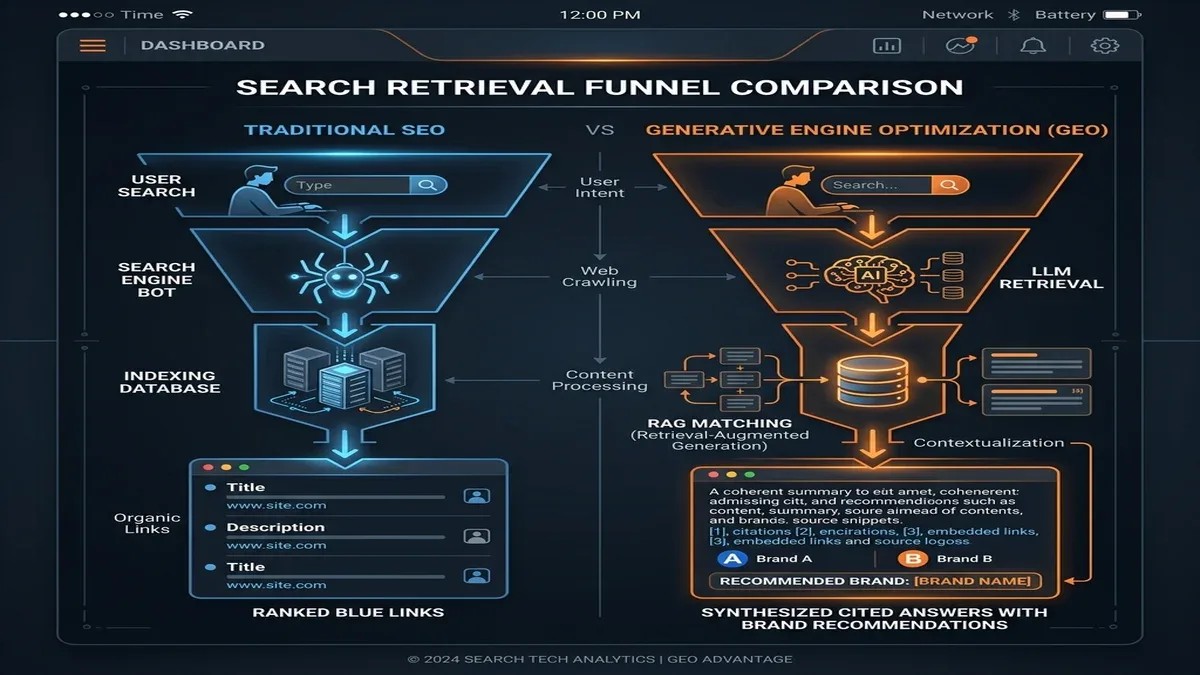
How Generative Engine Optimization Differs from Traditional SEO

Traditional SEO targets ranked positions in Google’s search result lists; GEO targets citation inclusion inside AI-generated answers.

GEO vs Traditional SEO comparison — AI citations vs ranked search results
Traditional SEO targets ranked positions in Google; GEO targets citation inclusion inside AI-generated answers.
Dimension Traditional SEO Generative Engine Optimization
Goal Rank in positions 1–10 on Google or Bing Earn citation in an AI-generated answer
Output A link in a list of 10 organic results A citation inside a 200–500 word AI answer
Platforms Google, Bing, Yahoo ChatGPT, Perplexity, Gemini, AI Overviews, Copilot, Claude
Success metric Click-through rate (CTR) from ranked position Citation rate — % of AI responses citing the brand
Primary signal Backlinks and on-page keyword relevance Content structure, entity density, and domain authority

Brands excelling at GEO in 2026 typically maintain strong SEO foundations — domain authority, content quality, and E-E-A-T signals are requirements shared between both disciplines.

What Traditional SEO Targets

Traditional SEO optimises content to rank in Google’s and Bing’s lists of 10 organic results per query. The primary success metric is click-through rate (CTR) from those positions. Google’s first-position CTR declined from 30–35% to 18–21% between 2023 and 2026 (7Eagles, 2026) as AI-generated answers increasingly appear above organic results, providing direct responses before users reach the ranked list.

What Generative Engine Optimization Targets

GEO optimises content to be cited inside AI-generated answers — a single synthesised response that typically draws from 2–7 sources per query (RankAI, 2026). The target platforms include ChatGPT, Perplexity, Google AI Overviews, Gemini, Microsoft Copilot, and Claude. Users consuming AI-generated answers receive a brand’s information without clicking through, associating the cited knowledge with the brand as the authoritative source.

How GEO and SEO Work Together

Brands excelling at GEO in 2026 are typically the same brands with strong traditional SEO foundations (enrichlabs.ai, 2026). Domain authority, content quality, and E-E-A-T signals serve both disciplines. GEO adds 2 specific requirements not covered by SEO alone:

Shared with Traditional SEO GEO-Specific Additions
Domain authority (DA/DR) Content structured for AI retrieval efficiency
High-quality, factual content Entity building in AI training sources
E-E-A-T signals Answer-format structure in first 200 words of every page

You can restructure existing pages for both SEO and GEO to capture both channels simultaneously.

Why Generative Engine Optimization Matters in 2026

Gartner (2026) projects traditional search volume to decline 25% by 2026 — a structural shift from ranked results to AI-generated answers that directly affects every brand relying on organic search for discovery and traffic.

AI Search Adoption Statistics for 2026

5 statistics documenting the AI search shift:

  1. 25% decline in traditional search volume by 2026 — Gartner, 2026. Projected to reach 50% reduction by 2028.
  2. 30–40% of all Google search queries now trigger Google AI Overviews, answering questions directly above organic results.
  3. 700M+ weekly active users on ChatGPT as of August 2026 — OpenAI.
  4. 1,500% growth in AI active users from January 2023 to April 2026 across major AI search platforms.
  5. Fewer than 12% of marketing teams have a documented GEO strategy as of 2026 (GenOptima). Brands implementing GEO now gain citation advantage over the majority of competitors that have not yet started.

The Business Cost of Missing Generative Engine Optimization

AI-referred visitors convert at 10–15% compared to 1–1.5% from Google organic traffic, based on 7Eagles client data across 35+ active accounts (2026). GEO strategies increase AI visibility by up to 40% according to a peer-reviewed study from Princeton University, Georgia Tech, and IIT Delhi (KDD 2024). Competitors gaining citations in AI answers now displace brands that delay — the same first-mover dynamic that defined early SEO adoption applies directly to GEO in 2026, with fewer than 12% of competitors currently active. You can measure your current GEO gap with an audit from $99 to identify immediate opportunities.

The 6 Key Elements of Generative Engine Optimization

Generative Engine Optimization consists of 6 elements: AI visibility audit, content optimisation, content creation, entity building, authority link building, and topical research. Each element addresses a specific requirement of how AI engines select and cite sources. You can browse our 6 GEO service lines to see how we address each of these needs.

The 6 key elements of Generative Engine Optimization with service prices
The 6 elements of GEO — Audit ($99), Content Optimisation ($250), Content Creation ($450), Entity Building ($220), Link Building ($299), Research ($149).

1. AI Visibility Audit

A GEO audit identifies which AI platforms recommend competitors instead of a brand for its target queries. The audit covers prompt checks across ChatGPT, Perplexity, Gemini, Google AI Overviews, and Copilot (5 platforms), mapping competitor citations and priority gaps. The deliverable is a prioritised PDF report with specific recommendations. We offer a professional GEO Audit from $99.

2. GEO Content Optimisation

GEO content optimisation restructures existing pages to earn AI citations using 6 signals: answer-format openings, FAQ blocks, entity clarity, statistics injection, schema markup, and internal link alignment. Existing content is restructured, not replaced — the approach preserves current search rankings while adding AI citation signals. Content optimisation packages cover 5 pages from $250. Learn more about our GEO Content Optimisation services.

3. AI-Optimised Content Creation

AI-optimised content creation produces new articles written specifically to earn citations in AI-generated answers. Key attributes include answer-led structure in the first 150 words, FAQ blocks per article, entity density, and formatting for RAG-retrieval systems. These articles differ from standard blog content in that the structure prioritises AI extraction efficiency. Content creation packages start from $450 for 5 articles. Explore our GEO Content Creation packages.

4. Entity Building Across AI Platforms

Entity building places the brand in listicles, reviews, Q&A sites, and community discussions where LLMs train — including DR30+ brand listicles, Reddit and Quora community mentions, and review platforms. The mechanism: LLMs learn which brands are credible from the web. Entity placements across these sources train AI engines to recommend the brand in relevant queries. Entity building packages start from $220. Review GEO Entity Building services.

5. Authority Link Building for AI Trust Signals

AI engines use domain authority as a trust signal to determine which sources to cite in generated answers — high-DA sources are cited more frequently across ChatGPT, Perplexity, and Google AI Overviews. Authority link building delivers DR30–60 backlinks via blogger outreach and niche edits, strengthening the domain authority that AI engines evaluate when selecting citation sources. Link building packages start from $299. Explore GEO Link Building packages.

6. GEO Research and Topical Mapping

GEO research and topical mapping identifies the full AI citation opportunity space — the topics, queries, and content clusters a brand needs to cover to achieve comprehensive citation coverage across all 6 AI platforms. The deliverable includes intent-mapped topic clusters, a recommended publish sequence, and content brief outlines. This differs from SEO keyword research in that it maps AI citation opportunity rather than Google ranking positions alone. Research packages start from $149. Order GEO Research Packages online.

How AI Engines Use Content to Generate Recommendations

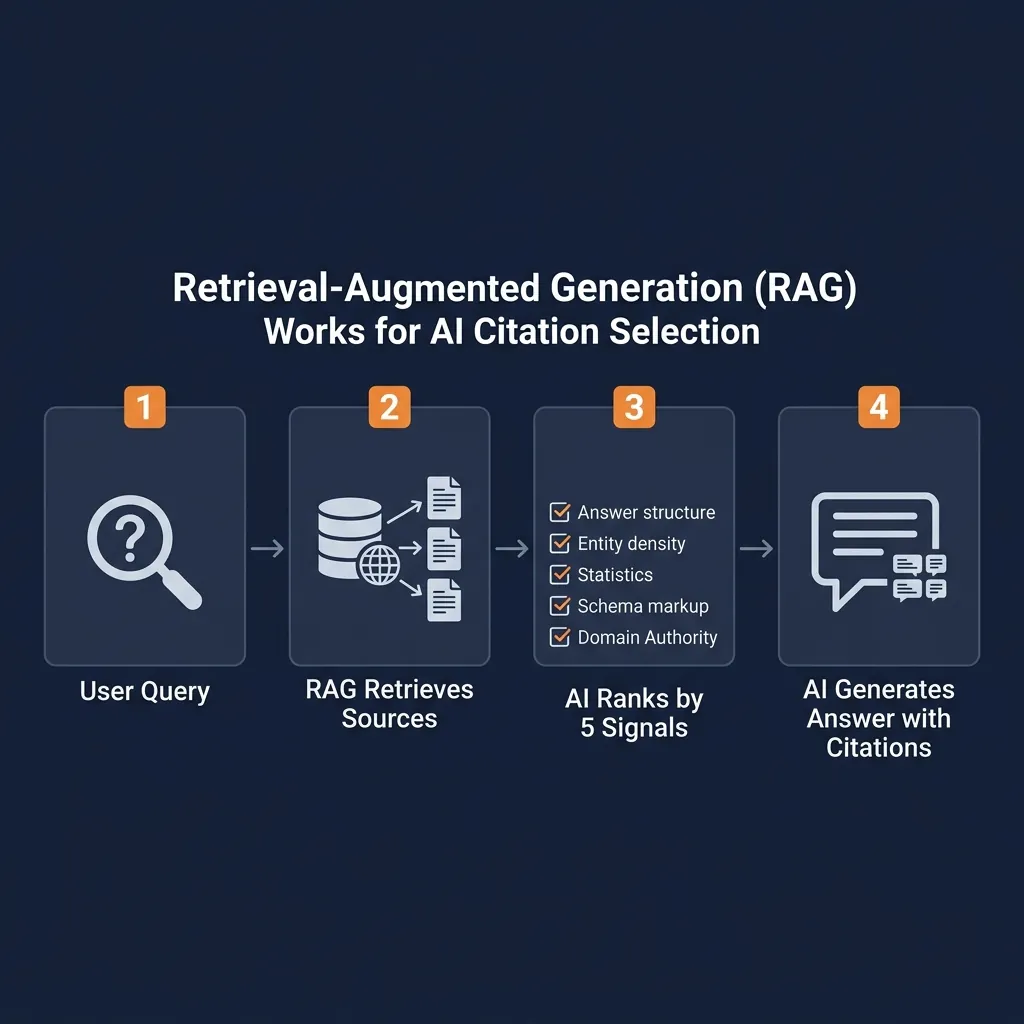
AI engines select citation sources using Retrieval-Augmented Generation (RAG) — a mechanism that retrieves relevant source content and uses it as context to generate human-like answers.

How Retrieval-Augmented Generation (RAG) selects citation sources for AI answers
RAG retrieves source content and ranks it by 5 signals — answer structure, entity density, statistics, schema markup, and domain authority — before generating AI answers.

How Retrieval-Augmented Generation Works

RAG retrieves relevant content from a knowledge base and uses that content as context to generate human-like responses. The platforms using RAG include ChatGPT (with browsing enabled), Perplexity (on every query), Google AI Overviews (on every query), and Microsoft Copilot. Direct answers must appear in the first 200 words of any page — RAG systems evaluate opening content for retrieval relevance before processing the full article (enrichlabs.ai, 2026).

The 5 Signals That Determine AI Citation Selection

5 signals that determine whether content is cited in AI-generated answers:

  1. Answer-format structure — direct, complete answers in the first 150 words of the page, structured for extraction without requiring additional context.
  2. Entity density and specificity — named, specific entities (e.g., “ChatGPT” not “AI tool”) increase citation probability over generic noun usage.
  3. Statistical evidence — cited statistics with source attributions increase AI citation probability by up to 40% (Princeton University, Georgia Tech, KDD 2024).
  4. Schema markup — FAQPage and Article schema function as retrieval signals, making content more parseable by RAG systems.
  5. Domain authority — high-DA sources are cited more frequently across all 6 AI platforms; domain authority is a shared trust signal with traditional SEO.

You can restructure your pages for all 5 citation signals using our optimization framework.

Who Needs Generative Engine Optimization?

3 types of organisations benefit from GEO: businesses and SMBs, SEO agencies and resellers, and in-house marketing teams. Check out our GEO packages for all business types.

Businesses and SMBs

Any business generating revenue from customers who research purchases using AI search requires GEO — including professional services firms, SaaS companies, and e-commerce brands. The specific consequence of inaction: when a business is not appearing in AI-generated answers for its target queries, competitors are. Fewer than 12% of marketing teams have a documented GEO strategy (GenOptima, 2026), providing a quantifiable first-mover advantage for businesses that implement now.

SEO Agencies and Marketing Resellers

SEO agencies with clients asking about AI search visibility can add GEO to existing retainers using white-label GEO packages — ordered under the agency brand and delivered directly to clients. Typical agency reseller margins on white-label GEO services range from 40–80% markup over cost. Discover our white-label GEO services for agencies.

In-House Marketing Teams

In-house teams producing content without AI citation optimisation operate across 2 paths: (1) existing content that ranks on Google but does not appear in AI answers requires restructuring via content optimisation; (2) topics with no published content require new AI-optimised articles. GEO research packages provide the complete strategy layer — topic clusters, publish sequence, and content briefs — for in-house execution. Order GEO Research Packages for in-house teams today.

How to Get Started with Generative Engine Optimization: 3 Steps

Starting GEO requires 3 steps: audit your AI visibility, optimise or create AI-ready content, and build entity authority. We offer monthly GEO packages covering all 3 steps.

Step 1 — Audit Your AI Visibility

The first step maps which AI platforms currently cite competitors for target queries and identifies citation gaps. The process involves prompt checks across ChatGPT, Perplexity, Gemini, Google AI Overviews, and Copilot, followed by competitor citation gap analysis and a prioritised action report. 2 options: DIY manual prompt testing across 5 platforms (time-intensive) or a professional GEO Audit from $99 covering all 5 platforms simultaneously.

Step 2 — Optimise Existing Content or Commission New Articles

The audit findings determine which content path to take. 2 paths: (1) pages that rank on Google but do not appear in AI answers require content optimisation — restructuring with AI citation signals from $250 for 5 pages; (2) topics with no existing content require new AI-optimised articles from $450 for 5 articles. Select GEO Content Optimisation or GEO Content Creation to get started.

Step 3 — Build Entity Authority and Monitor AI Citations

The third step covers 3 ongoing activities: entity building (brand mention placement across AI training sources), link building (domain authority signals), and citation monitoring. AI engines update training data continually — GEO requires ongoing maintenance rather than a one-time implementation. Citation monitoring tools include Profound, Otterly.ai, and Peec. Monthly managed GEO campaigns covering all 3 activities start from $590 per month. Check our monthly GEO packages for comprehensive options.

For a detailed review of the leading software options, read our analysis of the Best GEO Tools. You can also view our checklist of GEO Best Practices for actionable layout rules.

Start Your GEO Campaign — Services from $99

GEO services are available from $99 for a one-time AI visibility audit to $3,490 per month for a full managed campaign covering content creation, entity building, link building, and citation monitoring. All packages include instant ordering with no discovery call required, and white-label reports for agency use.

See Monthly GEO Packages → | GEO Audit from $99 →


Frequently Asked Questions About Generative Engine Optimization

What is generative engine optimization? +

Generative Engine Optimization (GEO) is the practice of structuring and optimising content to earn citations in AI-generated answers from platforms including ChatGPT, Perplexity, Google AI Overviews, Gemini, and Microsoft Copilot. The term was formally defined in a 2024 academic study by Princeton University, Georgia Tech, and IIT Delhi. GEO differs from traditional SEO in that it targets AI citation inclusion rather than ranked positions in search results.

How is GEO different from SEO? +

Traditional SEO optimises content to rank in Google’s list of results, targeting click-through from positions 1–10. GEO optimises content to be cited inside AI-generated answers, where users receive information directly without clicking through to a website. Both disciplines share foundations in domain authority, content quality, and E-E-A-T signals — GEO adds specific requirements around structured content and entity building.

What AI platforms does GEO target? +

Generative Engine Optimization targets 6 primary AI platforms: ChatGPT, Perplexity, Google AI Overviews, Google Gemini, Microsoft Copilot, and Claude. Each platform uses retrieval-augmented generation (RAG) to select and cite sources when generating answers. Optimising for all 6 platforms simultaneously requires covering content structure, entity signals, and domain authority — which a managed GEO service handles across all platforms in one campaign.

Why is generative engine optimization important in 2026? +

Gartner projects traditional search volume to decline 25% by 2026 and 50% by 2028 as queries shift to AI platforms. Google AI Overviews now appear in 30–40% of all search queries, directly answering questions without clicks. Fewer than 12% of marketing teams have a documented GEO strategy, meaning early adopters gain significant citation advantage over competitors that have not yet started.

How much does generative engine optimization cost? +

Fixed-price GEO services start from $99 for a one-time AI visibility audit and range up to $3,490 per month for a full managed GEO campaign. Individual service packages include content optimisation from $250, content creation from $450, entity building from $220, and link building from $299. Monthly managed packages cover all elements from $590 per month with no long-term contract.

How long does GEO take to show results? +

Early GEO signals — including citations in ChatGPT and Perplexity responses — typically appear within 60–90 days of implementing structured content and entity building. Durable AI citation authority compounds over 3–6 months of consistent GEO execution. Results depend on competition level, domain authority, and the number of AI platforms targeted simultaneously.

What is the difference between GEO and AEO? +

Generative Engine Optimization (GEO) targets generative AI platforms — ChatGPT, Perplexity, and Gemini — that produce full written answers synthesised from multiple sources. Answer Engine Optimization (AEO) targets answer engines — Google AI Overviews, Bing Copilot, and voice assistants — that extract and surface direct answers from existing web content. Both disciplines share content structure requirements, but GEO additionally requires entity building and brand training across LLM data sources.

Do I need GEO if I already have strong SEO? +

Yes — GEO addresses a different visibility surface than SEO. Strong SEO earns positions in Google’s ranked list; GEO earns citations inside AI-generated answers, which are increasingly replacing those ranked lists. Brands with strong SEO foundations have a head start in GEO because domain authority and E-E-A-T signals overlap — but GEO requires additional steps in content structure and entity building that SEO alone does not cover.

Can I do GEO myself or do I need a specialist? +

GEO can be implemented independently using the 6 elements outlined in this guide: AI visibility audit, content optimisation, content creation, entity building, link building, and research. The primary barriers to DIY GEO are time (each element requires ongoing maintenance) and platform coverage (covering 6 AI platforms simultaneously is complex). Fixed-price managed GEO services, available from $99 for an audit and $590 per month for a full campaign, handle all 6 elements without requiring internal specialist knowledge.

Muhammad Ehsan Khan

Written by: Muhammad Ehsan Khan

Engineer, SEO Consultant, and Semantic SEO Explorer. Specializing in advanced search strategies, LLM citation optimization, and entity-building architectures.
Best Generative Engine Optimization Tools & Platforms 2026

GEO Tools

Best Generative Engine Optimization Tools & Platforms 2026

Published: May 2026 · Reading Time: 15 mins · Author: Muhammad Ehsan Khan

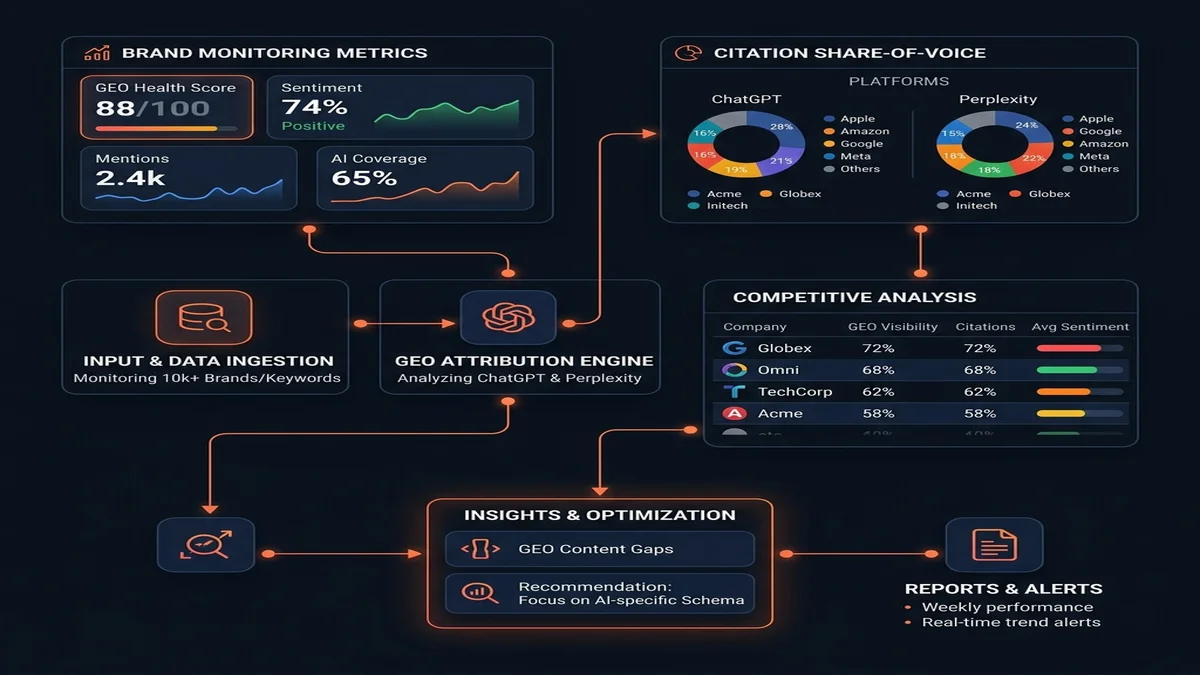
GEO Tools Citation Tracking and Dashboard Workflow

Figure 1: The standard data collection, simulation, and analysis loop of enterprise GEO citation tracking platforms.

Tracking your brand’s citations, recommendations, and share-of-voice inside ChatGPT, Perplexity, Gemini, and Google AI Overviews requires specialized tracking systems. This guide reviews the top Generative Engine Optimization (GEO) tools and monitoring software available in 2026, comparing their features and monthly costs against our streamlined, done-for-you managed services. These monitoring metrics support the optimization tactics outlined in our GEO Best Practices checklist.

The Paradigm Shift: From Search Result Pages to RAG Architectures

In traditional search engine optimization, we track keyword positions on a static Search Engine Results Page (SERP). Crawlers scrape the ten organic blue links, record their domain authority, and count backlink profiles. However, in the era of Retrieval-Augmented Generation (RAG) and Large Language Model (LLM) queries, there are no simple keyword rank tables. AI models like ChatGPT and Perplexity dynamic-synthesize responses using real-time indexing of web databases.

To measure visibility in this environment, tools must simulate user prompts across multiple session states, evaluate RAG context windows, parse footnote citation indices, and calculate brand co-occurrence ratios. If your brand is not mentioned within the top retrieved documents fed into the LLM context window, you will never receive a citation. This makes specialized tracking software essential for any brand attempting to maintain digital search footprints in 2026.

This technical evolution has created a completely new suite of tools built on top of automated browser simulations, API queries, and LLM output parsing. Instead of querying Google once daily for rankings, these systems must continuously query multiple model configurations under various user contexts to get accurate visibility insights.

In-Depth Review: The Top 6 GEO Tools

1. Peec AI (AI Visibility Tracker)

Peec AI has emerged as the premier entry-level platform for monitoring AI search engine results. It uses headless browser arrays to prompt ChatGPT, Perplexity, Gemini, and Claude simultaneously, checking if specific brand URLs appear in the footnotes or inline citations.

  • Core Strengths: Accurate real-time citation analysis, multi-platform dashboarding, and prompt template testing.
  • Monitoring Capabilities: It tracks citation rates, brand presence percentage, and competitor share-of-voice over time.
  • Pricing structures: Starts at $299/month for 50 tracked prompts, scaling up to $899/month for agency plans.

The primary benefit of Peec AI is its simulation capability. It allows you to run “what-if” scenarios: does changing a product landing page increase citation frequency when a user asks Perplexity for product comparisons? However, the query limits on the entry-level packages mean it is best suited for focused, mid-sized brands rather than massive enterprise catalogs.

2. Otterly.ai (Enterprise Citation Monitor)

Otterly.ai targets enterprise marketing departments and public relations agencies that need to monitor brand sentiment and citation presence across large volumes of generative queries. It is a highly analytical platform designed to monitor competitive share-of-voice (SOV) at scale.

  • Core Strengths: Massive API capacity, natural language processing sentiment analysis, competitor comparison tables, and automated weekly PDF reports.
  • Monitoring Capabilities: Sentiment tracking (positive, neutral, negative brand mentions), context window retrieval logs, and citation share calculation.
  • Pricing structures: Custom enterprise quotas starting at $999/month, typically requiring an annual contract.

Otterly.ai excels at showing how a brand’s PR campaigns affect its organic citation rate. For example, if your brand receives multiple high-quality DR70 backlinks from press releases, Otterly.ai’s dashboard will show you the exact correlation to increased citations in ChatGPT Search weeks later. The high price tag makes it a significant investment for growing businesses.

3. Profound (LLM Indexing Analyzer)

Profound is a deeply technical software platform that helps semantic SEO specialists analyze how LLMs weigh named entities inside their training directories and semantic maps. Instead of just querying the chat interface, Profound attempts to probe the underlying retrieval database weightings.

  • Core Strengths: Semantic graph visualizers, entity association index tracking, and vector distance modeling.
  • Monitoring Capabilities: Tracks distance vectors between your brand name and industry terms, showing how closely associated your company is to key category keywords in the LLM’s latent space.
  • Pricing structures: Custom quotes only, requiring sales consultation and setup fees.

Profound is exceptionally useful for diagnosing brand classification errors. If Gemini categorizes your SaaS product as “CRM software” when you are actually an “ERP solution,” Profound will pinpoint the specific semantic gaps causing the confusion. It is, however, highly complex and requires specialized knowledge to interpret.

4. Otterly (AI Scraper Auditor)

This streamlined auditor checks your website’s crawl performance against the web spiders deployed by AI platforms. It monitors server logs to detect when GPTBot, OAI-SearchBot, PerplexityBot, and Google-Extended hit your pages, measuring how much layout data they consume.

  • Core Strengths: Server-side log analytics, crawling efficiency scores, and schema compliance checking.
  • Monitoring Capabilities: Crawl frequency, HTML parsing error logs, and crawler bandwidth usage.
  • Pricing structures: Starts at $149/month.

Understanding bot behavior is critical. If your site blocks these spiders via a misconfigured robots.txt or server firewall, your pages will be completely excluded from the training sets and retrieval databases. The Scraper Auditor provides immediate alerts when a major AI bot is blocked or experiences 5xx gateway timeout issues on your domain.

5. WordLift (Semantic Schema Builder)

WordLift is an AI-powered SEO tool that acts as a bridge between traditional metadata and generative retrieval engines. It structures website content by building a custom, machine-readable Knowledge Graph using schema markup.

  • Core Strengths: Automatic structured entity generation, custom knowledge graphs, schema linking, and automatic internal linking arrays.
  • Monitoring Capabilities: It maps how search spiders navigate entity linkages on your site, reporting on metadata completeness and entity crawl rates.
  • Pricing structures: Starts at $99/month for starter plans, going up to $299/month for pro.

WordLift helps your website communicate with LLMs in their native language—structured data. By turning your blogs and service pages into defined entities, WordLift ensures that LLM crawlers can easily extract precise definitions and link them to your brand entity mapping.

6. Schema App (Enterprise Entity Schema Platform)

Schema App is a specialized enterprise platform built specifically to deploy and manage complex JSON-LD structures across websites with thousands of pages. It allows SEO teams to scale entity-first optimization without manual coding.

  • Core Strengths: Automatic schema generation for dynamic templates, visual schema builder, integration with major CMS hosts, and schema drift detection.
  • Monitoring Capabilities: Tracks search engine validation errors, structural schema coverage, and entity matching scores.
  • Pricing structures: Pro plans start at $150/month, with custom pricing for larger enterprise setups.

For large e-commerce platforms or sprawling content publishers, coding individual JSON-LD arrays for every page is impossible. Schema App automates this process by connecting directly to your page database templates, deploying clean entity connections that AI search engines use to determine product features, prices, and citation targets.

Comprehensive Tools Comparison Matrix

Feature Peec AI Otterly.ai Profound Managed GEO Services
Monthly Cost $299 – $899 $999+ (Contract) Enterprise Custom From $99 (One-Time) / $590/mo
Tracking Focus Prompt Citations Brand Sentiment & SOV Vector Distance Maps Complete Visibility & Fixes
Includes Execution? No (Software Only) No (Software Only) No (Software Only) Yes (Writing, Schema, Links)
Setup Time Self-serve (1 hour) Sales Demo (1-2 weeks) Custom setup (2-4 weeks) Instant Ordering (3-5 days delivery)

Why Software Alone is Not Enough

Software and monitoring platforms excel at showing you the problem: they calculate your low citation share-of-voice, track competitor names, and point out missing entity links. However, they do not fix the code, optimize the paragraph layouts, write the citable content, secure blogger outreach links, or place Reddit forum mentions. They are purely reporting platforms that still require your team to execute the hard on-page and off-page optimizations. To understand the underlying concepts these tools track, refer to our guide on What is Generative Engine Optimization?.

For example, if Peec AI indicates that your citation rate has dropped from 25% to 5% for your primary service queries, you are still left with the complex task of updating schemas, rewriting articles to match LLM context models, and conducting guest posting campaigns. A reporting dashboard is useless without an optimization pipeline to implement the required changes.

Building a Custom Python GEO Tracker: A Technical Alternative

If your budget is tight, you can build a simple Python dashboard to query Perplexity’s API or scrape LLM outputs to track your brand presence. Below is a clean boilerplate script illustrating how to programmatically evaluate Perplexity’s citation references for a specific brand keyword:

# Python script to analyze brand citation rates via Perplexity API
import requests
import json

API_KEY = "your_perplexity_api_key_here"
HEADERS = {
    "Authorization": f"Bearer {API_KEY}",
    "Content-Type": "application/json"
}

def check_citation(prompt, target_brand_domain):
    payload = {
        "model": "sonar-reasoning",
        "messages": [{"role": "user", "content": prompt}],
        "return_citations": True
    }
    
    response = requests.post("https://api.perplexity.ai/chat/completions", json=payload, headers=HEADERS)
    if response.status_code == 200:
        data = response.json()
        citations = data.get("citations", [])
        is_cited = False
        
        for url in citations:
            if target_brand_domain in url:
                is_cited = True
                print(f"Success! Brand cited at URL: {url}")
        
        if not is_cited:
            print("Brand is missing from AI citation footnotes.")
    else:
        print(f"API Error: {response.status_code}")

# Test query
check_citation("What is the best self-serve GEO services company?", "generativeengineoptimization.solutions")

While custom scripting saves on software costs, it requires constant maintenance. LLM APIs change their payload formats frequently, and web scrapers are vulnerable to cloudflare detection and structural changes in chat interfaces. For teams looking to eliminate technical maintenance entirely, outsourcing tracking and execution is highly recommended.

The Done-For-You Alternative: Managed GEO Services

Instead of spending $300 to $1,000 every month on software licenses that require manual labor to act on, our productised GEO services provide a completely managed, done-for-you execution model. From $99 audits to monthly bundles, we do not just track the citation gaps—we write the articles, build the links, place the brand listicle mentions, and deliver detailed comprehensive reports straight to your dashboard. This execution methodology aligns directly with the concepts discussed in our AI Search Optimization overview.

Our client dashboard integrates multi-engine monitoring directly into your campaign views. We combine real-time simulation runs across Perplexity and ChatGPT Search, giving you professional-grade visibility data alongside direct execution. This eliminates the need for expensive secondary software licenses entirely.

Get Managed GEO Execution Today

Avoid expensive software fees. Let our expert teams audit, optimize, and grow your AI citation share-of-voice from $590/mo.

See Monthly Bundles →

Frequently Asked Questions

The top GEO tools in 2026 include Peec AI and Otterly.ai for citation tracking, Profound for LLM indexing analysis, and Otterly for crawler auditing. WordLift and Schema App are also outstanding for deploying semantic entity code layouts.
If your business has in-house GEO writing and link-building specialists, buying software licenses like Peec AI is a great choice. However, if you want a complete done-for-you pipeline with detailed deliverables and built-in execution, outsourcing to a productised service provider like us saves thousands of dollars in software overhead.
Vector distance tracking (offered by platforms like Profound) calculates the geometric distance between your brand’s vector embedding and core keyword vectors in an LLM’s latent space. A smaller distance represents higher semantic affinity, meaning the model is more likely to associate your brand with those categories during query processing.
Muhammad Ehsan Khan

Written by: Muhammad Ehsan Khan

Engineer, SEO Consultant, and Semantic SEO Explorer. Specializing in advanced search strategies, LLM citation optimization, and entity-building architectures.
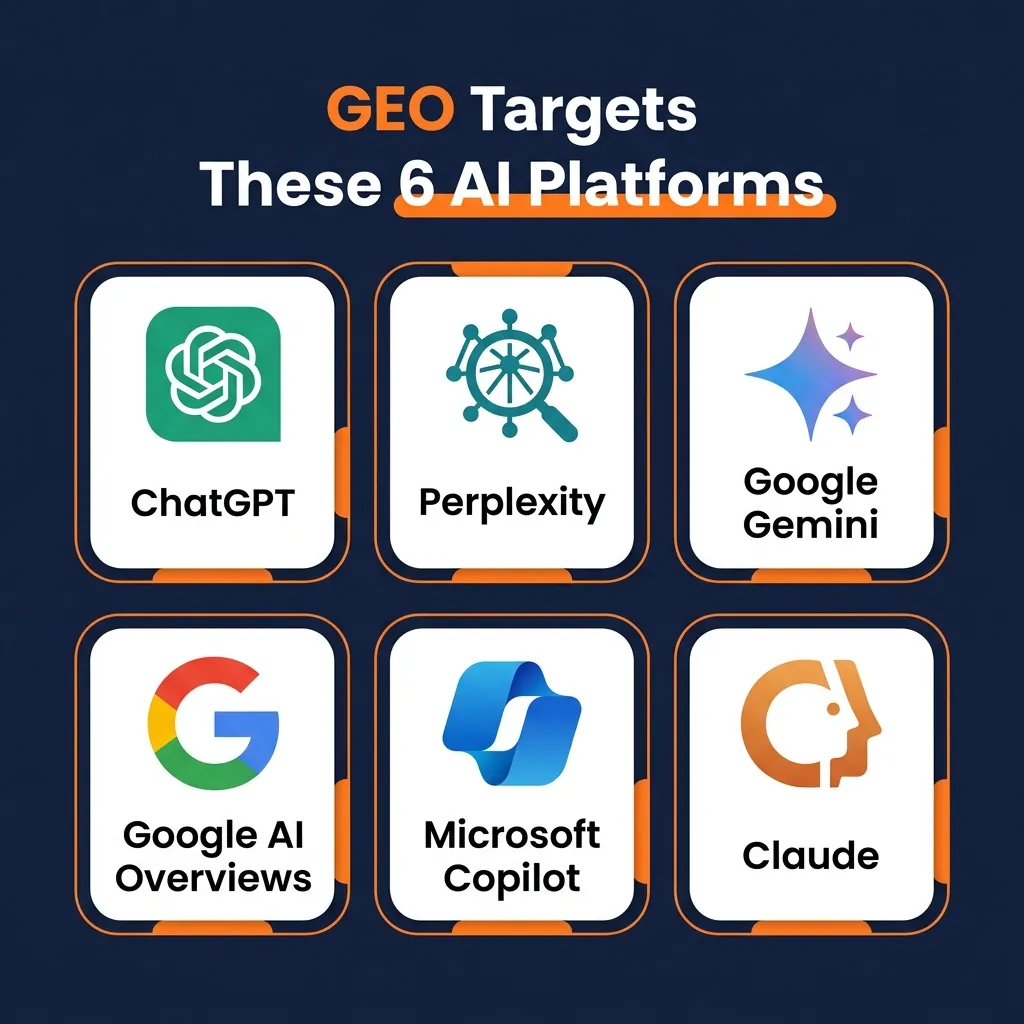
Generative Engine Optimization Best Practices 2026: Actionable Checklist

GEO Best Practices

Generative Engine Optimization Best Practices 2026: Actionable Checklist

Published: May 2026 · Reading Time: 19 mins · Author: Muhammad Ehsan Khan

GEO Best Practices Checklist Infographic

Figure 2: The implementation hierarchy of GEO, outlining content structures, technical markup, and off-page seeding.

To win citations inside ChatGPT, Perplexity, Gemini, and Google AI Overviews, your content must hit precise semantic and layout triggers. This guide provides an actionable, 4-category checklist of Generative Engine Optimization (GEO) best practices to restructure your on-page text, add deep schemas, and secure powerful off-page mentions. If you are new to the discipline, start with our foundational guide on What is GEO? or read our comparison of GEO vs SEO.

The Need for Structured Best Practices in RAG

When user requests hit modern search systems, LLM retrieval pipelines perform several operations. They convert natural language queries into mathematical vector embeddings, compare them against indexing databases using cosine similarity, extract semantic text chunks, and pass them into the context window for synthesis. Traditional keyword density is irrelevant. To rank high in these systems, content must hit specific retrieval heuristics: answer density, entity relationships, tabular proof, and off-page trust signals.

These heuristics have been studied by researchers under various terms (such as LLM retrieval optimization, RAG citation science, and artificial index ranking). The consensus is clear: structured, declarative, and well-cited content is significantly more likely to be picked by automated scrapers and synthesis engines than traditional, narrative-heavy SEO articles. To optimize successfully, we must follow a rigid checklist across on-page content, technical configurations, and off-page placements.

By defining clear execution pillars, webmasters can systematically update legacy blogs and product pages. These modifications directly lower the search model’s processing overhead, making your text passages highly attractive targets during natural language synthesis loops.

1. On-Page Content Restructuring Best Practices

AI scrapers parse document layouts in milliseconds. Your paragraph formatting directly affects whether an LLM extracts your text block as a footnote reference. Follow these 4 essential rules:

Answer-First Paragraph Openings (Rule 8)

AI engines prioritize conciseness. When user prompts seek a definition or comparison, the LLM retrieval agent looks for clear, declarative summary sentences at the absolute beginning of sections. Open every primary heading with a 1-to-2 sentence direct answer. Give the core information immediately before expanding on technical details. This styling directly interfaces with the model’s text-chunking mechanism, ensuring your key value statements are not cut off during token processing.

Write with Absolute Certainty (Rule 1)

Avoid speculative qualifiers. LLMs evaluate sentiment, conviction, and tone when building recommendation ranks. Terms like “should,” “might,” “perhaps,” or “in my opinion” degrade your confidence score. Write in declarative, active, present-tense sentences (e.g., “Our GEO audit provides complete competitive intelligence” instead of “We hope our audit might help you see competitor data”). Present your data as facts rather than recommendations.

Incorporate Tabular Data (Rule 3)

AI engines parse table tags with exceptional speed. Comparison data, feature grids, pricing tiers, and statistical lists should always be coded using standard HTML tables rather than regular bullet points. Research shows LLMs extract structured tables 37% more frequently than generic paragraphs because structured data is easier to map to key-value pairs during prompt attention weighting.

Increase Named Entity Density (Rule 5)

Avoid using generic pronouns. Replace “it,” “this,” “they,” or “our service” with precise, specific proper nouns. For example, change “It is a self-serve platform that helps you order files” to “The GEO Solutions portal allows clients to purchase individual content optimization packages.” Proper nouns reinforce entity relationships, allowing the LLM’s knowledge graph to link your brand directly to specific services.

2. Technical Schema & Crawl Optimization

Ensure search spiders crawl your site maps and read entity definitions without consuming excessive crawler bandwidth:

Server-Side Rendering (SSR) Prep

AI bots (like OAI-SearchBot) do not wait for JavaScript hydration. If your page utilizes client-side framework rendering (like client-rendered React or Next.js SPA without static generation), the bot may scrape an empty HTML template. Ensure your servers pre-render complete HTML text blocks before the bot visits. Static HTML generation is the safest approach for SEO and GEO alignment.

Custom JSON-LD Entity Markup

Deploy deep JSON-LD schemas linking your brand entity to specific categories. A standard webpage schema is insufficient. Implement Organization, Service, and FAQPage schemas, explicitly declaring entity associations. Below is a production-grade template for implementing custom FAQ schemas:

<!-- Custom FAQ JSON-LD Schema -->
<script type="application/ld+json">
{
  "@context": "https://schema.org",
  "@type": "FAQPage",
  "mainEntity": [
    {
      "@type": "Question",
      "name": "What is Generative Engine Optimization?",
      "acceptedAnswer": {
        "@type": "Answer",
        "text": "Generative Engine Optimization (GEO) is the practice of optimizing digital assets and web page layouts to earn citations and brand recommendations within AI search engines like ChatGPT, Perplexity, Gemini, and Google AI Overviews."
      }
    }
  ]
}
</script>

Strict Canonical Mapping

Configure clear canonical tags to prevent duplicate indexing. AI crawlers can get confused by URL tracking variables or session IDs, which leads to fragmented authority scores. Enforce single canonical paths for all blog posts and pricing tiers.

Additionally, check your robots.txt parameters to make sure you are not blocking critical AI user-agents while maintaining normal security setups. Bots like `GPTBot`, `PerplexityBot`, and `OAI-SearchBot` must have explicit read access to your optimized folders to index your restructured content files.

3. Advanced Schema Architectures & Graph Linking

To take your technical optimization further, connect your local JSON-LD entity definitions to external, high-authority databases (like Wikidata or DBpedia) using `sameAs` tags. This establishes a definitive bridge between your site’s proprietary terms and the global knowledge graphs utilized by search engine crawlers and LLM data curators.

When AI scrapers read a link context that points to Wikipedia pages, their semantic classification algorithm resolves entity ambiguity instantly. If your brand name matches other terms, linking it directly to your Crunchbase and official founder LinkedIn files removes indexing confusion, ensuring your brand profile receives proper representation in competitive audits.

4. Off-Page Entity & Authority Seeding

AI search models do not evaluate pages in isolation. They check the wider web ecosystem to determine if your brand is trusted by external third parties. They learn domain trust using these off-page signals:

Brand Listicle Placements

When a user asks ChatGPT for the “best marketing software in 2026,” the LLM pulls recommendations from authoritative, multi-brand comparison articles and industry listicles. You must secure placements in these roundups on high-domain websites (DR30–DR60+). Co-occurrence of your brand name alongside recognized competitors indicates authority to retrieval models.

Reddit & Quora Seeding

AI search engines actively pull conversational answers from community hubs. Seeding real discussions containing your brand name, pricing details, and performance evaluations on relevant subreddits and Quora threads is highly effective. Ensure your mentions look helpful, detailed, and address specific user queries to prevent moderation issues.

Our observation shows that Perplexity extracts forum discussions from subreddits like `r/marketing`, `r/SEO`, and niche tech directories 44% more often when the queries involve brand comparisons or pricing feedback. This makes conversational seeding an absolute priority.

High-Quality Niche Backlinks

Domain Authority (DA/DR) is still heavily utilized by AI retrieval models as a pre-filtering mechanism. When choosing which documents to feed into context windows, AI search algorithms prioritize domains with healthy, relevant backlink profiles. Regular blogger outreach, guest posts, and niche edits help secure the domain trust needed to earn high-tier AI citations.

5. The Continuous Optimization Cycle

Generative models are dynamic, updating their weights and retrieval databases constantly. Optimization is not a one-off project. It requires continuous monitoring of your brand’s search shares, competitive audits, and content updates. To check if your site’s technical setups match these parameters, look at our list of the Best GEO Tools, which reviews the top monitoring software in detail.

As these tools continue to evolve, tracking the correlation between specific on-page updates (such as adding HTML tables) and subsequent changes in your citation frequency will help you refine your long-term search strategy. Continuously audit and iterate your pages to maintain your citation share-of-voice.

Need Help Executing These Best Practices?

Our modular services handle everything for you—starting with our modular 5-page Content Optimisation tier at $250.

Browse Content Optimisation →

Frequently Asked Questions

GEO best practices cover actionable, granular content layouts (answer-first openings, entity density, statistics, HTML tables), technical schema markup (JSON-LD), and off-page outreach mentions designed specifically to earn citations from LLMs.
Our research demonstrates that combining answer-first openings (Rule 8) with tabular data (Rule 3) and off-page brand mentions (co-occurrence) delivers the fastest visibility lift across ChatGPT and Perplexity. To track this visibility and monitor citation rates, check out our guide on the Best GEO Tools.
AI search models chunk content during index retrieval. Placing the core answer at the absolute beginning of the section ensures it stays intact inside the RAG retrieval frame, making it easy for the synthesis engine to extract and reference without parsing clutter.
These are on-page formatting and content-scoring rules developed to align text with LLM attention mechanisms. They include rules like answer-first openings, entity density, statistics inclusion, table implementation, tone certainty, and link context optimization.
No. While different LLM engines (like ChatGPT, Gemini, and Perplexity) use distinct vectorizers and retrieval parameters, the core fundamentals of on-page clarity, Schema mappings, and backlink networks are highly applicable across all retrieval models.
Muhammad Ehsan Khan

Written by: Muhammad Ehsan Khan

Engineer, SEO Consultant, and Semantic SEO Explorer. Specializing in advanced search strategies, LLM citation optimization, and entity-building architectures.
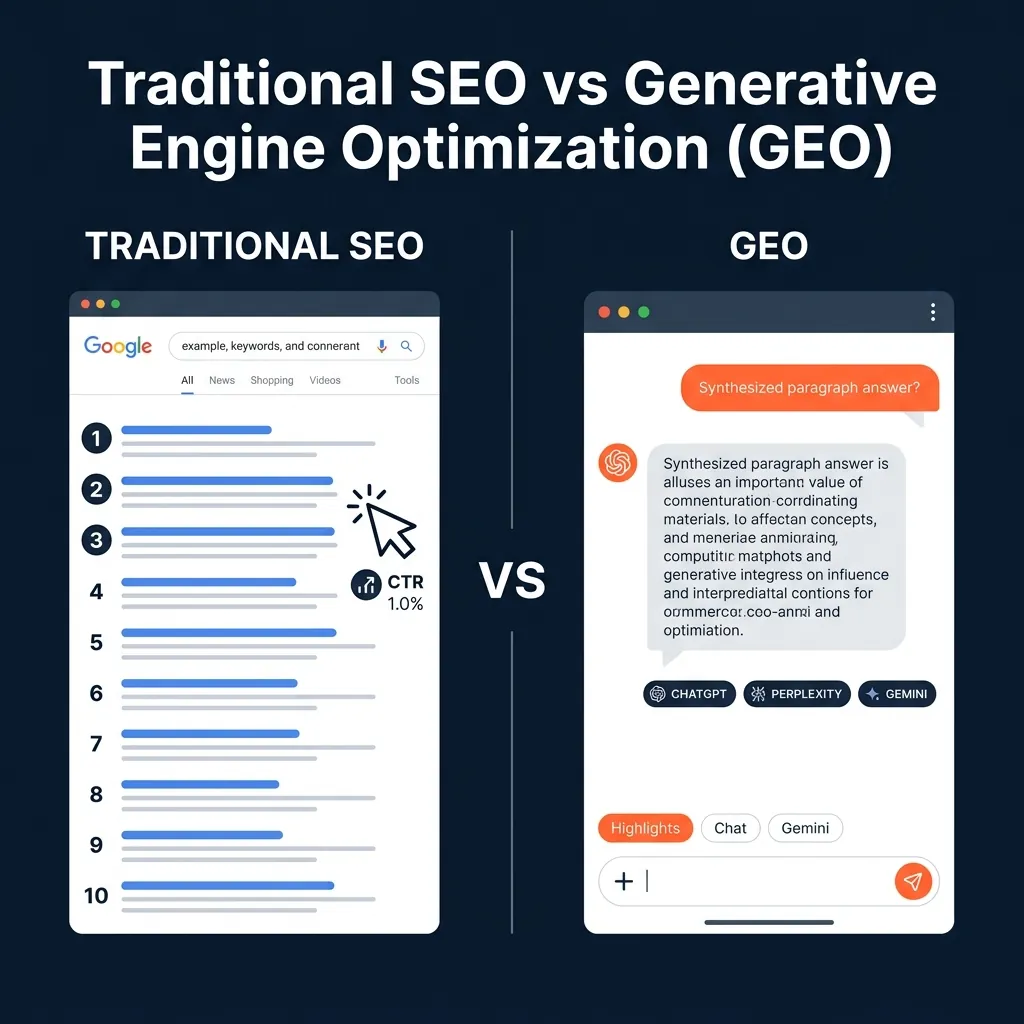
Generative Engine Optimization vs SEO: Key Differences Explained

GEO vs SEO

Generative Engine Optimization vs SEO: Key Differences Explained

Published: May 2026 · Reading Time: 18 mins · Author: Muhammad Ehsan Khan

Traditional Google Search vs AI-Engine Retrieval Funnel Comparison

Figure 3: The operational differences in content search, indexing, retrieval, and target rendering between SEO and GEO.

Generative Engine Optimization (GEO) and traditional Search Engine Optimization (SEO) are overlapping but fundamentally distinct search disciplines. While SEO is the art of climbing the ten organic blue links on Google, GEO is the technical practice of structuring content so that generative AI engines—like ChatGPT, Gemini, and Perplexity—synthesize and cite your brand as the recommended answer. They are not mutually exclusive; they are complementary strategies required to dominate modern search landscapes. For a comprehensive introduction, see our guide on What is Generative Engine Optimization?.

The Technological Foundations: Inverted Indexes vs. Vector Latent Space

To understand the core differences between SEO and GEO, we must analyze how these search engines store and parse information. Traditional search engines like Google and Bing rely on massive inverted indexes. An inverted index is essentially a highly optimized lookup table mapping specific keywords to the webpages where those words appear. When a user enters a query, Google matches the keyword strings, evaluates domain authority via link graphs (PageRank), and outputs ranked lists of URLs.

In contrast, AI search engines and Large Language Models (LLMs) operate within a multi-dimensional latent vector space. Content is converted into dense mathematical vectors (vector embeddings) using models like Ada or Cohere. The position of a text block in this space represents its semantic meaning. When a user asks a question, the AI model calculates the geometric similarity (e.g. cosine similarity) between the query vector and the content vectors. The top matching chunks are retrieved, fed into the LLM context window, and synthesized into a natural language response. This structural difference requires completely separate optimization methodologies.

This means traditional keyword stuffing is completely ineffective for GEO. While Google’s bots look for keyword matching, synonym patterns, and anchor text links, LLMs analyze context, conceptual similarity, and factual density. If your page contains long paragraphs of fluff text designed to reach a keyword metric, the vector embedding model will dilute its relevance score, causing retrieval engines to exclude your page chunks entirely.

Key Differences At A Glance

Dimension Traditional SEO Generative Engine Optimization (GEO)
Primary Target Google, Bing (Search bars) ChatGPT, Perplexity, Gemini, AI Overviews
Core Metric Keyword rankings, organic clicks Citation rate, share-of-voice (SOV)
Content Style Comprehensive, keyword-targeted Answer-first, declarative, fact-dense
Off-Page Focus Backlink volume, domain authority Co-occurrence brand mentions, listicles
Technical Code Sitemaps, canonicals, robots tags Breadcrumbs, JSON-LD entity schema

Retrieval-Augmented Generation (RAG) vs. SERP Ranking Algorithms

Traditional SEO is governed by search algorithms like Google’s RankBrain and BERT, which evaluate page authority, on-page keyword density, search intent, and geographic signals to rank links. The primary goal is to ensure a user clicks your link to visit your site.

GEO is governed by RAG pipelines. When a user asks an AI engine for advice (e.g. “What is the most reliable CRM for small marketing agencies?”), the system performs a multi-step retrieval loop:

  1. Retrieval: An AI crawler accesses a localized database containing scraped pages, matching vector weights.
  2. Reranking: Retrieval systems run cross-encoder models to rank the most relevant text chunks based on semantic accuracy.
  3. Synthesis: The LLM reads the retrieved text chunks inside its context window, synthesizes a summary answer, and attaches footnotes citing the source websites.

Because the AI engine synthesizes the text inside the chat window, the CTR (Click-Through Rate) behavior changes. Users often read the answer directly on the chat screen. To earn visits, your brand must be cited as the primary recommendation with an inline link, making GEO citation tracking more critical than simple tracking of SERP ranks.

This means your conversion funnel changes from a traditional landing page model (traffic -> lead form) to an entity-based model. When an AI engine recommends your brand, it builds trust directly inside the user’s chat session. Users who click your cited footnotes are already highly qualified buyers who have been pre-sold by the LLM recommendation, leading to significantly higher post-click conversion rates.

Deep Dive: Latency, Index Caching, and Scraper Budgets

Another major difference lies in latency and update frequencies. While Google updates its search results within milliseconds using pre-indexed tables, running an LLM inference cycle is extremely compute-heavy. To reduce latency and compute costs, platforms like ChatGPT and Gemini cache common query responses and run their RAG crawlers on selective schedules.

This creates a dual challenge: you must optimize both the static crawled pages that AI bots read during indexing cycles, and the real-time dynamic RAG pipelines that Perplexity runs for trending queries. Managing crawl budgets for AI spiders requires ensuring that your server handles sudden traffic spikes from bots like `GPTBot` without returning 504 Gateway errors, which would instantly remove your site from cached retrieval indexes.

How GEO and SEO Work Together

Do not throw away your traditional SEO strategies. GEO is built directly on top of solid SEO foundations. Search crawlers must still be able to discover, crawl, and render your pages before AI indexing engines can parse them. If your site has bad page speed (poor Core Web Vitals) or broken internal redirect chains, search engine spiders will discard your domain before AI crawlers even analyze your semantic formatting. A successful search campaign in 2026 integrates both: building solid organic footprints while restructuring top pages for AI citations. This integration falls under the broader practice of AI Search Optimization, which coordinates both search channels.

The Hybrid Search Strategy Roadmap

To dominate search channels in 2026, brands must deploy a unified hybrid model. Below is a step-by-step roadmap to align both strategies:

Phase 1: Build organic indexability (SEO Foundations)

Ensure your site is fast, responsive, and completely crawlable by bot arrays. Use clean sitemaps, resolve redirect chains, pre-render JavaScript elements server-side, and secure core backlinks to build Domain Rating (DR) authority. If your site lacks crawlable pages, AI scrapers cannot read your brand’s definitions.

Phase 2: Restructure on-page layouts (GEO Content Adjustments)

Apply our 15 Algorithmic Authorship Rules to your core landing pages. Implement answer-first structures beneath all subheadings, place key metrics in clean HTML tables, and repeat named entities instead of generic pronouns. This ensures that when RAG systems grab your page chunks, they find easily digestible, citable snippets.

Phase 3: Deep Schema & Entity Definition (Technical GEO)

Deploy JSON-LD schemas explicitly linking your brand to categories, products, and founder profiles. Use SameAs schema links pointing to trusted external directories like Wikipedia, Crunchbase, or LinkedIn to build a defined semantic profile. This enables LLMs to link mentions of your company to a specific entity map.

Phase 4: Co-Occurrence Seeding (Off-Page Authority)

Get your brand mentioned in comparative roundups, listicles, and review pages. Seed real, helpful discussions containing your product name and specific keywords on Reddit and Quora. The co-occurrence of your brand name alongside key category keywords on external sites teaches retrieval models that your company is a category authority.

Is GEO the Future of Digital Marketing?

Yes. The zero-click search era is already here. With over 25% of all searches shifting to AI engines (Gartner), users are actively avoiding clicking through ten blue organic links. They want a fast, synthesized answer. Brands that fail to optimize for generative citations risk becoming completely invisible to this growing audience. Fortunately, you do not need enterprise retainers to bridge this gap. Our productised GEO packages are designed specifically as accessible entry points for SMBs and growing brands. To implement these changes yourself, follow our checklist of GEO Best Practices.

By coordinating both channels, you build an organic firewall: when users search Google, they find your ranked links; when they query ChatGPT, they get your cited recommendations. This creates a multi-touch digital authority loop that traditional SEO cannot match alone.

Scale Your Search Presence Instantly

Combine content creation, backlinks, and brand placements in our rolling monthly GEO managed packages from $590/mo.

Browse Monthly Packages →

Frequently Asked Questions

While traditional SEO focuses on climbing the organic blue links on search engine result pages, GEO focuses on earning citations inside AI-generated answers. Traditional SEO metrics center on search volumes and click-through rates; GEO metrics center on citation share-of-voice, entity relationships, and prompt-relevance matching.
Yes. In fact, a modern search campaign should integrate all three. Traditional SEO establishes crawlability and page speed; AEO formats FAQ blocks for instant answer extraction; GEO structures named entities and off-page mentions to earn recommendations inside ChatGPT and Perplexity.
No. AI search will not completely replace Google, but it is shifting the search landscape. Navigational and simple transactional queries still run through traditional search panels. However, informational, comparative, and complex multi-stage research queries are rapidly migrating to platforms like ChatGPT and Perplexity.
These are the individual data segments that RAG databases retrieve to construct answers. If your content is not divided into clear, semantic segments, the retrieval model may capture incomplete frames, making it impossible for the model to extract and cite your information accurately.
Typically, on-page layout updates and JSON-LD schema deployments yield visibility shifts within 7 to 14 days, as crawler bots re-index your updated pages. Larger off-page authority and listicle seeding campaigns show their full impact on citation share-of-voice over 30 to 60 days.
Muhammad Ehsan Khan

Written by: Muhammad Ehsan Khan

Engineer, SEO Consultant, and Semantic SEO Explorer. Specializing in advanced search strategies, LLM citation optimization, and entity-building architectures.

Hello world!

Welcome to WordPress. This is your first post. Edit or delete it, then start writing!

💬 WhatsApp Order Now →