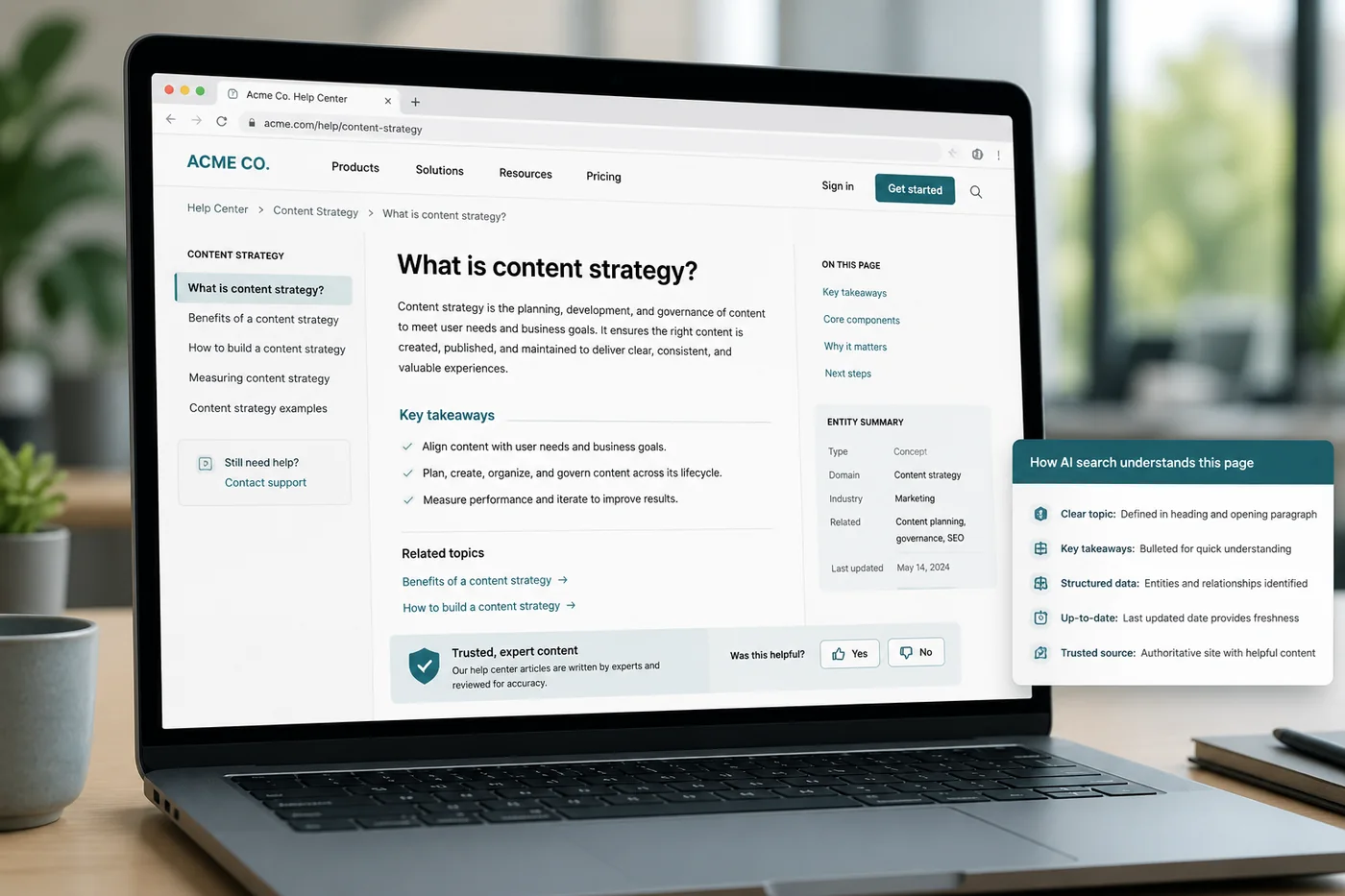
How to Rank a Local Business in ChatGPT Search
Published: June 2026 · Reading Time: 11 mins · Author: Muhammad Ehsan Khan
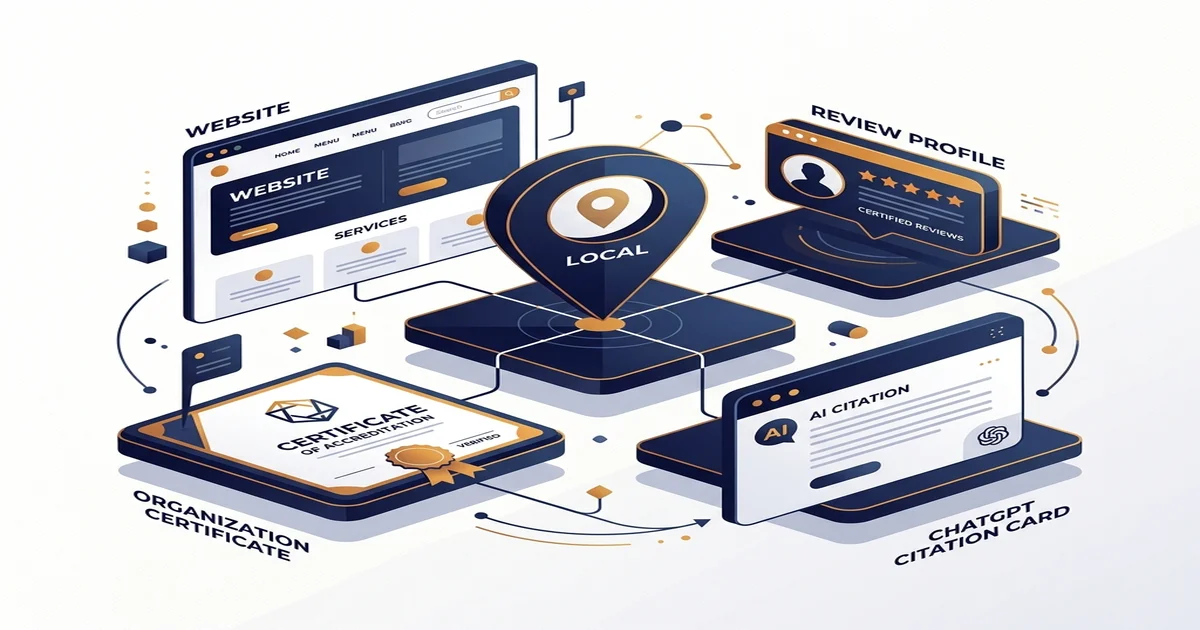
Editorial Boundary
OpenAI does not publish fixed ranking weights, a citation-selection formula, or a private recommendation score. This guide separates official documentation, an observed local-provider retrieval test, and practical actions that improve crawl access, discovery, relevance, verification, and conversion.
A local business improves its chance of appearing in ChatGPT Search when its website is crawlable, discoverable through search, directly relevant to the user’s service and location, tied to a clear real-world business entity, and supported by verifiable reviews, credentials, profiles, and local proof. No public checklist can guarantee a recommendation, because OpenAI does not publish fixed ranking weights or a guaranteed placement system. The practical goal is to become easy to find, easy to verify, easy to cite, and safe to recommend.
This guide uses three evidence labels:
- Documented behavior: confirmed in official OpenAI, Google, or Bing documentation.
- Observed behavior: recorded during a live local-provider search and verification test.
- Practical inference: an action that logically improves discovery, clarity, verification, or conversion, without being presented as a private ChatGPT ranking factor.
The core principle: Keyword relevance can put a business into the candidate pool. Independent verification can raise recommendation confidence. Clear factual pages make the business easier to cite.
1. What “Ranking in ChatGPT” Means for a Local Business
ChatGPT Search does not present one permanent local ranking list. The result can change with the wording of the prompt, the user’s location, the search queries generated from the prompt, current search results, and the sources available at that moment. A local business should measure four separate outcomes rather than treating visibility as one position.
| Visibility level | What it means | What to measure |
|---|---|---|
| Discovery | ChatGPT or a search provider finds the website, listing, or profile. | Impressions, indexed pages, candidate appearance, crawler access |
| Citation | A page is linked as evidence for a statement in the answer. | Cited URL, supported claim, referral traffic |
| Recommendation | The business is selected as a suitable provider for the user’s request. | Appearance in provider lists, order, stated reason for selection |
| Conversion | The user has enough confidence to call, book, request a quote, or visit. | Calls, forms, bookings, qualified leads, revenue |
These outcomes are connected but not identical. A website may be discovered without being cited. A page may be cited for a price, service, or opening-hour fact without the business being recommended. A business may also be recommended through a well-maintained profile or directory while its own website receives no citation. This is a core reason why brands perform a local GEO audit to identify visibility bottlenecks.
2. What OpenAI Publicly Documents About ChatGPT Search
OpenAI states that ChatGPT Search can rewrite a user’s prompt into one or more targeted queries. After reviewing the initial results, it may send additional, more specific queries to search providers. OpenAI also states that general location derived from an IP address may be used to improve local results, and precise device location may be used when a user enables it. [1]
A prompt such as “Who provides mold removal in Kansas City?” can therefore lead to searches around related service, location, urgency, trust, and property-type needs, such as:
- mold-remediation companies in Kansas City
- mold removal Kansas City, Missouri
- emergency mold-remediation service Kansas City
- residential mold removal near Kansas City
- certified mold-remediation contractors Kansas City
- Kansas City mold-removal reviews
The lesson is direct: a site should not rely on one exact keyword. It needs pages and profiles that answer the related questions ChatGPT may search while trying to satisfy the original request. Similar query-expansion mechanisms are detailed in our foundational guide on What is Generative Engine Optimization (GEO).
3. The Local-Provider Retrieval Pattern Observed in Testing
In a mold-removal test, the broad request returned a mixed pool rather than a clean list of providers. The pool included remediation companies, inspection-only firms, directories, government guidance pages, news pages, social profiles, and restoration companies. The search then became more specific, and individual businesses were checked through their websites, public profiles, review sources, and service pages.
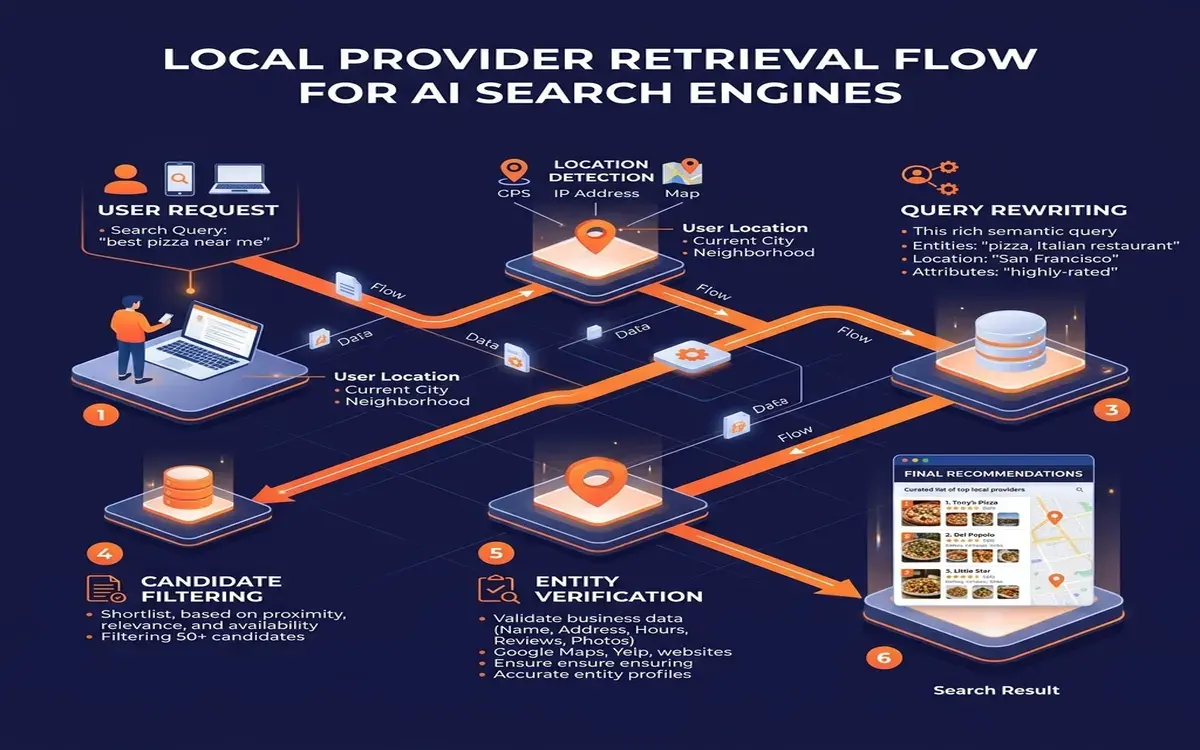
This flow is an observed working model, not a published OpenAI algorithm. It is useful because it shows where a local business can fail: the business may never enter the candidate pool, may not match the exact need, may be hard to connect to a real entity, or may contain claims that cannot be confirmed.
4. Why a Highly Relevant Local Website Can Still Be Missed
Our retrieval test showed that an exact-match domain can be highly relevant but absent from the initial results. The site was reviewed only after its URL was supplied directly. That does not prove the site was penalized. It shows that relevance alone does not guarantee discovery or recommendation.
A relevant site may be missed when:
- it does not surface for the rewritten search queries;
- its important pages are not indexed or have a limited search footprint;
- OAI-SearchBot or another search crawler is blocked;
- business names, phone numbers, addresses, or URLs conflict across profiles;
- the site lacks links connecting it to licensing, reviews, trade bodies, or a registered entity;
- the initial result pool is limited and established competitors occupy it.
An exact-match domain can make the subject clear, but the domain name does not prove that the company is established, licensed, insured, reviewed, local, available, or suitable for the user. To compare how these criteria differ from traditional SEO requirements, check our comparative guide on Generative Engine Optimization vs SEO.
5. The Seven-Stage Local ChatGPT Visibility Model
| Stage | Requirement | Failure example |
|---|---|---|
| 1. Crawl eligibility | The page is public and accessible to relevant crawlers. | robots.txt, firewall, CAPTCHA, or noindex blocks access |
| 2. Search discovery | The page or profile appears in search systems used during retrieval. | important URL is not indexed or lacks query coverage |
| 3. Query relevance | The page matches service, location, property type, urgency, and need. | generic page does not state exact service or area |
| 4. Entity resolution | The website connects to one stable real-world business. | conflicting names, numbers, addresses, or legal details |
| 5. Independent verification | Outside sources support reviews, credentials, identity, and service claims. | badges and ratings have no public source |
| 6. Recommendation suitability | The business fits the user’s requirements. | provider does not serve the area or property type |
| 7. Citation suitability | A page directly supports a factual statement in the answer. | marketing language does not prove the stated fact |
A strong local SEO program should audit every stage. Improving only content will not fix a crawler block. Adding reviews will not repair conflicting phone numbers. Addressing each of these requirements matches the standard checklist in our Generative Engine Optimization Best Practices.
6. Technical Foundation: Crawl Access and Indexing
6.1 Allow OAI-SearchBot
OpenAI identifies OAI-SearchBot as the crawler used to surface websites in ChatGPT Search. Sites that opt out will not be shown in ChatGPT Search answers, although a navigational link may still appear in some cases. OpenAI recommends allowing the crawler in robots.txt and allowing requests from its published IP ranges. [2]
User-agent: OAI-SearchBot
Allow: /
OAI-SearchBot and GPTBot have different purposes. OAI-SearchBot controls search visibility. GPTBot relates to content that may be used to improve OpenAI’s generative models. OpenAI states that these controls are independent. A site can allow search access while blocking GPTBot. [2]
6.2 Check the CDN, Firewall, and Bot Protection
A correct robots.txt file does not help when the hosting layer blocks the crawler. Review Cloudflare, hosting security, rate limits, and managed firewall rules. Test for 403 Forbidden responses, rate limits, and blocked OpenAI IP ranges. OpenAI publishes OAI-SearchBot’s user-agent string and IP range file dynamically. [2]
6.5 Maintain Google and Bing Discovery
OpenAI states that ChatGPT Search may send rewritten queries to search providers, including Bing. Good Bing and Google discoverability is therefore a sensible part of a ChatGPT Search strategy. [1] Utilize XML sitemaps, IndexNow, and search console submissions to speed notification. [5][6]
7. Business Entity, NAP, and Profile Consistency
A local business needs one stable identity that can be matched across the website and external sources. The system should not have to guess whether two names or numbers refer to the same company.
7.1 Use One Canonical Business Record
Use the same accurate information across the site and public profiles: public business name, address, verified telephone number, city, state, postal code, and license details. A different phone number on the footer, FAQ, schema, and Google profile creates a preventable verification problem. We handle this alignment as part of our GEO Entity Building services.
7.2 Complete the Google Business Profile
Google says local results are mainly based on relevance, distance, and prominence. Accurate profile data, categories, hours, services, reviews, and links support Google local visibility, which can also help a business become easier to discover and verify during wider search retrieval. [4] Our team handles complete Google Business Profile optimization under our GEO Entity Building service.
8. Service and Location Page Architecture
8.1 Build One Strong Primary Service-and-Location Page
A primary local service page should state the company, service, location, property types, availability, service boundaries, and contact method in the opening section. A direct opening is easier to interpret than a generic statement such as “We protect what matters most.” Brand language can follow after the service, location, and operating facts are clear.
8.2 Answer Customer Decision Questions
Customers often ask specific questions that matter more to them than a broad “best company” claim. These also give retrieval systems factual criteria for deciding whether the provider fits the request:
- Do you serve my location? Named cities, suburbs, states, and radius limits.
- Do you handle my problem? Specific services, materials, and property exclusions.
- Do you remove it or only inspect it? Clear boundaries between inspection and remediation.
- Are you licensed or certified? Issuer, license number, and direct verification link.
9. Citation-ready Content and Verifiable Claims
A citation supports a specific statement. The cited page should show the company, the fact, and the context clearly. If an answer says a company offers 24-hour emergency service across Kansas City, the source page should state all three facts. “We are always here for you” is not strong evidence for 24/7 availability.
9.1 Add Visible Fact Blocks
Tables are not a published ChatGPT ranking factor. They are useful because they reduce ambiguity for users and make business facts easier to scan, compare, and extract. We strongly recommend implementing structured tables as detailed in our GEO Content Creation guidelines.
9.2 Connect Every Trust Claim to Its Source
Local service websites often weaken their own credibility by publishing badges and numbers without verification. Link review ratings to the public review profile. Link certifications to the issuing organization or public directory. Show license and certificate numbers where public verification is available. One-click verification standard should be your design guideline.
10. Recommendation Confidence and External Proof
A provider can be a strong keyword match but a weak recommendation. Recommendation confidence rises when the service fit and location fit are backed by stable business data and independent proof.
Build Independent Corroboration: Placements in BBB profiles, state licensing databases, trade associations, and chamber profiles contribute to the brand’s entity authority score. This corroboration strategy is analyzed in depth in our guide on the Best GEO Tools for tracking citations.
11. Structured Data and Developer Implementation
Google states that LocalBusiness structured data can describe business details such as location and opening hours, while Organization structured data can help disambiguate an organization and its administrative details. [7][8] Structured data can support machine understanding, but OpenAI does not list schema as a guaranteed ChatGPT citation or recommendation factor. If you need assistance writing or validating these schema blocks, our GEO Content Optimisation service handles complete schema deployment.
<script type="application/ld+json">
{
  "@context": "https://schema.org",
  "@type": "LocalBusiness",
  "@id": "https://example.com/#business",
  "name": "ABC Mold Services",
  "legalName": "ABC Mold Services LLC",
  "url": "https://example.com/",
  "telephone": "+1-816-555-0123",
  "email": "service@example.com",
  "address": {
    "@type": "PostalAddress",
    "streetAddress": "123 Example Street",
    "addressLocality": "Kansas City",
    "addressRegion": "MO",
    "postalCode": "64101",
    "addressCountry": "US"
  },
  "areaServed": [
    {"@type": "City", "name": "Kansas City"},
    {"@type": "City", "name": "Overland Park"}
  ]
}
</script>
12. Tracking, Testing, and a 90-day Action Plan
OpenAI states that ChatGPT referral URLs include the parameter utm_source=chatgpt.com. Create an analytics segment for that source and measure landing pages, calls, forms, bookings, and revenue. [3] To see real-world performance metrics, check out our latest GEO Case Studies showing how local visibility directly drives calls and qualified leads.
| Period | Main work |
|---|---|
| Days 1-15 | Audit OAI-SearchBot access, robots.txt, canonicals, Google/Bing indexing, NAP, and profile ownership. |
| Days 16-30 | Improve the homepage and primary service-location page; add direct opening answers, visible facts, and LocalBusiness markup. |
| Days 31-60 | Build high-intent service pages and location pages; publish local case studies; verify licences; request genuine reviews. |
| Days 61-90 | Build relevant local references; track OAI-SearchBot and ChatGPT referrals; run prompt tests; update pages. |
13. Common Mistakes and FAQs
Ensure you avoid these classic mistakes: blocking OAI-SearchBot by mistake at your CDN level, having mismatched address records across reviews and your main domain, or relying on thin template city pages. Explore our comprehensive managed GEO service packages to let our specialists handle audit, optimization, and tracking for you.
Frequently Asked Questions

Written by: Muhammad Ehsan Khan
Engineer, SEO Consultant, and Semantic SEO Explorer. Specializing in advanced search strategies, LLM citation optimization, and entity-building architectures.