Generative Engine Optimization for E-Commerce Brands: Win the AI Shopping Recommendation
Published: July 2026 · Reading Time: 9 mins · Author: Muhammad Ehsan Khan

Get your products named when AI builds a shopper's buying guide. Our GEO and AEO services get your products cited in the comparison, buying-guide and "best product" answers that decide purchases.
The product page is no longer where a purchase decision starts. Shoppers describe what they need to ChatGPT, Perplexity or Google AI and get back a short list of options, and the brands on that list win the sale before the shopper ever opens a store. We fix your product data, build review and off-page authority, and write the guide content generative engines quote from.
That gets your catalog surfaced for the queries shoppers actually run: "best [product] for," "[product A] vs [product B]," and constraint-led searches like "waterproof, under $100."
- ✓ Cited across ChatGPT, Perplexity, Gemini and Google AI Overviews
- ✓ Win "best product," comparison and buying-guide queries
- ✓ Clean product schema, feed accuracy and review authority
- ✓ Fixed pricing, self-serve, no retainers or long contracts
1. E-Commerce Categories We Optimize for AI Shopping Search
We deliver GEO and AEO for online stores that want their products named when AI recommends what to buy. We get products cited for discovery, comparison, buying-guide and constraint-led queries across ChatGPT, Perplexity, Gemini and Google AI.
Categories we work across include:
- Fashion and apparel
- Beauty and skincare
- Health and supplements
- Home and kitchen
- Furniture and interiors
- Consumer electronics
- Sports, fitness and outdoor gear
- Baby, kids and toys
- Pet products
- Food, drink and specialty goods
- Jewelry and accessories
- DIY, tools and garden
Each category needs accurate product data, trusted review signals, and buying-guide content that answers how shoppers actually search. Our work teaches AI engines what you sell, who it suits, and why it belongs in the recommendation.
2. How Shoppers Now Ask AI What to Buy
Product discovery has moved into the chat window. As of 2026, roughly 80% of consumers plan to shop using generative AI and 61% already have, with ChatGPT the clear favorite among AI shoppers, one in four say its product picks beat Google's. The journey has compressed: instead of searching, opening a dozen tabs and comparing manually, a shopper asks for "a cordless vacuum for a small apartment under $200" and gets back one to three options.
The buyer who arrives this way is worth more. Shoppers referred from ChatGPT convert at roughly 1.7 times the rate of Google-referred shoppers, with around 11% higher average order value, because the AI has already matched the product to the need before the shopper lands on the page.
Here is the opening: only around 16% of brands currently track their AI search performance at all. Shopper behavior has outpaced retailer readiness, so the stores that fix their product data and review signals now win recommendations before their category catches up.
3. Where AI Sources Its Shopping Recommendations
This is the layer most stores never touch. When an AI engine builds a buyer's guide, it does not invent the shortlist, it pulls from the product data and third-party signals it has learned to trust. Knowing those sources is the whole strategy.
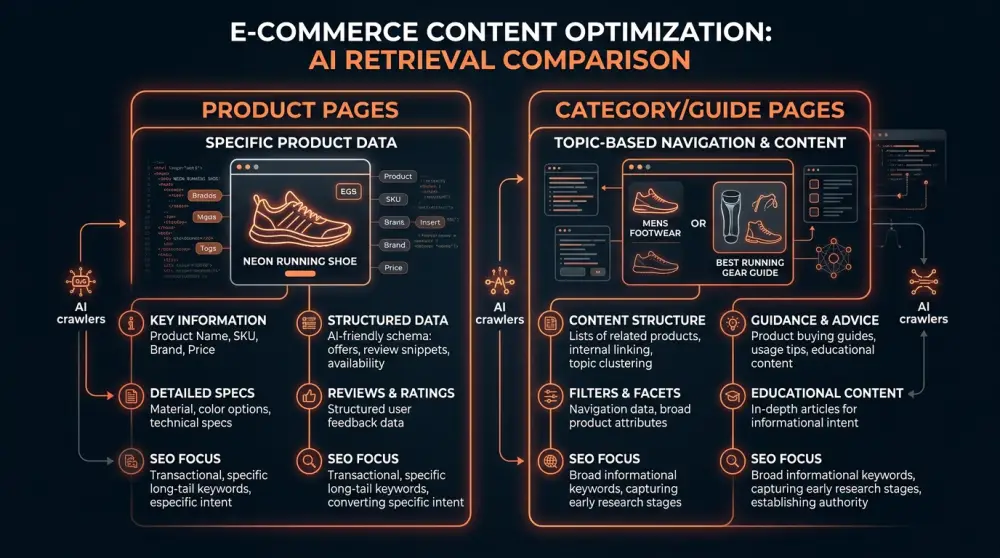
AI assembles shopping recommendations from a few signal types:
- Structured product data: Complete Product, Offer and Review schema tells the engine exactly what you sell, at what price, in what stock status, with what rating, the baseline for being read at all.
- Feed and page consistency: Price and stock that match between your feed and your live page confirm the data is trustworthy; conflicts get a product quietly dropped from consideration.
- Review platforms: Consistent ratings and review counts, both in your feed and across third-party platforms, corroborate that real customers back the product up.
- Buying guides and comparison content: "Best [product] for" and "X vs Y" articles carry outsized citation weight in shopping answers, so a placement or a well-built guide puts your product directly in the recommendation path.
Most stores optimize their product pages and stop there, leaving the feed accuracy and off-page review signals thin. That gap is exactly where shopping citations are won, and where our entity and content work concentrates.
4. High-Value AI Shopping Queries Your Store Must Win
Shoppers ask AI in natural, situational language, and because an AI buying guide names only a few products, being cited across these query types decides the sale.
| Query Type | What the shopper asks AI | What earns the citation |
|---|---|---|
| Best-for-use-case | "Best running shoes for flat feet" | Buying-guide content, review authority |
| Comparison | "[Product A] vs [Product B]" | Comparison content, consistent product data |
| Buying and gift guides | "Gifts for a coffee lover under $50" | Comparative guide content, the highest-citing shopping format |
| Constraint-led | "Waterproof, under $100, for hiking" | Accurate specs and attributes matching every constraint |
Win these and you enter the shortlist at the moment it forms. Miss them and a competitor whose data the model can verify takes the recommendation.
5. Product Pages vs Category Pages: Two Different AI Jobs
Product pages and category pages do different jobs in AI shopping, and treating them the same is why many stores stay invisible. Product pages feed the AI its data, so the work is technical: complete schema, and price, stock and reviews that match your feed exactly. Category and guide pages win the discovery query, so the work is editorial: buying guides and comparisons built to be quoted.
| Dimension | Product Pages (PDPs) | Category & Guide Pages (PLPs) |
|---|---|---|
| Job in AI shopping | Feed the AI accurate product data | Win the discovery and "best X" query |
| Type of work | Technical and factual | Editorial and content-led |
| What matters most | Product, Offer and Review schema; accurate specs | Buying guides, comparisons, use-case content |
| The make-or-break | Price and stock matching feed to live page | Answer-first content in shopper-intent clusters |
| Most overlooked win | Review count and rating in the feed itself | Comparative guides, the highest-citing format |
| If you get it wrong | Data conflicts drop the product from consideration | You never enter the AI's shortlist |
Get both right and you are citable at every stage: discovered through your guides, then confirmed through your product data, with the sale following.
See which of your pages AI can actually read.
Start with a GEO Audit from $99.
Run Your Store GEO Audit →6. Our Generative Engine Optimization Services for E-Commerce
We make your catalog citable through three connected, fixed-price services. Sequence matters: prove the gap, fix the data and authority, then create the content that wins discovery.
E-Commerce GEO Audit
We test how AI engines see your products and where rivals win.
- Prompt-level testing across "best," comparison and buying-guide queries
- Product schema, feed and review-signal review
- Where competitors are cited and your products are not
- A prioritized action plan, from $99 [Order E-Commerce GEO Audit →]
Product Entity and Review Authority
We build the off-page and data signals AI trusts when recommending products.
- Product, Offer and Review structured data implemented correctly
- Placements in DR30+ buying-guide listicles and roundups
- Review-platform presence and rating consistency
- Permanent, human-built placements, from $220 [Order placements →]
Buying-Guide and Comparison Content
We write the guide and comparison content that wins AI shopping queries.
- Answer-first buying guides and product comparisons
- Use-case and category content built to be cited
- Authored with accurate product details and clear sourcing
- From $450 [Order content →]
Already have product and category pages? GEO Content Optimization rebuilds them for AI citation from $250.
7. E-Commerce GEO Pricing
E-commerce GEO runs on our standard fixed prices, no custom retainer, no discovery call. Most stores follow a clear path:
- Start: GEO Audit, from $99. See how AI engines present your products.
- Build: Product Entity and Review Authority, from $220. Get your product data and schema into shape.
- Grow: Buying-Guide and Comparison Content, from $450. Publish content that wins AI shopping queries.
- Scale: Managed monthly programs, from $590 to $3,490 per month. Full catalog coverage.
Every service is fixed-price, ordered online with a self-serve brief at checkout, and white-label if you are an agency serving e-commerce clients. No minimums, no contracts.
8. E-Commerce AI Visibility Signals We Strengthen
AI engines need clear proof before they recommend a product in a shopping answer. We strengthen the signals that let ChatGPT, Perplexity, Gemini and Google AI read your catalog:
- Product, Offer and AggregateRating schema
- Feed-level review counts and ratings
- Price and stock consistency between feed and page
- Accurate specifications and product attributes
- Category and collection clarity
- Buying-guide and comparison content depth
- Multi-platform review presence
- Crawler access for AI shopping bots
- Brand and product entity signals
9. Why Comparative Guides Are the Highest-Value Format in AI Shopping
If there is one content format that decides e-commerce citations, it is the comparative guide. Across shopping queries, this format earns a disproportionate share of AI citations, more than product pages, more than category pages, because it does the AI's synthesis work for it.
Here is why it wins. A "best X for Y" or "X vs Y" guide already contains the comparison, the trade-offs and the recommendation in a structure an engine can lift directly. A standalone product page, however well optimized, only ever answers for itself.
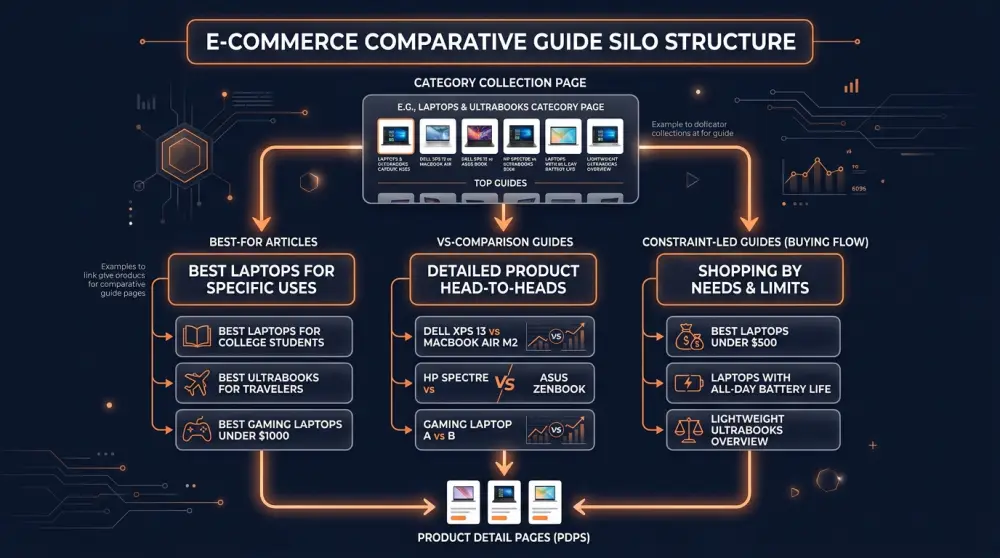
This is why our content strategy for e-commerce leads with guides and comparisons. We build the buying guides your category is missing, mapped to the exact use-case and gift-occasion queries shoppers run.
10. Why Choose Our E-Commerce GEO Service For Your Business
- Feed-Level Expertise: We get review counts, ratings, price and stock right inside your product feed, the data AI reads first.
- Catalog-Wide, Not Page-By-Page: We work across your whole catalog, fixing the product data that scales recommendations rather than optimizing a handful of hero products.
- Conflict-Free Product Data: We align your feed and live pages so prices and stock never clash, removing the data conflicts that quietly drop products from AI answers.
- Guides That Get Quoted: We write the buying guides and comparisons AI pulls from for "best product" queries, turning browsing shoppers into cited recommendations.
- Platform-Ready Delivery: We work cleanly with Shopify, WooCommerce, Magento and BigCommerce, so your structured data and feeds are built the way each platform needs.
11. How Our AI Shopping Optimization Process Works
- Audit your AI shopping visibility: You order a GEO Audit and we show you how AI engines present your products across "best," comparison and buying-guide queries.
- Fix data and authority, then content: We correct your product schema, feed and review signals, then build the buying guides and comparison content that win discovery.
- Win recommendations and compound: Early AI citations and shopping recommendations typically appear within weeks, with durable visibility building over the following months.
12. Get Your Products Into AI Shopping Answers
Your customers are already asking AI what to buy, and the answer names only a few products. Make sure yours are among them. Start with a GEO Audit to see how AI reads your store and which products and queries to win first. Fixed price from $99, no retainers, no calls.
13. Frequently Asked Questions (FAQs)

Written by: Muhammad Ehsan Khan
Engineer, SEO Consultant, and Semantic SEO Explorer. Specializing in advanced search strategies, LLM citation optimization, and entity-building architectures.